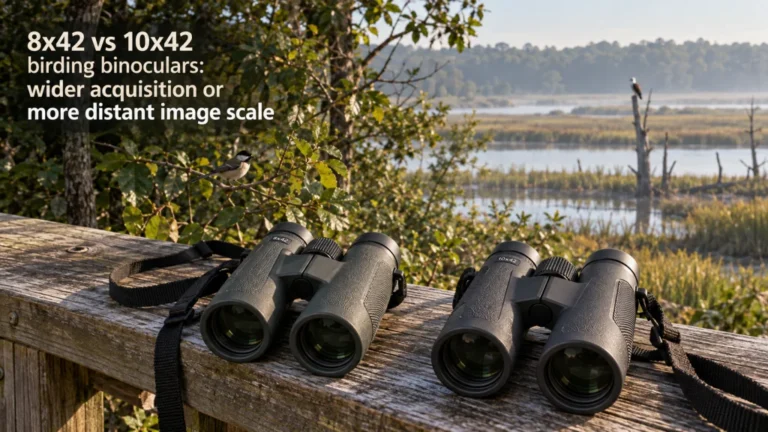
Binoculars for hawk watching should make it easier to find a moving raptor in a large sky before they help you study finer detail. That puts field of view, fast reacquisition, weight, eye relief, and weather protection ahead of a simple higher magnification equals better rule. An 8x or 10x configuration can both make sense, but the better choice depends on how far the birds usually are, how much of the sky you need to search, how long you hold the binoculars up, and whether you wear glasses. When the bird becomes a tiny, nearly stationary target at extreme distance, a spotting scope may solve the problem more effectively than forcing more magnification into a handheld binocular.

Find the raptor before trying to magnify it
A distant raptor can occupy only a tiny part of a broad, bright sky, which makes acquisition the first real test for hawk watching binoculars. If you raise the binoculars and spend several seconds searching for a bird that was easy to see with your unaided eyes, extra image scale is not helping yet. The useful configuration is the one that lets you transfer from naked eye to binocular view quickly, follow the bird through turns, and recover it after a brief loss. That is why field of view deserves attention before assuming that more magnification is automatically the better purchase.
This is a specialized branch of the broader binocular selection process for birding, but the open sky changes the priority order because there may be few visual landmarks around the target. If you are still comparing the major specifications across categories, the binocular buying framework for different viewing needs gives the wider decision context. For raptor watching, start by asking how often you lose moving birds, how distant they usually appear, and how long a typical scanning session lasts. Those answers tell you whether a wider field, greater image scale, lower weight, or a different support tool deserves priority.

The 8x42 configuration keeps magnification moderate for broad-sky scanning. Its 7-degree field of view gives more room to acquire and follow a moving raptor. Waterproof and fogproof construction with BaK-4 prisms makes it suitable for repeated outdoor observation.
Check on AmazonIf you click this link and buy, we earn a commission at no additional cost to you.
Hawk watching creates a wide-sky acquisition problem
HawkWatch International describes binoculars as essential equipment for migration crews, and its published migration material emphasizes the need to search large areas of sky. That context matters because the viewing task is not the same as studying a perched bird against a branch or feeder. A moving silhouette may cross a nearly featureless background, change direction, disappear in glare or cloud texture, and then reappear somewhere outside the center of your previous view. A binocular that feels wonderfully detailed on a stationary target can still be frustrating if its usable field makes repeated acquisition difficult.
The practical test is simple: think about what happens in the first few seconds after someone says there is a hawk moving left across the horizon. You need to point, acquire, track, and make small corrections without feeling as if you are looking through a narrow tunnel. A wider field does not identify the bird for you, but it gives you more visual room to keep a moving subject inside the image. That extra room becomes especially useful when several birds are in the same general part of the sky or when the target changes speed and direction.
- Prioritize fast acquisition if birds are frequently moving across a broad field.
- Compare exact field of view instead of assuming every 8x or every 10x model behaves alike.
- Reject a configuration that repeatedly makes you lose the target, even if its magnification looks attractive on paper.
- Consider how much time you spend scanning versus studying a bird you have already found.
That last distinction keeps the purchase grounded in your real use. If most of the session is spent scanning and reacquiring, field coverage carries more weight in the decision. If birds are routinely found first and the limiting problem is seeing enough detail at distance, magnification can move higher on the priority list. The point is not that one specification always wins, but that the first failure in your viewing sequence should guide the choice.

The Nature DX 8x42 uses phase-coated BaK-4 prisms and fully multi-coated optics for outdoor viewing. Its twist-up eyecups and generous eye relief support repeatable positioning during long scanning sessions. The 8x configuration fits a section where fast acquisition across a broad sky is the priority.
Check on AmazonIf you click this link and buy, we earn a commission at no additional cost to you.
8x can preserve more field in comparable designs
In many comparable binocular families, the 8x version offers a wider field than the 10x version, which can make it easier to place a moving raptor in the view and keep it there. Lower magnification can also make small hand movements less obvious, so the image may feel easier to manage during repeated handheld scanning. Those tendencies are useful for hawk watching, but they are not a license to shop from the magnification label alone. Two 8x binoculars can differ meaningfully in field of view, eye relief, weight, balance, and focus behavior, so the exact model specifications still control the final comparison.
An 8x configuration makes the strongest case when your main frustration is losing birds during acquisition or tracking rather than lacking detail after the bird is centered. It can also be a sensible choice when you scan for long periods and want a calmer handheld view without adding support equipment. The tradeoff is straightforward: the bird appears smaller than it would through a 10x binocular of otherwise similar quality. If you want a broader treatment of that configuration decision, the comparison of 8×42 and 10×42 binoculars for birding explains the wider use case without assuming hawk watching is the only activity.

The Diamondback HD 8x42 provides a 7.5-degree angular field of view and 393 feet at 1,000 yards. Its 17 mm eye relief adds a concrete fit specification to compare. The 8x configuration makes it a useful reference when field coverage and handheld control matter more than added image scale.
Check on AmazonIf you click this link and buy, we earn a commission at no additional cost to you.
The viewing constraints can reverse the configuration choice
It is easy to turn 8x versus 10x into a rule when it is really a routing decision. Start with the problem that happens repeatedly, not the specification you expect an experienced observer to choose. If you can find and follow birds comfortably but distant subjects remain too small to study, more image scale may help. If you constantly lose birds in the sky or dislike the steadiness and weight of your current setup, the same increase in magnification may make the experience worse.
Distance, movement, field of view, carry burden, eyeglasses, and weather can each change the answer, and several of them often matter at the same time. The best way to compare two candidates is to hold the use case steady, then verify the exact specifications that affect that use case. Do not assume the 8x member of one family will have the same field as another 8x, or that two 10x models will feel equally steady in your hands. Configuration labels narrow the search, but exact design details decide whether the binocular fits the job.
10x can add image scale when distance repeatedly limits the view
A 10x binocular can make a distant raptor appear larger, which may be valuable after acquisition is already under control. That benefit becomes more persuasive when birds are routinely far away and the missing information is image scale rather than field coverage. The cost is that higher magnification can make hand movement more visible and may come with a narrower field in a comparable design. Choose 10x because distance repeatedly creates a real limitation, not because the number looks more capable in isolation.
Exact field of view matters more than the magnification label alone
Field of view should be checked on the exact binocular you are considering because the magnification number does not determine it by itself. Mohonk Preserve highlights FOV as a central hawk watching consideration specifically because a wider view improves the chance of finding a bird after you raise the binoculars. Compare candidates using the same unit and the same stated distance so you are not mixing different presentation formats. If one model gives you meaningfully more sky without creating another fit problem, that difference can matter more than a small preference for one magnification label.
Weight matters during long stationary scanning sessions
Hawk watching can involve repeated cycles of raising, holding, lowering, and raising binoculars again while you remain in one location for a long session. A heavier binocular may feel acceptable during a short store comparison yet become less appealing after many repetitions. Mohonk Preserve specifically calls out weight because extended holding can increase the practical burden of the setup. Compare stated weight, then judge balance and grip in your own hands rather than assuming the lighter specification automatically feels better.
The Diamondback HD 10x42 provides 10x magnification with a 330-foot field of view at 1,000 yards. Vortex lists 15 mm of eye relief and a weight of 21.3 ounces. Those numbers make the tradeoff between added image scale, field width, fit, and carry burden explicit.
Check on AmazonIf you click this link and buy, we earn a commission at no additional cost to you.
Eye relief still controls usable field for glasses wearers
A wide field specification is less useful if your glasses keep you too far from the eyepieces to see the full image comfortably. Eye relief describes part of that fit, but the number alone does not guarantee that every glasses wearer will see the complete field. Eyecup shape, lens position, frame thickness, facial structure, and how the binocular rests against your glasses all affect the result. For hawk watching, losing the outer part of the view can undermine the very field advantage you were trying to buy.
When comparing models, verify the manufacturer’s stated eye relief and then treat actual fit as a separate check. Retract or fold the eyecups as designed for glasses, set the interpupillary distance again, and see whether the image remains full without pressing the eyepieces hard into the lenses. If the edges still appear clipped, do not assume a nominally wide field will solve the acquisition problem for you. The useful field is the field you can actually see while wearing your normal eyewear.

The TrailSeeker 8x42 lists 17 mm of eye relief, giving glasses wearers a concrete fit number to compare. Its metal multi-stop twist-up eyecups support repeatable eye positioning. A 426-foot field of view at 1,000 yards keeps the usable-view question tied to an exact model.
Check on AmazonIf you click this link and buy, we earn a commission at no additional cost to you.
Weather sealing matters at exposed overlooks
Raptor watching often places the observer on ridges, overlooks, coastlines, or other exposed positions where wind, damp air, light rain, dust, and temperature changes can be more relevant than they are during a short backyard session. Mohonk Preserve includes weather protection among its major selection factors for hawk watching, which is a sensible ownership concern for equipment that may spend hours outside. Weather sealing does not make a binocular indestructible, and marketing words should not be treated as proof of a specific protection level. Verify what the exact manufacturer states for the model you are considering.
Good ownership habits still matter even when a binocular is described as waterproof or fog resistant. Keep lens caps and the case available for transport, avoid leaving wet grit on focus or hinge areas, and follow the manufacturer’s cleaning instructions instead of improvising with household cleaners. If water gets inside the optical system or the image develops severe fogging that does not clear normally, owner-level cleaning is no longer the right response. The practical goal is to choose a model whose documented protection matches the conditions you expect, then care for it within those limits.

The Engage EDX 8x42 is rated IPX7 waterproof and uses argon purging for fog resistance. Bushnell applies EXO Barrier to the exterior lens surfaces and lists a 426-foot field of view at 1,000 yards. Those documented protections fit exposed overlooks where weather is part of the buying decision.
Check on AmazonIf you click this link and buy, we earn a commission at no additional cost to you.
Know when the job has become spotting scope observation
There is a point where asking a handheld binocular for more reach starts to work against the reasons you chose binoculars in the first place. HawkWatch International distinguishes the roles clearly: binoculars are easy to transport and central to migration work, while spotting scopes provide more magnification for subjects that are farther away. That does not mean a scope replaces binoculars for open sky searching. It means the workflow can change after a distant target is found and remains stable enough to study with a narrower, supported view.
A spotting scope becomes more compelling when the subject is extremely distant, relatively stationary in your viewing frame, and detail rather than acquisition has become the main limitation. The scope also asks more of the setup because it usually needs a stable support and is slower to redirect across a large area of sky. If you are chasing moving targets across a broad horizon, binoculars remain the faster tool for finding and following them. If you repeatedly wish your handheld binocular had much more power after the bird is already located, that is a sign to consider a two-tool workflow instead of pushing binocular magnification higher and higher.

The Ultima 80 uses an 80 mm objective and a 20-60x zoom eyepiece for supported long-distance viewing. Its 45-degree angled body is tripod adaptable and waterproof. The higher magnification range fits the point where the bird is already located and detail becomes more important than fast sky acquisition.
Check on AmazonIf you click this link and buy, we earn a commission at no additional cost to you.
Build a hawk watching shortlist from the problem you need to solve
A useful shortlist does not begin with brand prestige or a claim that one configuration is the universal hawk watching choice. It begins by writing down the failure you want to fix, then matching that failure to a specification or fit variable you can verify. If birds disappear during tracking, compare field of view and usable eye position. If birds are easy to follow but remain too small, compare 10x candidates without forgetting steadiness, field, and weight.
The table below is a decision filter, not a set of product recommendations. Use it to remove candidates that do not match your repeated viewing constraint before spending time on secondary features. After you narrow the list, check the manufacturer’s current specifications for the exact model and configuration rather than relying on a family name or retailer summary. A binocular that clears these practical checks is a stronger candidate than one that simply has the most impressive feature list.
| Repeated problem | What to compare first | What can make you reject a candidate |
|---|---|---|
| You lose moving raptors after raising the binoculars | Exact field of view and how quickly you acquire the target | A narrow usable view or difficult eye placement |
| Birds stay too small after you find them | 8x versus 10x image scale, then exact FOV and steadiness | More shake or a field penalty that outweighs the extra scale |
| Your arms tire during long scanning sessions | Weight, balance, grip, and how often you hold the binoculars up | A body that feels burdensome even if the optics look appealing |
| You wear prescription glasses | Eye relief, eyecup geometry, and full field fit with your glasses on | Clipped edges or pressure against your lenses |
| Your overlook is exposed to changing weather | Documented weather protection and owner care requirements | Protection claims that do not match your expected conditions |
| The bird is found but remains extremely distant | Whether a supported spotting scope is the better next tool | Trying to solve a scope problem by forcing more handheld power |
Once the shortlist is small, compare candidates in the order the problem occurs during use. Acquisition comes before detail, usable eye position comes before a paper field specification, and carry burden matters before a feature you may rarely notice. That sequence keeps you from paying for a specification that solves the wrong problem. It also gives you a clear reason to skip a model even when it is otherwise impressive.

The H2O Xtreme 10x42 gives the shortlist a second 10x configuration to compare against 8x options. It uses fully multi-coated optics with BaK-4 prisms and IPX7 waterproof, fogproof construction. That combination keeps the comparison grounded in image scale, weather protection, and real model specifications rather than magnification alone.
Check on AmazonIf you click this link and buy, we earn a commission at no additional cost to you.
Final Thoughts: choose for the sky you actually scan
The strongest hawk watching choice is the binocular that helps you find, follow, and study the birds you actually encounter, not the one with the highest number on the box. Start with acquisition, verify exact field of view, then decide whether 8x or 10x better solves your recurring distance and tracking problem. Check weight and eye relief against your own hands and glasses, and verify weather protection on the exact model before buying. When the target is already found but remains too distant for comfortable handheld study, let a spotting scope take over instead of asking one binocular to do every job.
Before buying, reduce the decision to the two or three constraints that appear most often during your own viewing. Check those constraints against the exact model specification, then confirm physical fit whenever you can handle the binocular in person. Skip features that do not solve a repeated problem, even if they sound impressive in a product description. A clear reason to reject a candidate is just as useful as a clear reason to keep it on the shortlist.

The GlassPak carries full-size binoculars in a protective chest harness with adjustable straps. It includes two bino tether straps, two mesh side pockets, and a zippered rear pocket. At 8 ounces, it addresses the carry and access side of long observation sessions without changing the binocular itself.
Check on AmazonIf you click this link and buy, we earn a commission at no additional cost to you.
FAQs
🦅 Is 8x or 10x better for hawk watching?
Neither is automatically better. Favor 8x when field coverage and easy tracking are the recurring problem, and consider 10x when distance repeatedly limits detail after you can already acquire birds reliably.
🔭 Why does field of view matter so much for raptors?
A wider usable field gives you more sky in the image, which can make a moving bird easier to acquire and keep in view. Compare the exact model specification because two binoculars with the same magnification can have different fields.
👓 What should glasses wearers check before buying?
Check the manufacturer’s eye relief specification, then confirm that you can see the full field with your normal glasses and the eyecups set correctly. If the edges are clipped, the published field may not be fully usable for you.
🎒 How important is binocular weight at a hawk watch?
Weight matters more when you repeatedly raise and hold the binoculars during long scanning sessions. Compare stated weight, but also judge balance and grip because equal weights can feel different in the hands.
🌦️ Do hawk watching binoculars need weather protection?
Weather protection is useful when you observe from exposed overlooks or spend long periods outside. Verify the exact manufacturer’s claim and still follow its cleaning, drying, and storage instructions.
🗻 When should I use a spotting scope instead?
Consider a scope when a bird is already located, remains very distant, and more detail has become the main need. Binoculars are usually the faster tool for broad sky acquisition and tracking, while a supported scope is better suited to sustained high magnification.
References and Sources
- HawkWatch International optics overview: Supports the role of binoculars in migration work and the handoff to spotting scopes for more distant observation.
- Mohonk Preserve binoculars for hawk watching: Supports the importance of field of view, weight, weather protection, and magnification tradeoffs in hawk watching selection.