Your first binoculars should solve a viewing job before they solve a shopping list. Start with where you will use them, how much you will carry them, whether glasses or hand fit change the setup, and how much magnification you can use comfortably. A conventional compact or full-size binocular often makes a better first decision than a feature-heavy option whose extra capability does not match the job. Once those requirements are clear, you can route the remaining question to budget, beginner choices, common buying mistakes, or a fit test before you keep the purchase.

Solve the viewing job before you compare the shortlist
Choosing your first binoculars gets harder when you try to solve use, magnification, size, price, optical quality, and special features at the same time. Picture a buyer choosing among a pocket compact, an 8×42, and a high-power model loaded with features. All three can look plausible on a product page, yet they are built around different compromises in carry size, steadiness, field of view, brightness, and handling. The useful first move is not to rank them, but to decide which compromise best fits the viewing you are actually likely to do.
That is also why a general binocular buying guide is most useful after you have compressed the problem into a few real constraints. A person who mostly scans moving wildlife on walks is solving a different problem from someone who watches distant stationary subjects from one location. A traveler who resents carrying bulk may accept a smaller objective lens, while another buyer may gladly carry more for easier handling and a larger exit pupil. The first purchase becomes manageable when you stop treating every specification as equally important.
Start with the most likely viewing job
Write down the use you expect most often, not every use the binocular could theoretically handle. Moving birds in trees, wildlife across open ground, sports from fixed seats, travel scenery, and occasional night-sky viewing each reward a different balance of field of view, reach, size, and light gathering. If one activity clearly dominates, let that activity set the first requirements and treat the rest as secondary use. A first pair that works well for the common job is usually more valuable than one that is merely possible to use for ten different jobs.
Choose a conventional format before adding specialized technology
A conventional fixed-magnification binocular is the cleanest baseline when you do not yet know which features matter to you. Extra electronics, unusually high magnification, zoom mechanisms, or specialized stabilization can be useful, but they also add cost, bulk, setup, or another decision that may not solve your actual problem. REI’s buying guidance makes the same basic point about magnification: more power is not automatically better because greater magnification also makes hand movement more visible and commonly narrows the field of view. Start simple unless a specific viewing condition gives you a clear reason not to.
Decide whether carry size or handling is the bigger constraint
A compact binocular earns its place when portability determines whether you bring it at all. A larger body can be easier to grip, can provide a larger objective lens, and may feel more forgiving during longer viewing, but only if you are willing to carry it. The useful comparison is therefore not compact equals beginner and full-size equals serious. It is whether smaller carry size or more substantial handling removes the bigger friction in your routine.
Treat magnification as a tradeoff, not a ranking
For many general-purpose choices, 8x and 10x deserve attention because they change the viewing experience in ways a beginner can notice immediately. An 8x configuration commonly gives a wider field of view and tends to be easier to hold steady, while 10x gives a closer view but also magnifies your hand movement more. That does not make 8x universally correct or 10x a bad beginner choice. It means the decision should follow target distance, movement, field of view, and your tolerance for shake rather than the idea that a larger number must be an upgrade.
Use field of view, eye relief, IPD, and controls as fit gates
Specifications matter most when they decide whether you can use the binocular comfortably and see the full image. Field of view affects how easily you can find and follow subjects, eye relief becomes especially important when glasses keep your eyes farther from the eyepieces, and interpupillary distance must adjust far enough to match your eyes. Celestron’s IPD guidance explains that a mismatch can leave you seeing only part of the scene, while Nikon’s setup guidance tells glasses wearers to lower the eyecups so the eyes can reach the intended viewing position. Treat those items as pass or fail fit checks, not decorative numbers on a comparison chart.
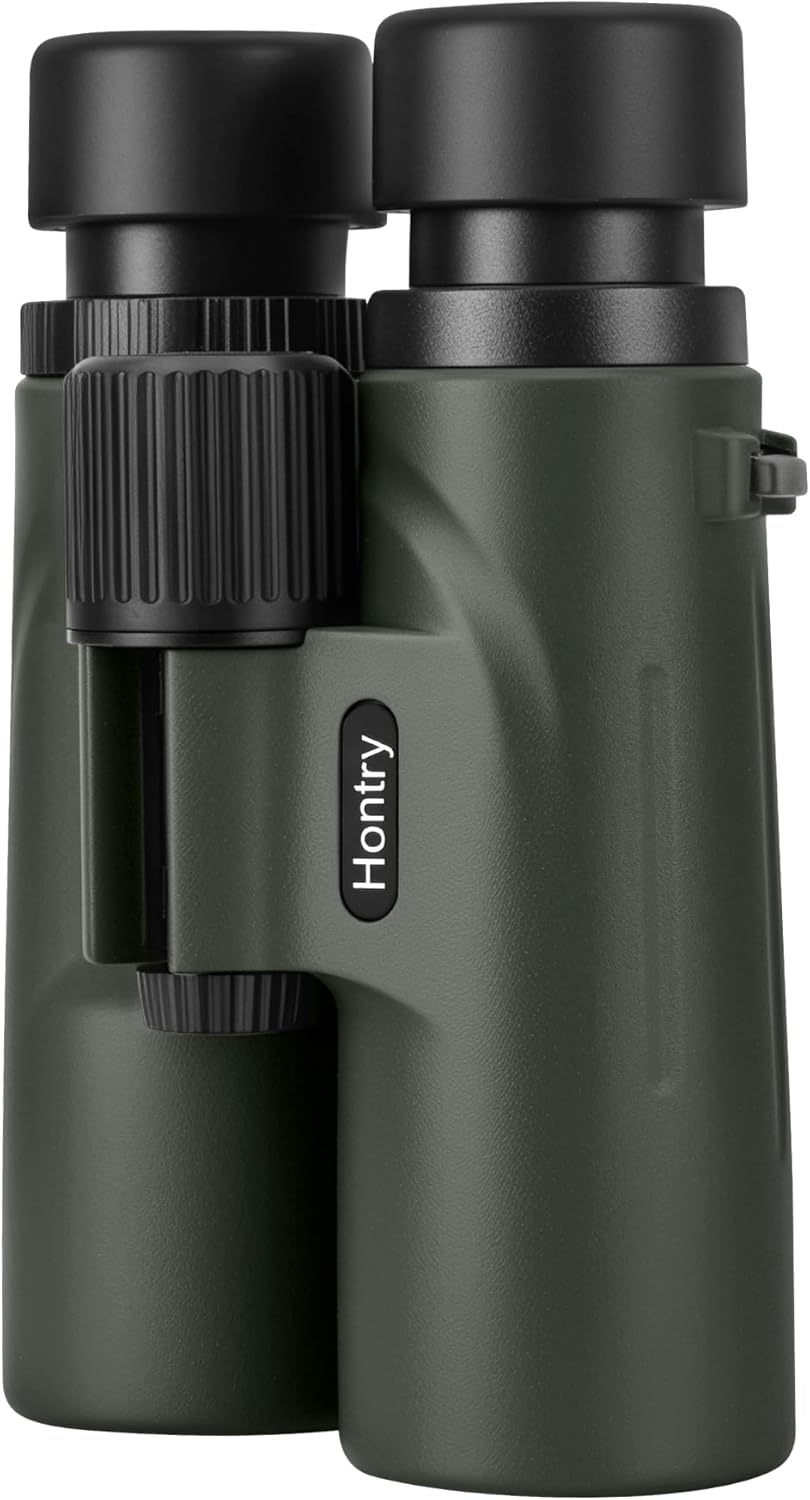
An 8x42 roof-prism format gives this model a conventional starting point for general viewing. Its IPX6 waterproof construction and nitrogen-filled body suit outdoor use, while the 42mm objectives keep the format full-size rather than pocket compact. Use it as a concrete baseline when deciding whether easier carry, more magnification, or a different fit matters more.
Check on AmazonIf you click this link and buy, we earn a commission at no additional cost to you.
Route the unresolved decision instead of reopening every specification
Once the likely job, carry format, and basic fit are clear, most first-purchase uncertainty falls into one of four narrower questions. You may still be unsure how much money to commit, which current beginner options deserve attention, which shortcuts tend to create regret, or whether the binocular in front of you actually fits. Solving only the remaining uncertainty keeps the shopping process from expanding again into dozens of loosely related specifications. It also makes it easier to reject a purchase for a concrete reason instead of feeling that another model must always be better.
This routing matters because price, shortlist quality, buying mistakes, and physical fit are different problems. A better budget does not fix an IPD range that does not fit you, and a strong optical reputation does not make a binocular convenient enough to carry. Likewise, a low price is not automatically a bargain if you cannot test the controls or return a poor-fitting sample. Use the next question as a handoff, then come back to the same core requirements instead of starting over.
Decide the commitment before setting the spend
Set spending by how often the binocular is likely to be used and how costly a bad fit would be, not by the prestige of the price tier. Someone testing a new hobby has a different risk tolerance from someone who already knows the binocular will be carried every week. If budget is still the dominant uncertainty, use the first binocular spending guide to decide the commitment level before looking at specific products. If the budget itself is the main constraint across several choices, the broader budget binocular guide can help frame what tradeoffs are reasonable.
Move to a current starter shortlist only after the requirements are known
A beginner shortlist is useful when it filters current options through requirements you have already defined. It is much less useful when the list itself has to decide whether you need compact carry, a wider field, longer eye relief, or more reach. After those gates are known, the beginner binocular shortlist can be read as a matching exercise rather than a ranking contest. That keeps a well-marketed model from winning simply because it appears near the top of a list.
Run a pre-mortem for predictable first-buy shortcuts
Before ordering, ask what would make you regret the choice after the first few outings. Common failure paths include buying more magnification because it sounds more capable, choosing a body too large to carry routinely, assuming listed eye relief guarantees glasses fit, or treating a low price as proof that return friction does not matter. The first binocular buying mistakes guide is the right place to challenge those shortcuts before money changes hands. A useful pre-mortem turns vague doubt into a short list of risks you can actually check.
Test the binocular or preserve a usable return path when fit is uncertain
Physical fit is difficult to settle from specifications alone because face shape, glasses, IPD, grip, focus-wheel reach, and eyecup geometry interact. If you can try the binocular before buying, check whether you can merge the image cleanly, reach the controls without shifting your grip, and see the full field with your normal eyewear. If you cannot test it first, preserve a return path that gives you enough time to perform the same checks at home. The binocular acceptance test lays out what to verify before you decide the sample is a keeper.

This 10x25 Outland X is a compact alternative for readers who have already decided portability matters. It uses BaK-4 prisms, multi-coated optics, twist-up eyecups, and a waterproof, nitrogen-purged body. The 10x magnification and 25mm objectives make it a useful real product for checking whether extra reach is worth the smaller compact format.
Check on AmazonIf you click this link and buy, we earn a commission at no additional cost to you.
Send specialist constraints to the guide that actually owns them
A first-purchase framework should simplify the choice, not swallow every binocular topic on the site. If one activity dominates, let the activity-specific requirements decide the next step rather than stretching a generic beginner answer until it becomes vague. Likewise, glasses fit and IPD are interface problems that deserve their own evidence because a nominal specification does not guarantee that a particular face and eyecup geometry will work together. Keeping those boundaries clear prevents a first-pair article from pretending that one configuration can fit every person and every use.
The same boundary applies after the purchase. Setup, focusing technique, cleaning, storage, and troubleshooting are ownership questions, not reasons to overload the buying decision before you know whether the binocular fits. If a question changes the required configuration, solve it before buying; if it only changes how you use or maintain the binocular, handle it after the core choice is settled. That separation keeps the first purchase focused on choosing something usable, not mastering the entire subject in one sitting.
When one activity dominates, let that viewing job control the next decision
A buyer who spends most outings tracking moving subjects should weigh field of view and steadiness differently from someone observing distant stationary targets. A traveler may accept a smaller objective diameter to reduce carry burden, while a buyer who stays near a vehicle or observation point may tolerate more size. The first pair does not need to be average at everything if the real use is not average. Let the dominant activity decide which tradeoffs deserve priority, then reject features that do not improve that activity enough to justify their cost or bulk.
Glasses fit and IPD need their own evidence
Eyeglass wearers should treat published eye relief as a screening number, not a promise of full-field comfort. Frame thickness, how close the glasses sit, eyecup shape, and the usable rather than nominal eye relief can all change the result. For a deeper fit discussion, use the eye relief guide and then verify the exact binocular with your normal glasses if possible. IPD deserves the same discipline because a binocular that cannot narrow or widen enough for your eyes is a poor fit regardless of optical reputation.

The H2O Xtreme pairs 10x magnification with 42mm objectives in a waterproof, fog-resistant design intended for outdoor use. Fully multi-coated optics and 17mm eye relief are relevant when weather resistance and viewing fit become activity-specific constraints. It is a stronger match here than a generic compact because this section asks readers to let the dominant use determine the configuration.
Check on AmazonIf you click this link and buy, we earn a commission at no additional cost to you.
Use a first-pair worksheet before you open another shopping tab
A short worksheet is more useful than another hour of browsing when your requirements are still mixed together. Fill it out before comparing models, and write an actual preference in each row rather than words such as good, better, or premium. The goal is to expose conflicts, such as wanting maximum portability while also insisting on a large objective, or wanting more reach while disliking visible hand shake. Those conflicts are not mistakes; they are the tradeoffs the final choice has to resolve.
Keep the worksheet simple enough that it can reject a candidate quickly. If a binocular misses a nonnegotiable fit gate, do not let an attractive price or feature list talk you back into it. If two candidates both pass, the softer preferences such as weight, price, close focus, accessories, and finish can break the tie. A first purchase is easier when the acceptance criteria exist before the product page starts making its case.
| Decision | Write down before comparing | Reject when |
|---|---|---|
| Likely use | Your most common target, distance, movement, and light | The configuration solves a rare use better than the common one |
| Carry format | Compact carry, mid-size compromise, or fuller handling | You already know the size will stay at home |
| Magnification | Whether wider view and steadiness or extra reach matters more | You are choosing the larger number without a viewing reason |
| Field of view and fit | FOV, eye relief, IPD range, eyecup position, and control reach | You cannot see the full field or use the controls comfortably |
| Weight and spend | Your carry tolerance and commitment level | The purchase creates more burden than the use justifies |
| Test and return status | Where you can test, what you will inspect, and the return path | You cannot reasonably verify fit or reject a poor sample |
Run the worksheet in order because the early rows control the later ones. A lower-cost binocular that passes the real fit gates can be a better first purchase than a more expensive model that solves the wrong job. If the result still feels ambiguous, use this decision sequence rather than reopening every category at once.
- Choose the dominant viewing job.
- Choose the carry format you will actually bring.
- Choose magnification by reach, field of view, and steadiness.
- Verify eye relief, IPD, grip, eyecups, and control access.
- Set spending by commitment, then preserve a practical test or return path.
That sequence is deliberately plain because a first-pair decision should be easy to explain to yourself. If you cannot say why a feature survives each step, it probably should not be driving the purchase. If you can explain the choice in terms of the viewing job, carry burden, fit, and commitment, you are ready to compare actual options. The product search should be the last stage, not the first.

Outland X 8x25 gives the worksheet a concrete compact format to test against carry, magnification, and fit requirements. It combines 8x magnification and 25mm objectives with BaK-4 prisms, multi-coated optics, twist-up eyecups, and waterproof, fogproof construction. Those traits make it easy to compare a portable 8x option against the reader's nonnegotiable gates before keeping it on a shortlist.
Check on AmazonIf you click this link and buy, we earn a commission at no additional cost to you.
Final Thoughts: Make the first pair easy to use and easy to reject if it does not fit
The best first-pair process is not the one that produces the longest shortlist. It is the one that gives you clear reasons to keep or reject a configuration before brand reputation and feature count take over. Start with the viewing job, carry format, magnification tradeoff, and fit gates, then decide how much commitment the purchase deserves. If the binocular cannot pass those checks, move on without trying to rescue it with a better specification somewhere else.
Once the requirements are stable, the remaining question should be narrow enough to route to one focused guide. That may be current beginner choices, spending, predictable buying mistakes, or an acceptance test before you keep the binocular. A first purchase does not need to solve every future use. It needs to be something you can carry, fit, use, and reject confidently if the real-world fit is wrong.

Hontry's 10x25 is a palm-size compact option with 10x magnification, BaK-4 prisms, and an adjustable 60mm to 75mm IPD range. Its small format makes carry convenience easy to evaluate, while the published IPD range gives the reader a specific fit gate to check. That matches the section's keep-or-reject approach instead of treating a feature list as sufficient.
Check on AmazonIf you click this link and buy, we earn a commission at no additional cost to you.
Continue the first purchase decision
Use the next guide that matches the uncertainty you still have after completing the worksheet. If your requirements are already clear, there is no value in reopening every beginner question at once. A buyer who has settled the likely viewing job and physical format may only need help with spending, while someone who already knows the budget may be ready for a current shortlist. Treat this section as a routing step that keeps the remaining decision focused on the one issue that can still change what you buy.
| Next question | What you’ll find |
|---|---|
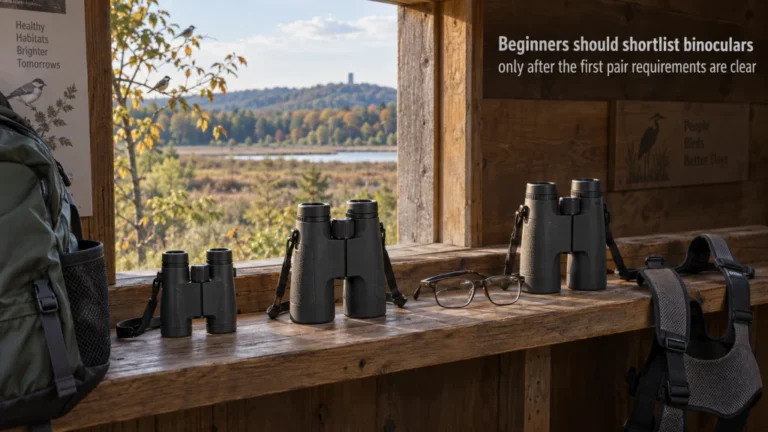
| Best binoculars for beginners | A current shortlist to use after you know your likely job, carry format, and fit requirements. |
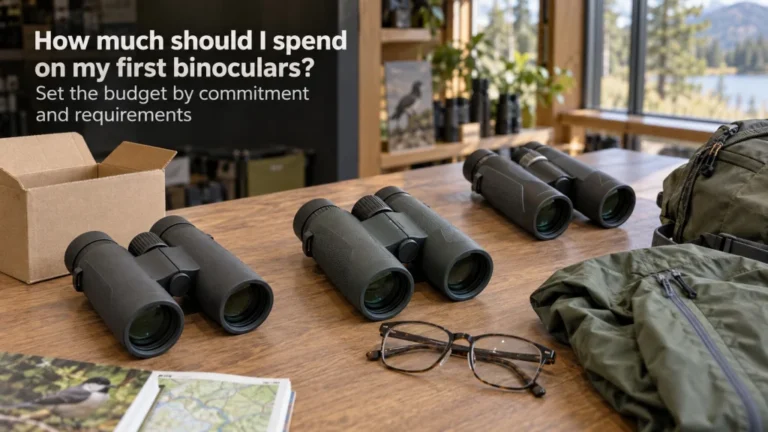
| How much should I spend on my first binoculars? | A way to set spending by commitment and role instead of treating price as a quality ranking. |
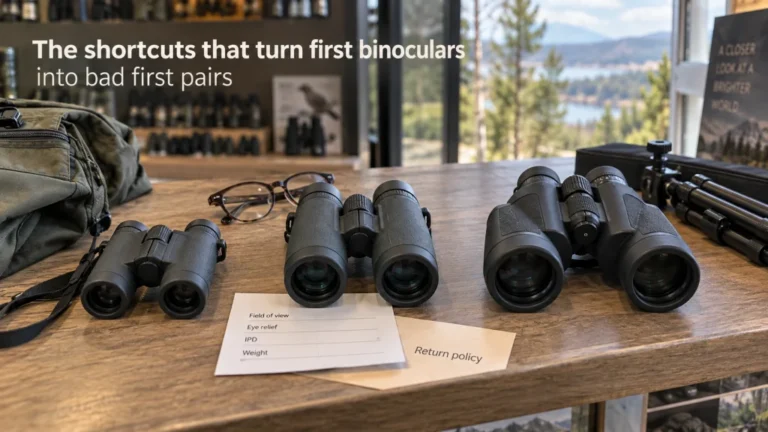
| First binocular buying mistakes | A pre-purchase check for shortcuts that can create avoidable regret. |
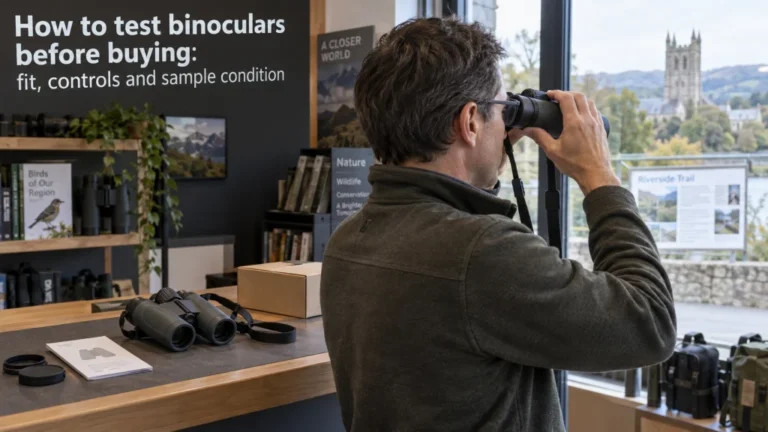
| How to test binoculars before buying | A practical acceptance check for fit, controls, image merging, and sample quality. |
Do not reopen all four paths unless your requirements genuinely change. If one guide resolves the remaining uncertainty, return to your worksheet and use those criteria to judge the actual binocular rather than starting the entire search again. That keeps a first purchase from expanding back into a giant comparison exercise every time you encounter another model or feature. The point of routing is to keep the next decision smaller than the one you just solved, with a clear reason for moving forward or rejecting the purchase.

The Triumph HD 10x42 is a full-size roof-prism option with fully multi-coated lenses, adjustable eyecups, and a 17mm eye-relief specification. It is waterproof, fogproof, and tripod adaptable, and it includes Vortex's GlassPak harness for field carry. It fits this routing section as a concrete 10x42 option to compare only after the reader has settled the job, format, and fit requirements.
Check on AmazonIf you click this link and buy, we earn a commission at no additional cost to you.
FAQs
🔭 Are 8×42 binoculars always the best first pair?
No. An 8×42 is a common general-purpose format, but a compact option may make more sense when carry size dominates, while 10x can make sense when extra reach matters and you can hold it steadily enough. Choose by use, field of view, fit, weight, and carry tolerance rather than by a universal beginner rule.
🎒 Should my first binoculars be compact or full-size?
Choose compact when smaller size materially increases the chance that you will carry the binocular. Choose a larger format when you value fuller handling, a larger objective, or a more forgiving grip enough to accept the extra bulk. The better first pair is the one that fits your routine, not the one that looks more serious.
👓 What should I check if I wear glasses?
Check eye relief, eyecup travel, and whether you can see the full field with your normal glasses in place. Published eye relief is a screening number, because frame position and eyecup geometry can change usable fit. If possible, test the exact binocular with the glasses you normally wear.
📏 Why does IPD matter for a first purchase?
The binocular must adjust so its eyepieces line up with your eyes. If the interpupillary distance range does not fit you, the two views may not merge cleanly or you may lose part of the field. Treat IPD as a fit gate before price or extra features.
🔎 Is 10x too difficult for a beginner?
Not automatically. Ten-power binoculars give more image scale, but they also make hand movement more visible and often reduce field of view compared with a similar 8x design. If the extra reach solves a real viewing need and you can hold the image steadily enough, 10x can still be a reasonable first choice.
💵 How much should I spend on a first pair?
Set the budget by how certain you are about the use and how often you expect to carry the binocular. A higher price does not remove fit risk, and a lower price does not excuse poor usability. Decide the commitment first, then compare products that pass your nonnegotiable fit and use requirements.
References and Sources
- REI binocular buying guidance: Supports the practical tradeoffs among magnification, field of view, objective size, eye relief, focusing, and in-store testing.
- Nikon binocular setup guidance: Supports the eyecup and eye-relief setup used when explaining glasses fit.
- Celestron IPD guidance: Supports the explanation of interpupillary distance and why incorrect adjustment can reduce the usable field.
- r/Binoculars first-purchase discussion: Used to frame recurring beginner uncertainty around mixed use, glasses, portability, and 8x versus 10x, not as technical proof.