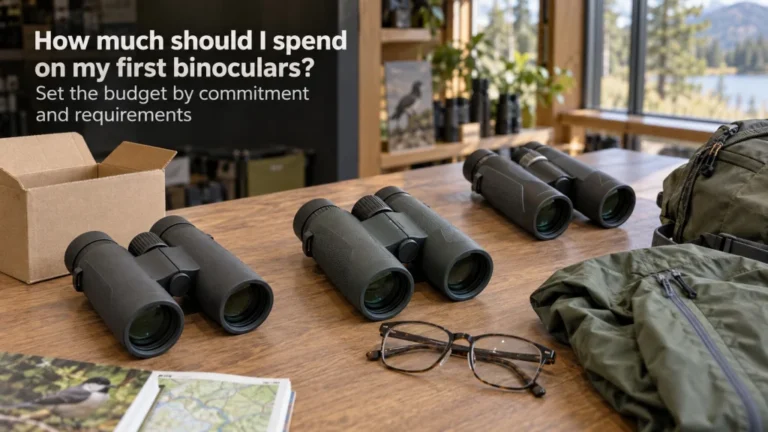
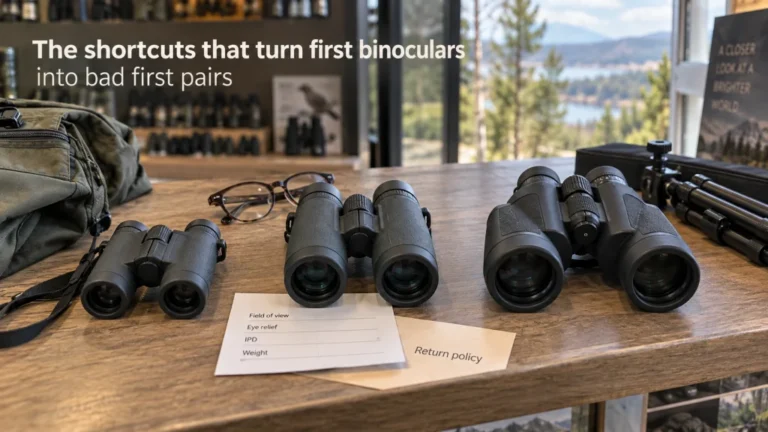
Beginner-friendly binoculars should be shortlisted only after the first viewing job, carrying burden, and fit requirements are clear. A compact 8×25, a conventional 8×42, and a 10×42 can all survive the first screen for different reasons, but none is automatically the right starter format. Field of view, eye relief, interpupillary distance, weight, control access, waterproofing, and support terms should be checked on the exact binocular being considered. The goal is not to find the most impressive specification sheet, but the simplest credible first pair that fits how it will actually be used.
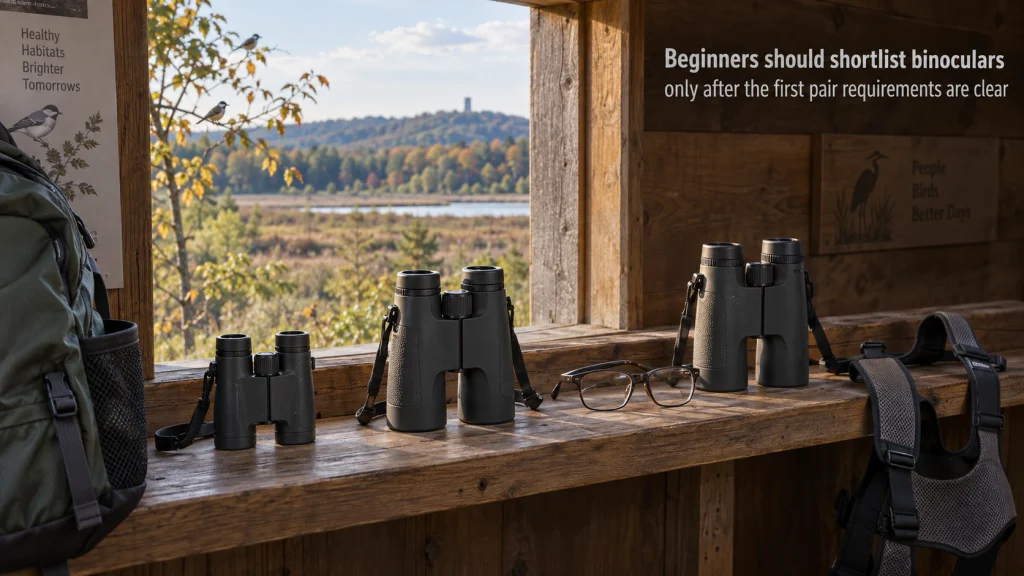
Beginner-friendly means a simple binocular matched to a defined first job
The best binoculars for beginners are not a single model or even a single size. A beginner-friendly first pair is the simplest binocular that matches a defined viewing job, carrying tolerance, and physical fit. Before making a shortlist, use the first binocular framework to define what you expect to watch, then use the binocular buying guide to understand the specifications you will be comparing. That sequence keeps the shortlist from collapsing into whatever 8×42 happens to be popular.
Three formats make a useful first screen for a general adult buyer: compact 8×25, conventional 8×42, and 10×42. The compact option earns its place through low carry burden, the 8×42 through a broadly forgiving balance of field and objective size, and the 10×42 through extra image scale when distance matters more. Those are starting hypotheses, not verdicts, because the exact field of view, eye relief, IPD range, weight, and controls can change the ownership experience substantially. A format survives only when its advantages solve the buyer’s real constraint without creating a larger problem somewhere else.
Apply the first-pair requirements before naming candidates
Start with what will be viewed, how far away it usually is, whether it moves, what the light is like, and how long the binoculars will be carried. Then add the physical constraints that can reject an otherwise reasonable choice, especially eyeglasses, hand size, IPD, preferred grip, and tolerance for weight around the neck or in a bag. A first pair for backyard wildlife and casual travel may need a very different carry profile from one used mainly for distant stationary subjects. If those requirements are still vague, adding more candidates usually creates noise rather than a better decision.
Keep conventional fixed magnification unless added complexity solves a real need
For a general first pair, fixed magnification in the common 7x to 10x range keeps the operating task simple: raise the binoculars, acquire the subject, focus, and observe. Zoom mechanisms and very high magnification add another variable before the buyer has learned which limitation actually matters. That extra complexity is justified only when a specific viewing job demands it and the buyer accepts the corresponding trade-offs in field, stability, bulk, or support needs. A beginner does not need fewer choices because beginners are incapable of using equipment, but because unnecessary controls make it harder to identify what is actually working or failing.
Compare compact and full-size formats on actual carry burden
Compact and full-size should be treated as ownership choices, not quality labels. One current manufacturer listing for an 8×25 gives a weight of 10.9 ounces, while representative current 8×42 listings reviewed for this article are around the low to mid 20-ounce range, which is enough of a difference to matter on walks, travel days, and small bags. The compact format can therefore win simply because it is present when the larger pair would have been left at home, but a smaller body can also bring shorter eye relief or tighter controls. The useful question is not whether compact binoculars are good or bad, but whether the exact compact’s fit and viewing limitations are acceptable for the job that makes portability valuable.
| Starter format | Why it can survive the first screen | What can eliminate it |
|---|---|---|
| 8×25 compact | Low carry burden, small storage footprint, easy to keep available for travel and casual observation | Short eye relief, small controls, lower low-light tolerance, or poor fit for the user’s hands and face |
| 8×42 | Generally forgiving magnification, useful field options, and a full-size body that can be easier to grip and adjust | Too much bulk or weight for the way it will actually be carried |
| 10×42 | More image scale for distant subjects without moving to an unusually large objective | Narrower field, less forgiving steadiness, shorter eye relief on some designs, or no real need for the extra reach |
The table is a routing tool, not a ranking. If portability is the constraint that decides whether the binoculars come along at all, the compact deserves serious consideration. If easy acquisition and general handling matter more, an 8×42 may remain the cleaner baseline. If the buyer already knows that distant detail dominates, a well-fitted 10×42 can stay on the list rather than being rejected merely because it is not the conventional first recommendation.
Use a small current candidate set to finish the shortlist
Once the format decision is clear, the shortlist should move from generic size classes to a few exact binoculars whose specifications can be checked. The purpose is not to declare a universal winner, but to give each surviving format a concrete candidate that can pass or fail the same fit gates. Current manufacturer specifications provide enough detail to compare field of view, eye relief, IPD, weight, close focus, and weather protection without pretending those numbers prove comfort for every user. A candidate stays only if its exact specifications match the job that allowed its format to survive.
That makes the shortlist commercial without turning it into a catalog. A compact candidate should earn its place through portability, an 8×42 through a balanced fit for general viewing, and a 10×42 through a genuine need for more image scale. Two 8×42 candidates can also remain together when they solve different fit problems, because the shared configuration does not make them interchangeable. Price can then be checked against the candidate that already fits rather than used to rescue one that failed the physical or viewing requirements.
| Current candidate | Why it survives | What to verify before buying |
|---|---|---|
| Nikon Trailblazer II 8×25 | At 10.9 oz with an 8.3-degree field and a 56 to 72 mm IPD range, it gives the compact route a genuinely low carry burden without forcing very high magnification. | Its listed eye relief is 10 mm, so eyeglass users and anyone sensitive to eye placement should treat fit as the first gate rather than assuming portability settles the decision. |
| Nikon PROSTAFF P3 8×42 | A 377-foot field at 1,000 yards, 20.2 mm eye relief, and a listed weight of 20.3 oz make it a useful full-size reference when longer eye relief and moderate weight matter. | Confirm that the 9.8-foot close focus and full-size body suit the intended subjects and carrying pattern rather than choosing it only because the eye-relief figure looks generous. |
| Celestron Nature DX 8×42 | A 388-foot field at 1,000 yards, 17.5 mm eye relief, 56 to 74 mm IPD range, and 6.5-foot close focus create a different 8×42 fit profile from the Nikon candidate. | Its listed weight is higher than the Nikon 8×42 example, so compare carry burden and grip directly if both otherwise pass the viewing requirements. |
| Nikon PROSTAFF P3 10×42 | A 367-foot field at 1,000 yards keeps the 10x route relatively broad while providing the larger image scale that can matter for distant subjects. | Its listed eye relief is 15.7 mm and its 10x view still demands more steadiness than 8x, so distance must matter enough to justify those trade-offs. |
These candidates are useful because they expose different failure points rather than because one is universally superior. The compact can fail on eye relief, one 8×42 can fail on close-focus needs, another can fail on carry burden, and the 10×42 can fail when steadiness or eye relief matters more than distant image scale. That is the candidate-level decision the format screen was preparing for. If none passes cleanly, keep the requirements and replace the candidate rather than weakening the requirements to preserve a favored model.
Key point: There is no universal starter format or universal starter model. The useful first choice is the exact binocular that passes the buyer’s viewing, carry, and fit requirements with the fewest unnecessary complications.

This compact 8x25 weighs 11.85 ounces and is rated IPX7 waterproof. It uses fully multi-coated lenses and BaK4 roof prisms in the 8x25 format. Its low carry burden makes it relevant when portability decides whether a first binocular will actually be brought along.
Check on AmazonIf you click this link and buy, we earn a commission at no additional cost to you.
Screen the shortlist for fit, simplicity, and usable optics
Once the three broad formats are visible, the next step is to stop comparing labels and start comparing the exact numbers that affect use. Two binoculars marked 8×42 can differ in field of view, eye relief, IPD range, weight, close focus, and control design, so the shared configuration does not guarantee the same beginner experience. Representative current manufacturer listings make that clear: one 8×42 lists a 377-foot field at 1,000 yards and 20.2 mm of eye relief, while another lists a 393-foot field and 17.0 mm of eye relief. Neither set of numbers is automatically better, because the useful choice depends on target motion, eyeglasses, face geometry, grip, and carry burden.
This is also where feature badges should move down the priority list. Coatings, glass labels, and premium-sounding optical language can matter, but they do not rescue a binocular that does not fit the user’s eyes, cannot be held comfortably, or is annoying to carry. A beginner-friendly shortlist should therefore pass fit and handling gates before optical marketing becomes a tiebreaker. The simplest credible option is the one that makes acquiring, focusing, and carrying straightforward without asking the user to tolerate a mismatch just to gain a specification that may not matter in the intended viewing conditions.
Use exact field of view instead of assuming every 8x is equally easy to acquire with
Magnification alone does not tell you how much scene is visible. The exact linear or angular field of view on the manufacturer’s specification page is the number to compare when moving subjects, wooded scenes, or quick target acquisition matter. Wider field can make initial acquisition and tracking easier, but it should still be considered alongside edge quality, eye placement, and the way the binocular fits the user. Treat “8x” as one input, not as proof that two options will frame the same amount of the scene.
Check eye relief, IPD, and control access before optical feature badges
Eye relief and IPD can eliminate a candidate before image-quality claims become relevant. The listed eye relief should be compared especially carefully when the user wears glasses, but the number still does not guarantee that every face and eyecup shape will deliver the full field comfortably. IPD must also cover the user’s eye spacing, and the focus wheel and diopter need to be reachable without an awkward grip. If possible, verify these points in person or use a seller with a reasonable return path rather than assuming a specification label guarantees fit.
Waterproofing and support simplify ownership only after fit passes
Waterproof construction and clear warranty or service terms can make a first pair easier to own, especially when it will live in a daypack, car, damp yard, or changing weather. Those protections are useful because they reduce avoidable ownership worry, not because they improve physical fit or make a poorly chosen magnification easier to use. Check the exact manufacturer’s description of sealing and support rather than treating “outdoor” or “rugged” as a standardized rating. Once fit passes, straightforward support can be a legitimate reason to prefer one otherwise similar option.
A 10×42 can survive when distance matters and the exact field remains usable
There is no rule that a beginner must reject 10x. A 10×42 deserves to remain on the shortlist when distant, relatively stationary subjects are common and the buyer accepts the smaller field or greater steadiness demand of the exact design being considered. Current same-family manufacturer examples show why the exact specification matters: an 8×42 can list a 393-foot field at 1,000 yards while its 10×42 counterpart lists 325 feet, and eye relief can also drop from 17.0 mm to 15.0 mm. That trade can be worthwhile for the right job, but the extra image scale should solve a real distance problem rather than serve as a default upgrade.
- Keep 8x in front when quick acquisition, moving subjects, and a more forgiving handheld view are dominant needs.
- Keep 10x in contention when distant detail matters enough to justify the exact model’s field and handling trade-offs.
- Keep a compact format in contention when carry burden determines whether the binoculars will actually be brought along.
- Reject any format that fails eye relief, IPD, grip, or weight requirements even if its optical feature list looks stronger.
The list is deliberately conditional because the first pair should be selected around the user’s constraints, not around a universal starter specification. A buyer who knows the job can make a strong first decision with 8×25, 8×42, or 10×42. A buyer who does not know the job should narrow the use case before narrowing the product list.

This 8x42 provides a 7.4-degree field of view, 17.5 mm of eye relief, and a 6.5-foot close focus. It uses phase-coated BaK-4 prisms and a waterproof body with nitrogen filling. Those specifications make it useful for screening field, eye placement, close focus, and weather protection together.
Check on AmazonIf you click this link and buy, we earn a commission at no additional cost to you.
Turn the surviving formats into a first-pair decision
By this stage, the shortlist should be smaller because each surviving format has earned a reason to stay. The compact remains because low carry burden matters, the 8×42 remains because it fits a broad general-use job, or the 10×42 remains because distance is important enough to accept its trade-offs. The next decision is not which one has the longest feature list, but which one creates the fewest unresolved problems in fit, handling, carrying, and viewing. If two formats both fit, the simpler and easier-to-carry one is often the safer first ownership decision because there is less friction between buying the binoculars and actually using them.
This is also the point to separate uncertainty about the binocular from uncertainty about the purchase. If the buyer is still tempted by extreme magnification, zoom, or a long list of premium features without a defined need, revisit the job rather than expanding the shortlist. If the only unresolved issue is budget, solve that separately so price does not quietly override fit. If one activity has become dominant, hand the decision to a more specific use-case guide instead of forcing a general first-pair article to answer a narrower question.
Reject extreme-power and zoom marketing unless the job clearly requires it
Higher numbers are easy to compare on a product page, which is exactly why they can distract a first-time buyer. Very high fixed magnification can narrow the field and make handheld stability more demanding, while zoom adds operating complexity and can bring additional optical or mechanical compromises depending on the design. If the buyer cannot state what the extra range solves, it should not displace a simpler fixed-power option. The common first binocular buying mistakes are useful here because many poor choices begin with a feature that sounded impressive before the actual viewing job was defined.
Resolve first-pair spending uncertainty before stretching the shortlist
A beginner should not stretch the candidate list merely because a higher price introduces more coatings, accessories, or prestige. Spending more makes sense when the extra cost fixes a verified problem such as inadequate eye relief, poor control access, excessive weight, limited field, weak support, or another requirement the cheaper choice cannot meet. If the cheaper option already passes the important gates, more expensive does not automatically mean easier to learn or more suitable to own. Use the separate guide to decide how much to spend on a first pair once the required format and fit are clear.
When one activity dominates, use an activity-specific shortlist
General first-pair logic stops being enough when most viewing happens in one clearly defined setting. A buyer focused mainly on moving wildlife in wooded conditions may prioritize field and acquisition differently from someone watching distant stationary scenery, and a travel-heavy user may give carry burden much more weight than either. That does not mean the general shortlist failed; it means the job has become specific enough to deserve a narrower comparison. Keep the general fit gates, then apply them to the dominant activity rather than restarting from marketing labels.
| If this is the unresolved question | Use this decision next |
|---|---|
| Will I actually carry a full-size pair? | Compare packed size, ready-to-use weight, strap or case burden, and how often the binoculars need to be available immediately. |
| Do I need 10x rather than 8x? | Compare target distance, exact field of view, handheld steadiness, and eye relief on the exact candidates. |
| Will they fit with my glasses or face shape? | Check eye relief, eyecup travel, IPD range, and return options before paying for optical extras. |
| Should I pay more? | Name the specific limitation the extra money removes. If no limitation can be named, keep the simpler option in front. |
A strong first-pair decision should now be explainable in one or two sentences without mentioning prestige or feature count. The explanation should identify the viewing job, the fit requirement, and the trade-off being accepted. If that explanation is still impossible, the shortlist is not ready and should be narrowed again before purchase.

This 10x42 provides a 367-foot field of view at 1,000 yards and 15.7 mm of eye relief. Nikon lists it at 20.6 ounces with waterproof and fogproof construction. It fits a distance-first shortlist where the added 10x image scale is worth checking against field width and handheld steadiness.
Check on AmazonIf you click this link and buy, we earn a commission at no additional cost to you.
Final thoughts: shortlist the simplest credible format that fits the first job
A compact 8×25, a conventional 8×42, and a 10×42 can all be sensible starting formats for different people. The correct first pair is the one that passes the real viewing job, carry burden, eye relief, IPD, control, and weight checks without relying on a premium badge to excuse a mismatch. That makes the decision more durable because the buyer knows why the format was chosen and what trade-off comes with it. It also leaves room to learn from actual use before paying for a more specialized second pair.
Before buying, verify the exact field of view, eye relief, IPD range, weight, sealing description, and support terms on the current manufacturer page for the exact binocular under consideration. Then decide whether the remaining compromise is one you will notice in the conditions that matter to you. If the answer is yes, remove that option even if it is popular. If the answer is no, stop expanding the shortlist and choose the simplest candidate that already fits the job.

This 8x42 provides a 377-foot field of view at 1,000 yards and 20.2 mm of eye relief. Nikon lists it at 20.3 ounces with waterproof and fogproof construction. It gives the final decision a concrete full-size baseline for checking field, fit, weight, and weather protection before choosing.
Check on AmazonIf you click this link and buy, we earn a commission at no additional cost to you.
FAQs
🔭 Is 8×42 always the best first binocular?
No. An 8×42 is a useful baseline for many general-use buyers, but a compact 8×25 may be better when carry burden dominates, while a 10×42 can make sense when distant viewing is the main job. Check the exact field, eye relief, IPD, and weight before treating the format as a verdict.
🎒 Are compact binoculars a bad choice for beginners?
No. A compact pair can be the better first choice when small size determines whether the binoculars are carried regularly. The trade-off is that some compact designs have shorter eye relief, smaller controls, or less forgiving low-light behavior, so exact fit still matters.
👓 How much eye relief does a beginner need with glasses?
There is no single number that guarantees fit for every face and pair of glasses. Use the manufacturer’s eye-relief figure as a screening tool, then verify whether you can see the full field comfortably with the eyecups set correctly. A reasonable return option is valuable when you cannot test the binoculars in person.
🌲 Is 10x too difficult for a first pair?
Not automatically. A 10x option can work well when the buyer values distant detail and can accept the exact binocular’s field and steadiness demands. It should remain a conditional choice, not a default upgrade over 8x.
📏 Why does field of view matter so much for a beginner?
Field of view affects how much of the scene is visible and how easy it can be to acquire or follow a subject. Two binoculars with the same magnification can list different fields, so compare the exact manufacturer specification rather than assuming the magnification tells the whole story.
💧 Should waterproofing decide my first binocular purchase?
Waterproofing is useful when the binoculars will be exposed to weather, damp storage, or frequent outdoor use, but it should not outrank fit. First confirm eye relief, IPD, controls, field, and weight, then use sealing and support as ownership advantages among the options that already fit.
References and Sources
- Nikon Trailblazer II 8×25 specifications: Supports the compact candidate’s weight, field of view, eye relief, IPD range, and waterproof construction.
- Nikon PROSTAFF P3 8×42 specifications: Supports the 8×42 candidate’s field of view, eye relief, weight, close focus, and waterproof construction.
- Vortex 8×42 technical specifications: Supports the 8×42 examples for field of view, eye relief, IPD, weight, sealing, and warranty context.
- Vortex 10×42 technical specifications: Supports the same-family 8×42 versus 10×42 comparison for field of view and eye relief.
- Nikon PROSTAFF P3 10×42 specifications: Supports the 10×42 candidate’s field of view, eye relief, weight, close focus, and waterproof construction.
- Celestron Nature DX 8×42 specifications: Supports the second 8×42 candidate’s field of view, eye relief, IPD range, weight, close focus, and waterproof construction.