10×42 vs 10×50 binoculars for birding is a same-magnification decision, so both configurations give the same nominal 10x reach. The useful difference starts with the objectives: 42 mm produces a 4.2 mm geometric exit pupil, while 50 mm produces 5.0 mm, but that arithmetic alone does not prove that every 10×50 will look brighter than every 10×42. Exact field of view, eye relief, dimensions, weight, optical design, and handling still depend on the model. For mobile birding, the smaller package often has the cleaner carry case, while a 10×50 can justify its extra bulk when the larger objective and larger exit pupil solve a real viewing or eye-placement need.
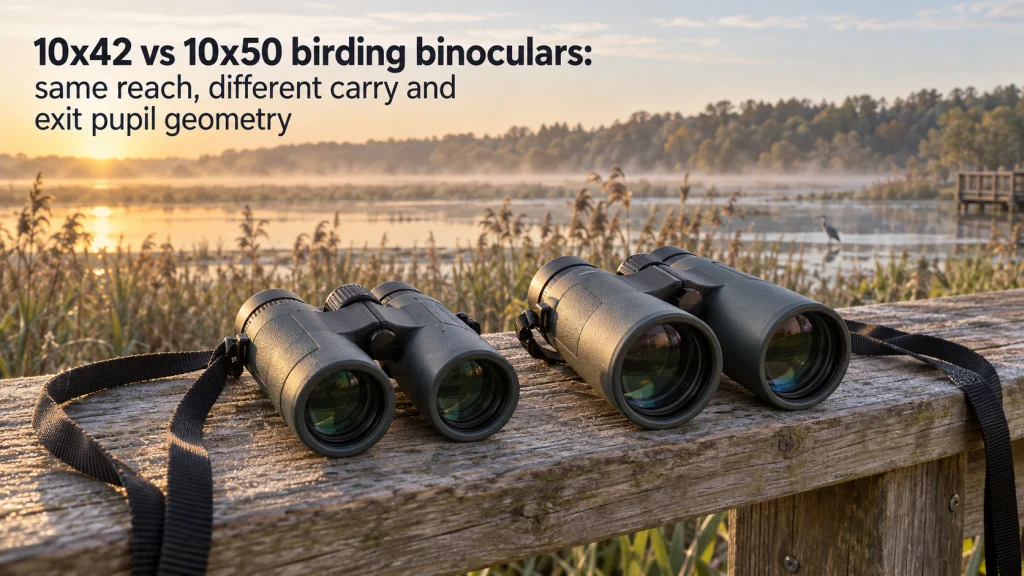
Same 10x reach, two different birding loads
Put a 10×42 and a 10×50 beside the same birding day and the first number does not change: both magnify the scene ten times. That means the choice is not about getting more nominal reach from the 50 mm model. It is about what the larger objective changes around that fixed magnification, then whether those changes are worth carrying. If you are still deciding whether 10x itself fits your viewing style, start with the broader birding binocular decision guide before treating objective size as the main question.
The second link in the decision chain matters for the same reason. A 42 mm or 50 mm label cannot replace checks for field of view, eye relief, grip, weight, and actual use duration, so the wider binocular buying framework is useful when this comparison exposes a fit issue rather than an objective-size issue. For a birder already committed to 10x, however, the comparison can stay much narrower. The job is to hold magnification constant and decide whether portability or the larger optical opening deserves more priority.
Hold magnification constant before judging the objective
Comparing 10×42 with 10×50 is cleaner than comparing 8×42 with 10×50 because magnification is no longer moving at the same time as objective diameter. Both options show the same nominal angular enlargement, so a distant perched bird is not made larger simply because the objective grows from 42 mm to 50 mm. This keeps the real tradeoff visible: the 50 mm configuration has a larger entrance aperture, while the body usually needs more space and mass to support it. That is a more useful starting point than treating the larger number as an automatic upgrade.
It also prevents several unrelated specifications from being smuggled into the conclusion. A 10×50 does not automatically have wider field of view, longer eye relief, better coatings, or better optical correction than a 10×42. Those are model-specific design choices that must be checked on the exact binoculars being compared. For birding, that distinction matters because finding a moving bird, seeing the full field with glasses, and carrying the binocular for hours can matter more than the objective label by itself.

This full-size binocular keeps magnification at 10x while using 42 mm objectives. Nikon lists waterproof and fogproof construction, rubber armor, and an oil- and water-repellent lens coating. A locking diopter helps preserve the user's focus adjustment between outings.
Check on AmazonIf you click this link and buy, we earn a commission at no additional cost to you.
A 42 mm objective gives a 4.2 mm geometric exit pupil at 10x
Exit pupil is simple geometry when the stated magnification and objective diameter are known. Divide 42 mm by 10 and the result is 4.2 mm. That number describes the diameter of the light bundle leaving each eyepiece in an idealized geometric sense. It is useful because it lets you compare configurations without pretending that a marketing brightness claim is a laboratory measurement.
For a 10×42, the 4.2 mm result is part of a package that is commonly easier to make compact than a 10×50. That can matter on a route where the binocular stays on a harness, comes up repeatedly for short observations, and goes back down while you keep walking. The relevant question is not whether 4.2 mm is universally enough, because viewing conditions and optical design vary. The useful question is whether the exact 10×42 gives you the field, eye relief, image quality, and handling you need without asking you to carry unused bulk.
Exit-pupil arithmetic: 42 divided by 10 equals 4.2 mm. The calculation is exact for the stated configuration, but it is not a complete brightness verdict.
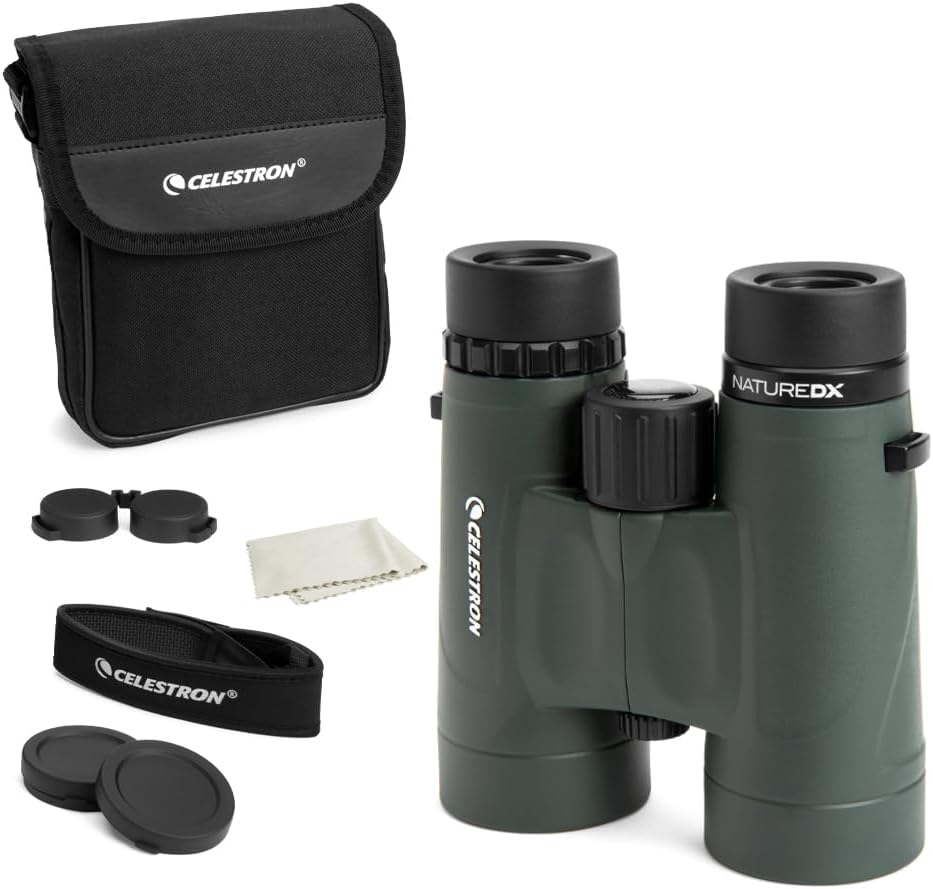
The Nature DX pairs 10x magnification with 42 mm objectives in a roof-prism binocular. Its listing specifies phase-coated prisms, a nitrogen-purged housing, and twist-up eyecups. Waterproof construction and a rugged housing suit the field-use context of this 10x42 configuration.
Check on AmazonIf you click this link and buy, we earn a commission at no additional cost to you.
A 50 mm objective gives a 5.0 mm geometric exit pupil at 10x
Run the same arithmetic on a 10×50 and the result is 5.0 mm. The magnification is still 10x, so the larger exit pupil comes entirely from the larger objective diameter in this comparison. Geometrically, the 50 mm objective also has about 42 percent more area than a 42 mm objective because area scales with the square of diameter. That is a real physical difference, but it still does not tell you how efficiently a finished binocular transmits light or how the complete view will look.
The 5.0 mm exit pupil can also give more positional margin at the eyepiece than 4.2 mm, which may make eye placement feel less fussy on a well-designed binocular. That benefit is separate from claiming that everyone will see a brighter image. Eyecup shape, eye relief, interpupillary adjustment, and the user’s viewing position still affect whether the sight picture is easy to acquire and keep. If the larger exit pupil solves a repeated eye-placement problem for you, that is a stronger reason to accept the 50 mm body than the objective number alone.

The Crossfire HD uses 10x magnification with 50 mm objectives, matching the configuration discussed in this section. Vortex lists an HD optical system plus waterproof, fogproof, and shockproof construction. The body is tripod adaptable and the listing includes a GlassPak harness.
Check on AmazonIf you click this link and buy, we earn a commission at no additional cost to you.
Exit pupil is geometry, not a universal brightness prediction
The cleanest mistake to avoid is turning 5.0 mm versus 4.2 mm into a promise that every 10×50 must look brighter to every observer in every condition. Exit pupil describes geometry, while perceived image brightness in a finished binocular is also affected by transmission, coatings, prism system, internal baffling, stray light control, alignment, and the available light in the scene. Two binoculars can therefore share the same basic 10×50 label and still differ in how the view is rendered. The configuration tells you what to investigate, not the entire result.
This is why a 10×50 earns its size only when the larger optical opening matters in the way you actually bird. A stationary observation point near the edge of usable light places different demands on the binocular than a bright open trail where the instrument spends much of the day hanging from a harness. The first situation can make the larger exit pupil and objective more relevant, while the second can make ounces and dimensions more noticeable. Keep the conclusion conditional and the comparison stays useful instead of becoming a slogan.
- Use exit pupil to compare configuration geometry.
- Use manufacturer specifications to compare exact field of view, eye relief, dimensions, and weight.
- Use your own fit check to judge eyecup position, grip, balance, and how easily you acquire the full view.
- Do not infer optical quality from objective diameter alone.
That sequence separates what the configuration proves from what the exact model still has to prove. It also keeps low-light expectations bounded without discarding a genuine geometric advantage. Once that distinction is clear, field of view becomes the next specification worth checking rather than assuming.

This Nikon Lens Pen is a dedicated lens-cleaning system for optical surfaces. It gives binocular users a compact tool for routine lens care before evaluating the view. Keeping exposed lenses clean helps avoid adding removable surface contamination to an optical comparison.
Check on AmazonIf you click this link and buy, we earn a commission at no additional cost to you.
Compare exact field of view instead of guessing from objective size
Field of view is especially important in birding because a wider view can make it easier to acquire and follow a moving subject. Objective diameter does not determine that specification by itself. A current same-family example makes the point cleanly: Kowa lists its BD III XD 10×42 at 378 feet at 1,000 yards and its 10×50 at 346 feet at 1,000 yards. In that pair, the smaller-objective model is actually wider, so the rule “50 mm means wider field” fails immediately.
The same table also shows why exact eye relief belongs in the comparison rather than being inferred from size. Kowa lists 16.5 mm for the 10×42 and 17.0 mm for the 10×50, a small difference that should be treated as a fit variable rather than a universal advantage. If you wear glasses, published eye relief is a useful screening figure, but eyecup design and the usable field still need an actual fit check. The practical lesson is simple: compare the two exact models you might buy, not two labels in isolation.
| Specification | Kowa BD III XD 10×42 | Kowa BD III XD 10×50 | Why it matters here |
|---|---|---|---|
| Magnification | 10x | 10x | Reach is held constant. |
| Objective diameter | 42 mm | 50 mm | This is the controlled configuration change. |
| Geometric exit pupil | 4.2 mm | 5.0 mm | Shows the direct geometry difference. |
| Field of view at 1,000 yd | 378 ft | 346 ft | Shows that 50 mm does not guarantee a wider view. |
| Eye relief | 16.5 mm | 17.0 mm | Must be checked for actual fit, especially with glasses. |
This is a specification example, not a recommendation for either model. Its value is that both configurations come from one product family, so the comparison exposes how much can change even when brand and series stay constant. The same check should be repeated on whichever exact pair you are considering.
Compare exact weight and dimensions because carry cost is real
The larger objective usually needs a larger housing, but the amount of extra size is not fixed across brands or series. In the same Kowa BD III XD example, the 10×42 is listed at 5.3 by 5.0 by 2.0 inches and 21.5 ounces, while the 10×50 is 6.9 by 5.2 by 2.2 inches and 25.5 ounces. That is a four-ounce increase plus a much larger jump in length than the objective numbers alone suggest. Kowa also lists the 10×42 at $499 and the 10×50 at $599, which shows that the physical step can arrive with a price step as well.
None of those differences is automatically disqualifying, but they should be priced into the way the binocular will be carried. Four ounces may feel trivial on a desk and more meaningful after repeated lifts from a harness during a long walking route, while an extra 1.6 inches of length can affect case fit and pack space. A stationary birder can reasonably assign less importance to that burden because the binocular may spend more time in the hands or on a support and less time traveling. The correct comparison is therefore not “large versus small,” but “what do I gain for the exact ounces, inches, and dollars I am accepting?”
| Carry factor | 10×42 example | 10×50 example |
|---|---|---|
| Length | 5.3 in | 6.9 in |
| Width | 5.0 in | 5.2 in |
| Height | 2.0 in | 2.2 in |
| Weight | 21.5 oz | 25.5 oz |
| Manufacturer-listed price | $499 | $599 |
Prices can change, so the price row is a comparison point rather than a permanent value. Weight and dimensions should also be checked on the exact current variant because a redesign can move them even when the familiar configuration name stays the same. That is why the purchase decision should remain model-specific all the way to checkout.
10×42 favors lower carry burden when the light margin is sufficient
A 10×42 makes the strongest case when you already want 10x and expect to move enough that size and weight stay in the decision all day. Open trails, long walks, frequent stops, and repeated transitions between binoculars and camera gear can reward a package that takes less room and adds less load. The 4.2 mm exit pupil is still a substantial geometric opening for a handheld birding binocular, but its real suitability depends on the exact optics and the light you actually use it in. Choosing 42 mm is therefore not a declaration that low-light performance does not matter; it is a decision that the smaller package is the better trade for your routine.
The 10×42 also makes sense when a specific model gives you a field of view, eye relief, and hand fit that you prefer over the available 10×50 alternatives. That can happen even within the same product family, as the controlled Kowa example shows with its wider listed field in the 42 mm version. If steadiness rather than objective size is the limitation you are trying to solve, compare image-stabilized binoculars for birding instead of assuming a larger objective addresses the problem. The smaller model wins only when its complete specification set and fit support the way you bird.
10×50 earns its size when the larger objective solves a real need
A 10×50 is easier to justify when your birding is less mobile and you repeatedly work near the edge of available light. The 5.0 mm exit pupil and larger objective are real geometric differences, and the larger exit pupil can provide more eye-placement margin on a well-designed model. Those benefits become more relevant when you spend longer periods scanning from a fixed position instead of carrying the binocular over distance. The extra body size is then a cost you have deliberately accepted for a feature you can name.
That still does not make 10×50 the default premium choice. If the exact 10×50 is narrower, heavier, longer, more expensive, or less comfortable in your hands than the 10×42 you are comparing, those costs remain part of the optical decision because a binocular that stays in the case solves nothing. A useful test is to ask whether you can identify the recurring situation in which the 50 mm model fixes a limitation you have actually noticed. If you cannot, the larger objective may be capacity you pay for and carry without using.
| Birding pattern | Configuration that deserves the first look | What to verify before buying |
|---|---|---|
| Long walking routes and frequent handheld use | 10×42 | Exact FOV, eye relief, grip, weight, and harness comfort |
| Mostly stationary observation with regular dim-light use | 10×50 | Whether the larger exit pupil and objective justify the added size |
| Eyeglasses or sensitive eye placement | Either | Usable eye relief, eyecup positions, and ability to see the full field |
| Moving birds are the main challenge | Either | Compare exact field of view instead of assuming 50 mm is wider |
The table is a routing tool, not a substitute for trying the exact binocular. It keeps the decision tied to a recurring birding constraint instead of a larger-number reflex. If both configurations fit comfortably and the larger model solves a real limitation, the 10×50 has earned its burden rather than merely adding it.

The Diamondback HD combines 10x magnification with 50 mm objectives and an HD optical system. Vortex lists waterproof, fogproof, shockproof, and tripod-adaptable construction. The listing also includes a GlassPak harness for carrying the binocular between viewing locations.
Check on AmazonIf you click this link and buy, we earn a commission at no additional cost to you.
Final Thoughts: choose the burden that earns its place
At 10x, a 42 mm and 50 mm binocular give the same nominal reach, so the objective decision should stay focused on what actually changes. The 10×42 gives a 4.2 mm geometric exit pupil and usually offers the easier route to a smaller carry package. The 10×50 gives a 5.0 mm exit pupil and more objective area, but it normally asks for more space, weight, and often more money. Neither configuration wins until those differences are connected to the exact field conditions and model specifications you care about.
If most of your birding is mobile and the 10×42 already provides the fit and light margin you need, carrying less is a legitimate advantage rather than a compromise to apologize for. If you work from fixed positions, use the binocular repeatedly in dimmer conditions, or benefit from the larger exit-pupil margin, a 10×50 can be worth the additional load. Before buying, compare exact FOV, eye relief, dimensions, and weight side by side, then check how the binocular sits at your eyes and in your hands. The better choice is the one whose extra capability you can explain in terms of a real birding need.

This metal binocular adapter uses a standard 1/4-20 thread and is designed for roof and Porro binoculars. Celestron describes it as a hands-free support for stable viewing on compatible binoculars. It fits the section's fixed-position use case when the binocular provides a compatible tripod connection.
Check on AmazonIf you click this link and buy, we earn a commission at no additional cost to you.
FAQs
🔭 Is 10×50 more powerful than 10×42?
No. Both are 10x binoculars, so their nominal magnification is the same. The difference is the objective diameter, which changes exit-pupil geometry and usually changes the size and weight of the binocular.
🌅 Is 10×50 always brighter than 10×42 for birding?
No universal brightness claim is safe from configuration alone. A 10×50 has a 5.0 mm geometric exit pupil versus 4.2 mm for a 10×42, but transmission, coatings, optical design, available light, and fit also affect the finished view.
🎒 Is a 10×50 too heavy for all-day birding?
That depends on the exact model and how you carry it. Compare the listed weight and dimensions with the 10×42 you are considering, then judge the burden with your normal harness, pack, and walking routine.
📏 Does a 10×50 have a wider field of view than a 10×42?
Not necessarily. Field of view is model-specific, and current same-family examples exist where the 10×42 is wider than the 10×50. Check the exact FOV specification instead of inferring it from objective diameter.
👓 Which size is better if I wear glasses?
Objective size alone does not answer that. Compare usable eye relief and eyecup positions on the exact models, then confirm that you can see the full field comfortably with your glasses in place.
🌲 Which configuration is better for walking birding trails?
A 10×42 often deserves the first look because smaller dimensions and lower weight can reduce carry burden, but exact models vary. If a particular 10×50 fits you well and its larger objective solves a recurring need, the extra load may still be justified.
References and Sources
- Kowa BD III XD specifications: Current same-family 10×42 and 10×50 specifications used for field of view, eye relief, dimensions, weight, and manufacturer-listed price comparisons.
- BirdForum 10×42 or 10×50 discussion: Community discussion used to confirm the recurring buyer questions around carry weight, low-light priorities, and eye-placement differences.