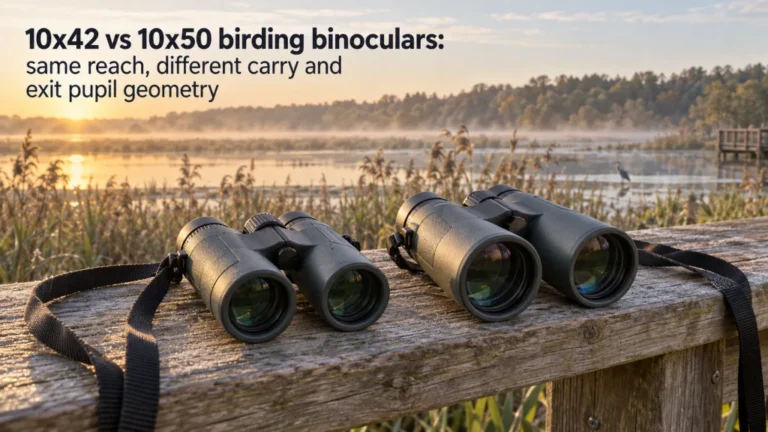
Image stabilized binoculars for birding are worth considering only when stabilization changes a real part of the birding workflow, such as holding a distant bird steady long enough to inspect detail. The feature does not erase the usual trade-offs in field of view, target acquisition, weight, weather protection, or carrying comfort. Higher magnification can become more usable when the view is steadier, but it can still make a moving bird harder to find in the first place. The practical decision is whether the steadier view solves a recurring problem strongly enough to justify batteries, added complexity, and the exact model’s physical burden.
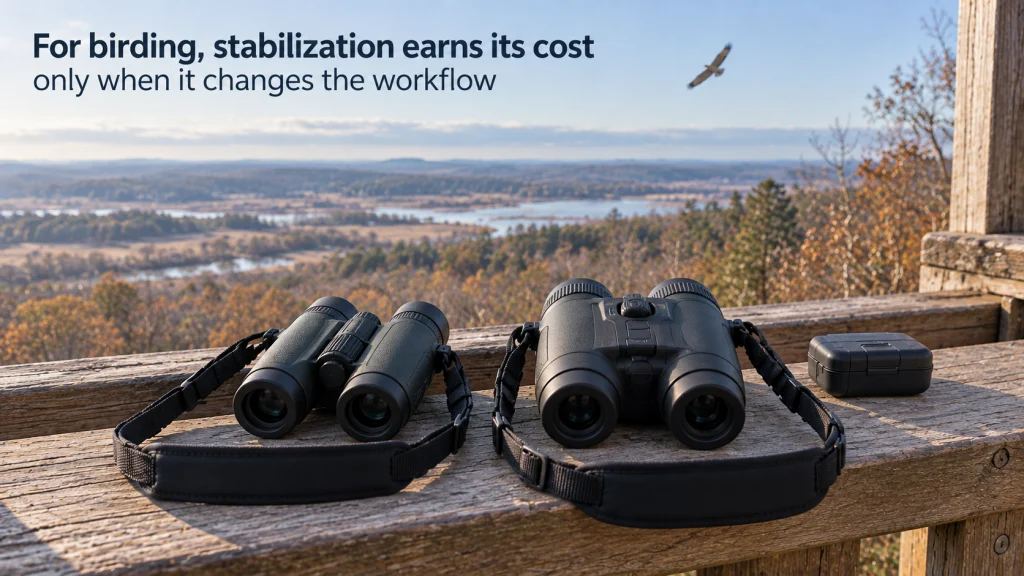
Stabilization has to earn its batteries from the birding workflow
Image stabilized binoculars for birding face a simple test at the edge of a distant treeline. A conventional wide-field binocular may make it easier to get the bird into view, while a higher-power stabilized binocular may make the bird easier to inspect once it is centered. That is the real decision behind choosing binoculars for birding conditions, and it is why the broader binocular buying decision cannot be reduced to magnification alone. The stabilized option has to improve that sequence enough to offset what it adds in batteries, weight, cost, controls, and model-specific weather concerns.
The key distinction is acquisition versus observation. Stabilization can make the image calmer after the bird is in the field, but it does not automatically widen the field, lighten the binocular, improve close focus, or make a poorly fitting eyecup system comfortable. A birder who loses fast-moving birds during acquisition may gain less from stabilization than someone who repeatedly studies distant, slower-moving birds from open viewpoints. Start with the birding problem, then decide whether stabilization addresses that problem directly.
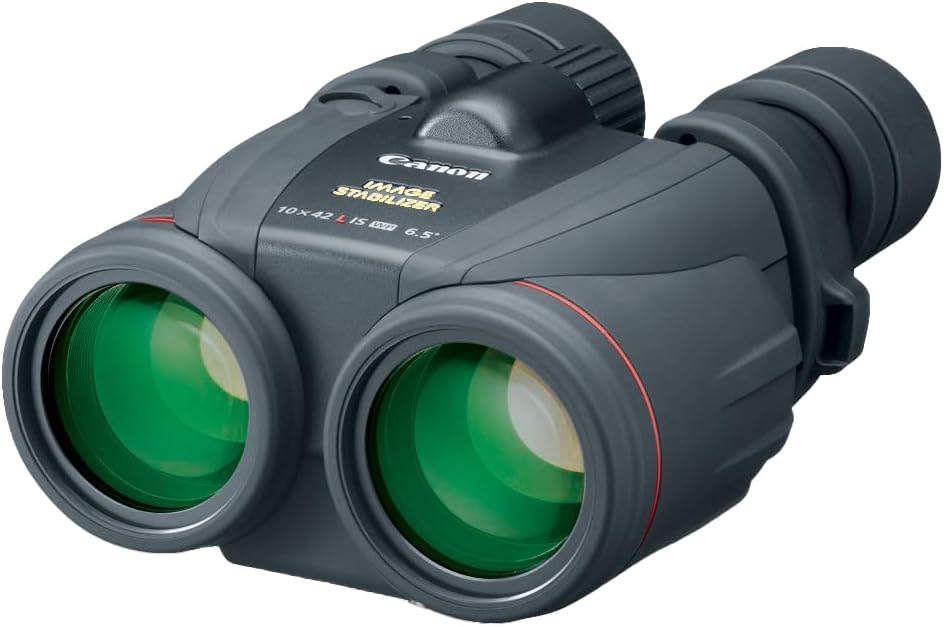
Canon combines 10x magnification and 42 mm objectives with optical image stabilization. The model is waterproof and uses two AA batteries for its stabilization system. Its 6.5 degree real field of view makes it a useful reference for balancing steadiness with bird acquisition.
Check on AmazonIf you click this link and buy, we earn a commission at no additional cost to you.
Define the birding problem before buying image stabilization
Stabilization has the clearest value when ordinary hand movement prevents you from using the detail that the binocular can otherwise deliver. That can happen when observing distant waterbirds, perched raptors, birds across broad fields, or other subjects that stay in roughly the same area long enough for careful inspection. In those cases, a steadier image may let you hold a field mark in view instead of repeatedly reacquiring it. The benefit is less obvious when most of your birding happens at close range in tangled cover where the main challenge is finding a moving bird quickly.
Before comparing specifications, write down the failure you want the new binocular to fix. Useful questions include whether you are missing birds during the lift to your eyes, whether distant detail disappears because the view will not settle, whether your usual sessions involve long scans, and whether the binocular must stay ready during light rain or damp weather. Also note how often you already brace against a railing, tree, vehicle, or other support, because that changes the size of the stabilization advantage. A feature earns its place only when it solves a problem that happens often enough to matter.
- Prioritize acquisition if birds are often close, moving quickly, or partly hidden in branches.
- Prioritize steadiness if birds are usually distant, slower moving, or observed for longer periods.
- Prioritize carry comfort if the binocular stays around your neck or in a harness for most of the day.
- Prioritize sealing and battery access if the binocular is used far from shelter or convenient resupply.
This checklist keeps the buying decision tied to the actual observation job. It also prevents the common shortcut of treating higher stabilized magnification as automatically more capable for every kind of birding.

Celestron Nature DX uses an 8x42 configuration with a 7.4 degree angular field of view. Its waterproof body and phase coated BaK-4 prisms suit general outdoor observation. It provides a conventional wide field baseline for deciding whether stabilization solves a real birding problem.
Check on AmazonIf you click this link and buy, we earn a commission at no additional cost to you.
Higher stabilized power still changes field of view and acquisition
Stabilization does not cancel the optical consequences of magnification. A higher-power binocular can show a smaller slice of the scene, which may make a bird harder to locate when it jumps between branches or crosses the sky. The view can be beautifully steady after acquisition and still be frustrating during acquisition. For active birding, that distinction matters more than a simple claim that a stabilized image contains more detail.
Current specifications make the point clearly. Canon lists a 6.5 degree real field of view for its 10×42 L IS WP and 5 degrees for its 12×36 IS III, while Fujifilm lists 4.2 degrees for its TS12x28WP. Those numbers are not a ranking because the binoculars differ in objective size, weight, eyepiece design, sealing, and stabilization system. They show why power and stabilization cannot be evaluated without the exact field of view of the exact model.
| Birding situation | What a wider field helps | What stabilization may help |
|---|---|---|
| Small birds moving through woodland | Finding and reacquiring birds as they change branches | Holding a briefly perched bird steady once centered |
| Raptors circling at distance | Picking up the bird and keeping it in the scene during movement | Studying shape, pattern, and posture during steadier portions of the flight |
| Distant waterbirds on open water | Scanning a larger group or section of shoreline | Inspecting one bird for longer without as much visible hand movement |
| Mixed general birding | Maintaining versatility across close and moving subjects | Adding value only if distant inspection is a recurring limitation |
The field-versus-steadiness trade-off is therefore situational rather than theoretical. If getting the bird into view is the harder part of your day, protect field of view before chasing extra power.

Nikon PROSTAFF P3 pairs 8x magnification with 42 mm objectives in a full size roof prism binocular. Nikon describes this model as waterproof and fogproof with a wide field of view. That conventional 8x format gives readers a practical acquisition reference before moving to higher stabilized power.
Check on AmazonIf you click this link and buy, we earn a commission at no additional cost to you.
Compare exact weight and carry burden, not the stabilization label
Image stabilization adds components, but that does not mean every stabilized binocular is automatically huge. Current examples span a wide range: Fujifilm lists the TS12x28WP at 485 g without its battery, Canon lists the 12×36 IS III at 660 g without batteries, and Canon lists the 10×42 L IS WP at about 1,110 g. Those are very different carrying burdens even before you consider a strap, case, spare batteries, or other accessories. The useful comparison is the complete system you will actually carry, not the fact that all three use stabilization.
Weight also affects the workflow in ways that a spec table can hide. A heavier binocular may feel acceptable during a short viewing stop but become annoying after repeated lifting, walking, and lowering over a long outing. A lighter stabilized model may reduce that burden, but a smaller objective or different field of view may change brightness, acquisition, or viewing comfort in other ways. Check weight alongside dimensions, grip, eye relief, and how the binocular will be carried before treating stabilization as the deciding feature.

Vortex Triumph HD uses a 10x42 configuration in a waterproof and fogproof binocular. The package includes an adjustable GlassPak harness as well as a neck strap. That included carry system makes it relevant when comparing the burden of the complete field setup rather than the binocular alone.
Check on AmazonIf you click this link and buy, we earn a commission at no additional cost to you.
Weather sealing must be verified on the exact stabilized model
Birding often happens in damp grass, mist, drizzle, or sudden weather changes, so weather protection cannot be assumed from an outdoor-looking body. Fujifilm specifies IPX7 water resistance for the TS12x28WP, and Canon describes the 10×42 L IS WP as waterproof. By contrast, Canon’s published technical specifications for the 12×36 IS III do not state an equivalent waterproof rating. That does not prove the model cannot tolerate any moisture, but it does mean the buyer should not invent a sealing level that the manufacturer has not stated.
This is especially important with an electronic feature because battery doors, switches, and control surfaces are part of the ownership system. Read the exact manual or official specification for the model you are considering, including any limits attached to water resistance. A weather rating on one stabilized model does not transfer to another model from the same brand. If wet-weather use is routine, sealing belongs near the top of the shortlist rather than being checked after purchase.

Vortex Binocular Rainguard is made for mid size and full size binocular eyepieces, with Kaibab HD excluded from the stated fit. It covers the ocular end while the binocular is being carried. The accessory supports wet weather field routines without implying that it changes the binocular's own sealing rating.
Check on AmazonIf you click this link and buy, we earn a commission at no additional cost to you.
Compare image stabilization against the conventional 8x and 10x route
The fair comparison is not stabilized binoculars versus nothing. For many birders, a conventional 8x or 10x binocular already solves the job with fewer controls, no stabilization battery requirement, and often a simpler carrying routine. An 8x configuration can be especially forgiving when the priority is quick acquisition and a broad, active view, while 10x can add reach if the field remains usable for the habitat. Stabilization has to beat that practical baseline, not merely demonstrate that a button can calm visible movement.
The comparison also needs to account for what happens when the electronics are not being used. A conventional binocular has no stabilization state to manage, while an IS model introduces battery condition and control behavior that vary by design. That may be trivial for someone who routinely carries spare batteries and checks gear before leaving home. It may be pointless overhead for someone whose current 8x or 10x binocular already delivers the birds they want to see.
| Decision factor | Conventional 8x or 10x route | Image stabilized route |
|---|---|---|
| Target acquisition | Often strong when paired with a wide field of view | Depends on exact magnification and field of view |
| Handheld steadiness | Depends on power, technique, support, and user | Can reduce visible movement when stabilization is active |
| Carry burden | Varies widely by size and construction | Varies widely, so check exact weight rather than assuming |
| Battery dependency | No stabilization battery system | Battery type, runtime, and control behavior are model specific |
| Weather use | Must still be verified by exact model | Must be verified by exact model and not inferred from the category |
If your current binocular already covers your normal viewing distances without creating a recurring inspection problem, a new electronic system may add more ownership burden than useful capability. The stabilized route deserves a closer audit only when the conventional setup leaves a specific, repeated gap that matters in the field.

Vortex Diamondback HD uses a conventional 10x42 roof prism configuration without electronic stabilization. Its HD optical system is paired with a waterproof and fogproof housing. It gives readers a direct 10x conventional route to compare against battery powered image stabilized models.
Check on AmazonIf you click this link and buy, we earn a commission at no additional cost to you.
Hawk watching can raise the value of stabilized reach without removing the need for field
Open-sky birding is one of the clearer cases where stabilization can earn its cost. A distant raptor may stay visible long enough for a steadier view to help with shape, wing position, tail pattern, or other visual detail that is difficult to hold in a bouncing image. Higher magnification can be useful in that setting because the viewing distance is often greater than it is in close woodland birding. The catch is that the bird is still moving, and a narrow field can make initial pickup or reacquisition slower.
This is why hawk watching should not be reduced to choosing the highest stabilized power available. Consider how wide an area you scan, how quickly birds cross the viewing sector, how often you need to switch between scanning and inspection, and whether you can brace against a fixed support. If objective size and carrying burden are also part of the decision, the trade-offs in 10×42 versus 10×50 birding binoculars provide a useful conventional reference point. Stabilization may increase usable reach, but field and handling still determine whether that reach fits the actual watch site.

Canon 12x36 IS III combines 12x magnification with optical image stabilization for handheld viewing. Canon lists a 5 degree real field of view and a weight of 660 g without batteries. Those specifications make it a useful example for weighing stabilized reach against acquisition and carrying burden at a hawk watch.
Check on AmazonIf you click this link and buy, we earn a commission at no additional cost to you.

Vortex Crossfire HD is a conventional 10x42 binocular with HD optics and no electronic stabilization system. The Amazon listing describes it as waterproof, fogproof, shockproof, and tripod adaptable. It illustrates why useful birding features need to be judged as a complete package rather than by stabilization alone.
Check on AmazonIf you click this link and buy, we earn a commission at no additional cost to you.
Run a birding image stabilization audit before deciding
A good audit separates category claims from exact model facts. Start with the magnification and real field of view, then add weight, eye relief, close focus, weather rating, battery type, and the way stabilization is activated. Those details determine whether the binocular fits your habitat and routine far more reliably than the letters IS on the body. The table below uses current manufacturer specifications as reference examples, not as product recommendations.
Notice how the rows do not move together. The lighter example is not the widest-field example, the 12x examples do not share the same field of view, and the weather information differs by model. That is exactly why a birding decision should be built from the whole system rather than one headline feature. Use the same audit on any stabilized binocular you are considering, including models not shown here.
| Reference model | Magnification | Real field of view | Weight | Battery | Weather information |
|---|---|---|---|---|---|
| Canon 10×42 L IS WP | 10x | 6.5 degrees | About 1,110 g | 2 AA batteries | Canon describes it as waterproof |
| Canon 12×36 IS III | 12x | 5 degrees | 660 g without batteries | 2 AA batteries | No equivalent waterproof rating stated in the cited Canon technical specifications |
| Fujifilm TS12x28WP | 12x | 4.2 degrees | 485 g without battery | 1 CR2 battery | IPX7 listed by Fujifilm |
After the spec audit, return to the observation problem you wrote down at the start. If the model solves that problem without creating a larger acquisition, carry, weather, or ownership problem, stabilization may be justified.
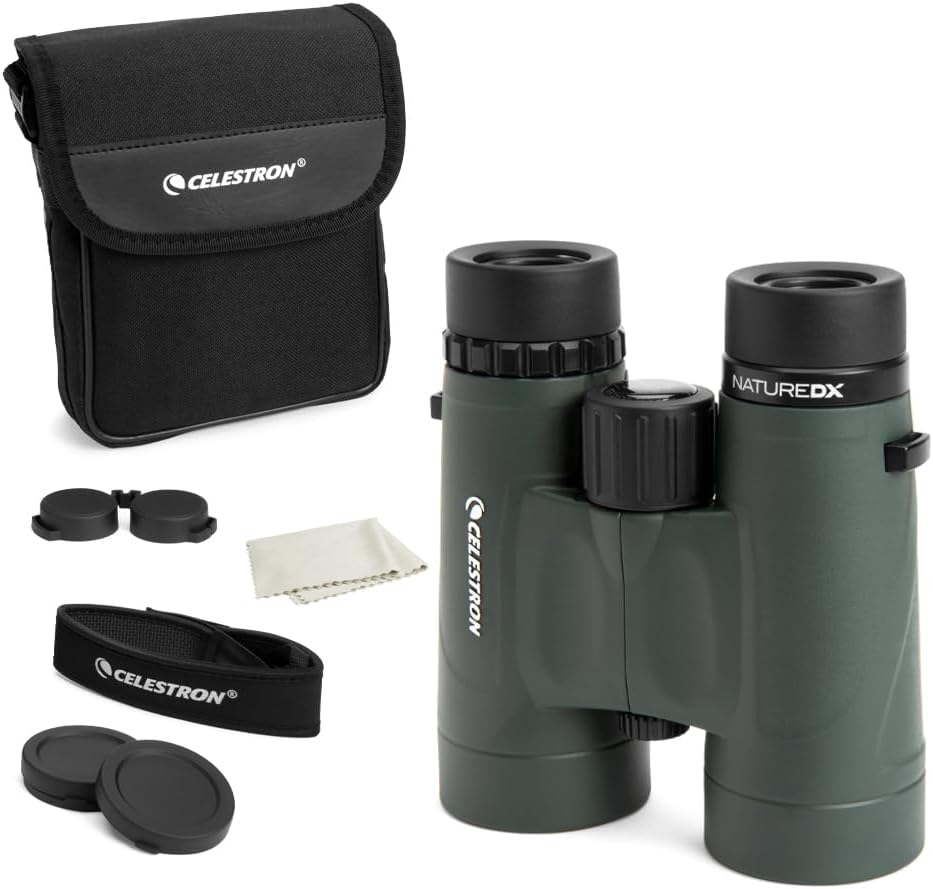
Celestron Nature DX 10x42 combines 10x magnification with 42 mm objectives in a waterproof roof prism binocular. The listing specifies phase coated prisms, a nitrogen purged housing, and twist up eyecups. It gives readers another exact configuration to audit instead of judging a category from one headline feature.
Check on AmazonIf you click this link and buy, we earn a commission at no additional cost to you.
Final Thoughts: choose stabilization for the job it changes
The strongest case for birding stabilization is not that it makes every binocular better. It is that a steadier view can make higher magnification or longer inspection more usable when distant detail is the recurring limitation. That gain still has to survive the rest of the checklist, especially field of view, acquisition speed, weight, sealing, battery setup, and physical fit. If those trade-offs weaken the birding workflow, the more complex system has not earned its place.
Start with what you fail to see or hold steady today, then compare the exact specifications of the systems that might fix it. Keep conventional 8x and 10x binoculars in the comparison rather than assuming electronics are the upgrade path by default. A stabilized binocular is a good decision when it removes a real observation bottleneck without creating a larger one. That conditional test is more useful than any category label or premium badge.

Celestron Outland X uses a conventional 10x42 configuration with BaK-4 prisms and multi coated optics. Its body is waterproof and fogproof with rubber armor for outdoor handling. It provides a straightforward non electronic alternative when the final decision comes back to the viewing job rather than the feature label.
Check on AmazonIf you click this link and buy, we earn a commission at no additional cost to you.
FAQs
🔭 Are image stabilized binoculars worth it for birding?
They can be when distant detail is repeatedly limited by visible hand movement. They are less compelling when quick target acquisition, low weight, or simple all-day carry matters more than holding a distant bird steady.
🦅 Is 12x too much for birding if stabilization is active?
Not automatically, but 12x still needs an acceptable field of view, weight, eye relief, and handling for your habitat. Stabilization can calm the view after acquisition, while the narrower scene associated with some higher-power models can still make moving birds harder to find.
🌧️ Can image stabilized binoculars be used in rain?
Only according to the exact model’s stated weather protection. Some current stabilized models carry explicit waterproof ratings, while others do not, so verify the manufacturer specification or manual before treating the binocular as wet-weather gear.
🔋 What happens if the battery runs out?
Do not assume every model behaves identically when the stabilization system has no power. Check the exact manual for normal optical use, control behavior, supported battery types, and any shutdown or auto-off behavior that affects your routine.
🌲 Are conventional 8x or 10x binoculars still better for moving birds?
They can be if the exact binocular provides a wider, easier-to-acquire view and comfortable handling. The better choice depends on whether your main limitation is finding and following the bird or holding a distant bird steady once you have found it.
References and Sources
- Fujifilm Techno-Stabi specifications: verifies magnification, field of view, weight, battery type, eye relief, and water resistance for current Techno-Stabi models.
- Canon 10×42 L IS WP support specifications: verifies magnification, real field of view, eye relief, weight, battery type, and other model-specific specifications.
- Canon 10×42 L IS WP product information: supports Canon’s waterproof claim and current product positioning.
- Canon 12×36 IS III specifications: verifies magnification, field of view, weight, battery type, and other published specifications for the 12x model.
- Live Science bird-watching binocular guide: provides independent birding context showing image stabilization as a current birding category while also discussing weight and practical trade-offs.