The most damaging first-binocular mistakes usually happen before a buyer compares brands or prices. A pair can look impressive and still be wrong because the buyer optimized magnification, compactness, labels, or budget before defining the viewing job. The safer approach is to turn every attractive claim into a check involving field of view, eye relief, IPD, weight, architecture, seller terms, and actual use. A first pair does not need to be perfect, but it should survive those checks before checkout.
The dangerous mistake is skipping the question that would reject the product
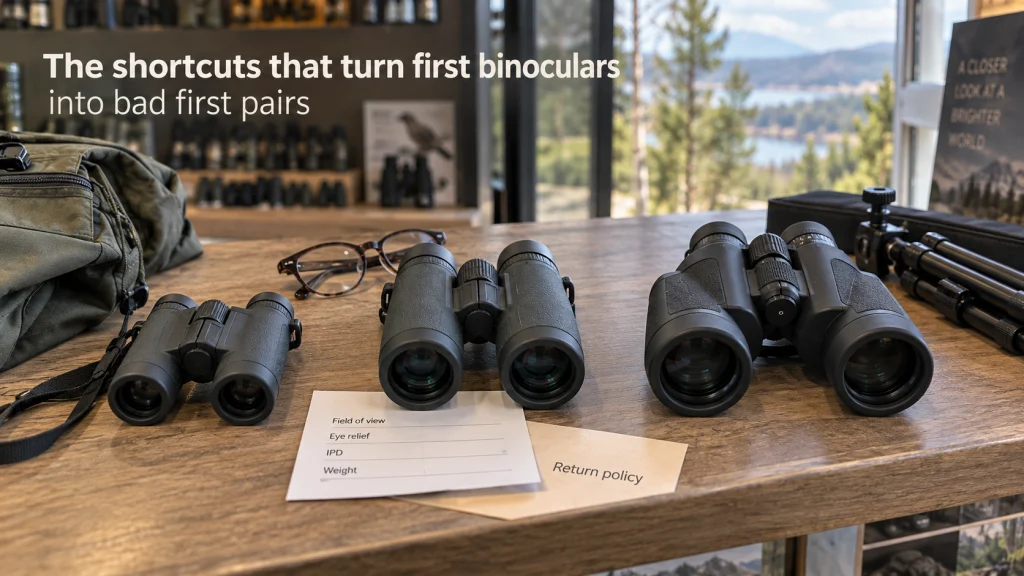
Most first binocular buying mistakes are not failures to memorize enough specifications. They happen when a buyer sees a powerful number, a compact body, an optical badge, or a familiar brand and never asks what would make that choice wrong. A 12x compact can sound better than an 8x model until hand stability, field width, objective size, and eye position enter the decision. The useful question is, “What fact would make me reject it?”
Start by defining the viewing job, then test the candidate against it. The broader first-binocular decision process helps establish what a new buyer needs, while the site’s binocular buying guide explains the specifications behind those decisions. This page stays narrower and deals only with preventable buying shortcuts before setup begins. If a product cannot pass a use, fit, and transaction check, its feature list should not rescue it.

Nocs Provisions Standard Issue 8x25 is a waterproof binocular in the Cypress Green II variant. Amazon lists 8x magnification, BaK4 prisms, and wide-view multi-coated lenses. Its 8x25 configuration gives this section a concrete model for checking whether portability, field, fit, and actual viewing needs align.
Check on AmazonIf you click this link and buy, we earn a commission at no additional cost to you.
Configuration shortcuts that create the wrong first pair
Configuration numbers can look like a ranking system, with more magnification and larger objectives appearing to mean better binoculars. That reading ignores the tradeoffs that affect subject acquisition, hand stability, carry weight, and eye placement. Beginner guidance repeatedly warns about excessive magnification and objective-size neglect because both mistakes are easy to make from a listing. Treat the configuration as a bundle of consequences, not a score.
An extreme-power compact is a useful pre-mortem. High magnification plus pocket size sounds like two wins, but the same package can also bring a smaller exit pupil, narrower field, more visible hand movement, and less forgiving eye placement. The buyer should be able to explain why the power, objective size, field, and carry benefit fit the real viewing situation. If that explanation is missing, the product has not earned checkout.
Mistake: choosing the highest magnification before defining the viewing job
Higher magnification increases image scale, but it also makes hand movement more visible and often narrows the real field. Compare the exact field of view and decide whether the image can stay steady enough for the intended duration and subject movement. If the extra power solves no defined viewing problem, the larger number is not a reason to buy.
Mistake: buying the smallest body only because it fits in a pocket
Compact binoculars are valuable when a larger pair would be left behind, but pocketability does not guarantee viewing fit. Compare folded size and weight with eye relief, field of view, minimum IPD, objective size, and expected light. A compact first pair is sensible when those checks also work for the user.
Mistake: assuming 8×42 is automatically correct because beginner guides repeat it
An 8×42 configuration is a useful starting format, not a standardized experience. Exact models still differ in field width, eye relief, focus behavior, weight, grip, and IPD range. Verify the specific model against glasses, face geometry, carrying tolerance, and subject movement before treating the configuration as safe.
Mistake: treating zoom or extreme-power marketing as free versatility
A zoom range sounds like several binoculars in one body, but first verify what kind of zoom the listing actually describes. Optical zoom changes magnification through the binocular’s optical system, while digital zoom or digital enlargement crops and enlarges an electronic image rather than adding optical detail. Neither label makes versatility free, and they should not be judged as the same architecture. Nikon publishes a 199-foot field at 1,000 yards and 8.6 mm of eye relief at 10x for its ACULON A211 10 to 22×50 optical zoom, so the useful check is the exact field, eye relief, weight, architecture, and support need at the magnifications you expect to use.

Celestron SkyMaster 25x70 is a high-magnification binocular for astronomy, long-range viewing, and wildlife. Amazon lists multi-coated BaK-4 optics and includes a tripod adapter with this model. Its 25x70 configuration makes stability and support planning directly relevant before checkout.
Check on AmazonIf you click this link and buy, we earn a commission at no additional cost to you.
Specification and fit shortcuts that hide the real decision
Optical labels can identify a real material or treatment, but they are weak as a complete quality score. Fit specifications have the opposite problem because they look boring even though they decide whether the binoculars line up with the user’s eyes. A first-time buyer should give field, eye relief, IPD, weight, and controls the same attention as optical badges. The checkout question is what each claim proves and what it leaves unknown.
Exact-model verification matters because similar labels do not create identical binoculars. Two models can both say HD, ED, BaK4, or fully multi coated and still differ in field, eye relief, focus behavior, weight, and mechanical execution. Two users can also experience the same model differently when glasses or IPD needs differ. Separate optical claims from physical fit and verify both.
Mistake: treating HD, ED, BaK4, or fully multi coated labels as a complete quality score
These terms can describe real design choices, but none proves the quality of the complete view. They do not tell you field width, eye relief, focus feel, alignment quality, weight, or how the system works together. Verify what the manufacturer claims on the exact model, then check the remaining specifications that matter for the intended use.
Mistake: ignoring glasses fit and usable eye relief until after purchase
Eye relief deserves attention before checkout when glasses will stay on during viewing. Published eye relief is useful, but eyecup shape, lens recess, glasses thickness, and face geometry can affect how much is practically usable. Compare the stated number and eyecup design, then rely on a real tryout or workable return path if full-field access is still uncertain.
Mistake: ignoring IPD and focus-wheel access because they look like setup details
Interpupillary distance is a purchase constraint because the barrels must match the spacing of the user’s eyes. Manufacturer specifications show that minimum IPD varies, so a normal-looking body is not proof of fit. Confirm the published range when available and physically check hinge movement, eyecup position, and focus access when fit is close or uncertain.

Nikon PROSTAFF P3 8x42 is a full-size waterproof and fogproof binocular with a rubber-armored body. Amazon describes a wide field of view and long eye relief for this Nikon USA model. Those listed characteristics make it useful for checking field, eye access, and physical fit instead of treating the 8x42 label as enough.
Check on AmazonIf you click this link and buy, we earn a commission at no additional cost to you.
Transaction shortcuts that turn uncertainty into ownership risk
A technically suitable binocular can still be a poor first purchase if the transaction gives the buyer no practical way to resolve uncertain fit. New buyers may not yet know which grip shape, eyecup position, focus feel, or field width they prefer. Return terms therefore matter more when physical fit has not been tested. Warranty language should also be read as actual terms, not as a badge beside the product.
Price can create a shortcut in either direction. A high price cannot guarantee that the hinge closes far enough, the eye relief works with glasses, or the weight feels acceptable during a long carry. A low price does not automatically make a pair unsuitable if the non-negotiables are met. Requirements should shape the transaction, not the other way around.
Mistake: assuming brand reputation or price guarantees physical fit
Brand reputation can say something about a company, but it cannot measure the buyer’s face or hands. Within one brand, exact models can differ in eye relief, IPD range, field, weight, and dimensions. Ignore the logo for a moment and reject any model whose published fit or handling specifications conflict with the user’s needs.
Mistake: buying from a seller without a practical return path when fit is unknown
When fit has not been tested, a return policy becomes part of the buying decision. Verify who the seller is, what condition the item must be in, who pays return shipping, and whether the policy applies to that listing. Warranty coverage is separate, so do not assume a retailer return window and a manufacturer warranty solve the same problem.
Mistake: setting a hard budget before defining the non-negotiables
A budget works best after the buyer identifies what cannot be compromised. Eye relief, IPD, manageable weight, adequate field, weather protection, or carrying size may matter more than an arbitrary ceiling. Define the must-haves first, then use the separate guide on how much to spend on a first pair of binoculars to decide which secondary preferences can bend.

KOWA SV II 8x32 is a nitrogen-filled binocular with multi-coated lenses. Amazon describes the model as lightweight and compact and includes lens caps, a strap, and a case. This exact 8x32 listing gives the buyer a specific variant on which to verify seller, return, warranty, and fit details before ownership.
Check on AmazonIf you click this link and buy, we earn a commission at no additional cost to you.
Convert every warning into a verification step
Generic warnings are easy to agree with and easy to ignore. “Do not buy too much magnification” is incomplete unless the buyer knows what to compare, and “check the fit” is vague without a rejection condition. A useful warning ends with evidence that can be checked before money changes hands. The matrix below turns common shortcuts into checkout filters.
These tests are model-specific because the same configuration label can hide meaningful differences. Leupold publishes 376 feet at 1,000 yards for one 8×42 model in its BX-4 Pro Guide HD Gen 2 line and 314 feet for the 10×42 counterpart, along with different eye relief and weight figures. Those numbers do not create a universal winner. They show why the exact specification sheet matters.
| Shortcut | What to verify | Reason to reject |
|---|---|---|
| Highest magnification wins | Real field, stability requirement, weight, support plan | Extra power solves no defined viewing problem |
| Smallest body wins | Objective size, eye relief, IPD, field, weight | Carry benefit comes with unacceptable viewing fit |
| 8×42 is automatically safe | Field, eye relief, IPD, grip, focus access | The format is sensible but the exact model does not fit |
| Optical badge equals quality | What the claim proves plus missing fit and viewing data | Labels replace decision-relevant information |
| Brand or price guarantees fit | Exact specifications and physical trial when possible | The user cannot access the view or controls comfortably |
| Return and warranty are afterthoughts | Seller, return conditions, shipping, warranty terms | Fit is uncertain and there is no practical recovery path |
Compare exact real field and the stability requirement before accepting more power
Do not infer field of view from magnification alone when the manufacturer publishes the actual number. Compare candidates at the same reference distance and ask whether the field is wide enough for the subject’s movement. Then decide how the binocular will be supported during a normal session, not just during a brief store test.
Verify manufacturer claims on the exact model rather than scoring badges
Use manufacturer pages to verify measurable specifications and to learn what a named feature actually describes. Check magnification, objective diameter, field, eye relief, IPD, weight, dimensions, weather protection, and compatibility when those details matter. If a crucial value is missing, treat it as unknown instead of borrowing a number from a similar model.
Check seller, return, and warranty evidence before checkout
Check the exact listing rather than the brand in general. A manufacturer warranty and a seller return process address different stages of ownership and may have different conditions. If physical fit is uncertain, a clear return path can be more useful than another feature that will not matter if the binoculars cannot be used comfortably.

This 72-inch tripod includes a binocular adapter and two quick-release plates. The kit also includes a phone holder and carry bag and is listed for binoculars, spotting scopes, cameras, and phones. It directly supports the article's verification step of deciding how a higher-power view will be stabilized during normal use.
Check on AmazonIf you click this link and buy, we earn a commission at no additional cost to you.
Keep post-purchase focus, diopter, and troubleshooting errors outside this decision
Some problems only become meaningful after the pair is in hand, and mixing them into a pre-purchase mistake list weakens the buying decision. Center focus technique, diopter setup, eyecup adjustment, and troubleshooting belong to the use stage. A buyer should verify that controls exist and are accessible, but this is not a setup tutorial. The goal here is to reject unsuitable hardware or an unsuitable transaction before ownership begins.
This boundary also keeps a fit problem from being mislabeled as user error. If the binocular cannot match the user’s IPD, cannot provide an accessible field with glasses, or is too heavy for the intended carry, more focusing practice will not change those constraints. An appropriate pair can still seem wrong when set up poorly, which is a different issue. For a hands-on purchase check, use the separate binocular testing checklist before purchase.

Nikon 7072 Lens Pen uses a soft retractable brush to sweep away dust and dirt. Its cleaning tip uses a non-liquid compound on a natural chamois tip for fingerprints, dust, and grit. The pen-style format fits the article's post-purchase boundary because lens cleaning belongs to care after the binocular choice has already been made.
Check on AmazonIf you click this link and buy, we earn a commission at no additional cost to you.
A first-buy rejection card
A rejection card changes shopping from accumulation to elimination. Instead of collecting more models, remove any candidate that fails a requirement already known to matter. This prevents a new buyer from becoming attached to a discount, brand, or specification before checking usability. The remaining candidates may still differ in image quality and price, but they have survived the basic constraints.
Use the card in order because early failures save time. There is little value in comparing coating language if the minimum IPD is incompatible, and little value in debating a warranty if there is no workable return path for untested fit. A candidate does not need the best number in every row. It needs acceptable evidence in every row that is non-negotiable for the intended use.
| Check | Question | Reject if |
|---|---|---|
| Use and architecture | What will be observed, in what light, at what distance, and with what movement? | The configuration was chosen before the viewing job was defined |
| Magnification | What does the extra power improve, and how will the view stay steady? | Higher power is justified only by the larger number |
| FOV | Is the published real field wide enough for the intended subjects? | The field is too narrow for the required acquisition or tracking |
| Eye relief and IPD | Can the user align both barrels and access the intended field? | The published fit conflicts with the user or cannot be tested safely |
| Claims | What does each badge prove, and what remains unknown? | Labels substitute for model-specific information |
| Carry and weight | Will the pair actually be carried for the expected duration? | The binoculars are likely to stay home because of bulk or weight |
| Seller and return | Who is selling it, and what happens if physical fit is wrong? | The return path is unclear or impractical |
| Warranty | What does the manufacturer actually cover? | The purchase depends on assumed coverage not stated in the terms |
Use, architecture, and magnification
Start with the viewing job because it decides which tradeoffs are acceptable. A travel pair, a long-session pair, and a supported high-power pair can all be reasonable for different people. Reject the shortcut of importing someone else’s configuration without matching their distance, movement, light, and carrying constraints.
FOV, fit, and claims
Field of view, eye relief, and IPD are access specifications because they determine how easily the user can reach the view the optics can provide. Marketing labels may describe materials or treatments, but they do not override poor physical fit. Check the exact variant and use a hands-on trial or workable return path when a fit-critical detail remains uncertain.
Seller, return, and warranty
Finish with the transaction because it decides how much uncertainty the buyer is accepting. Confirm seller identity, return conditions, and manufacturer warranty coverage separately, then keep the order information. Leupold’s binocular support page, for example, states its guarantee and service path directly, which is better evidence than assuming every “lifetime” promise works the same way.

KOWA SV II 10x32 combines 10x magnification with a 32 mm objective in a nitrogen-filled body. Amazon describes multi-coated lenses and a lightweight, compact design and includes lens caps, a strap, and a case. This exact configuration makes the rejection card useful because magnification and portability still need to survive the buyer's field, stability, and fit checks.
Check on AmazonIf you click this link and buy, we earn a commission at no additional cost to you.
Final Thoughts: prevent the shortcut that would defeat the first-pair requirements
The best defense against beginner binocular buying mistakes is not memorizing a longer list of rules. It is identifying the unanswered question that could reject the product before checkout, then finding evidence for it. That question may concern field of view, minimum IPD, usable eye relief, carry weight, zoom behavior, or return conditions. If the answer changes whether the binoculars can do the job, it belongs ahead of brand preference.
A good first pair is not the one with the most impressive specification sheet. It is the pair whose magnification, field, fit, carrying burden, claims, and transaction terms make sense for the same person and viewing situation. Accept tradeoffs deliberately and reject candidates that fail a non-negotiable requirement. That process is less exciting than chasing a bigger number, but it is more likely to produce binoculars that get used.
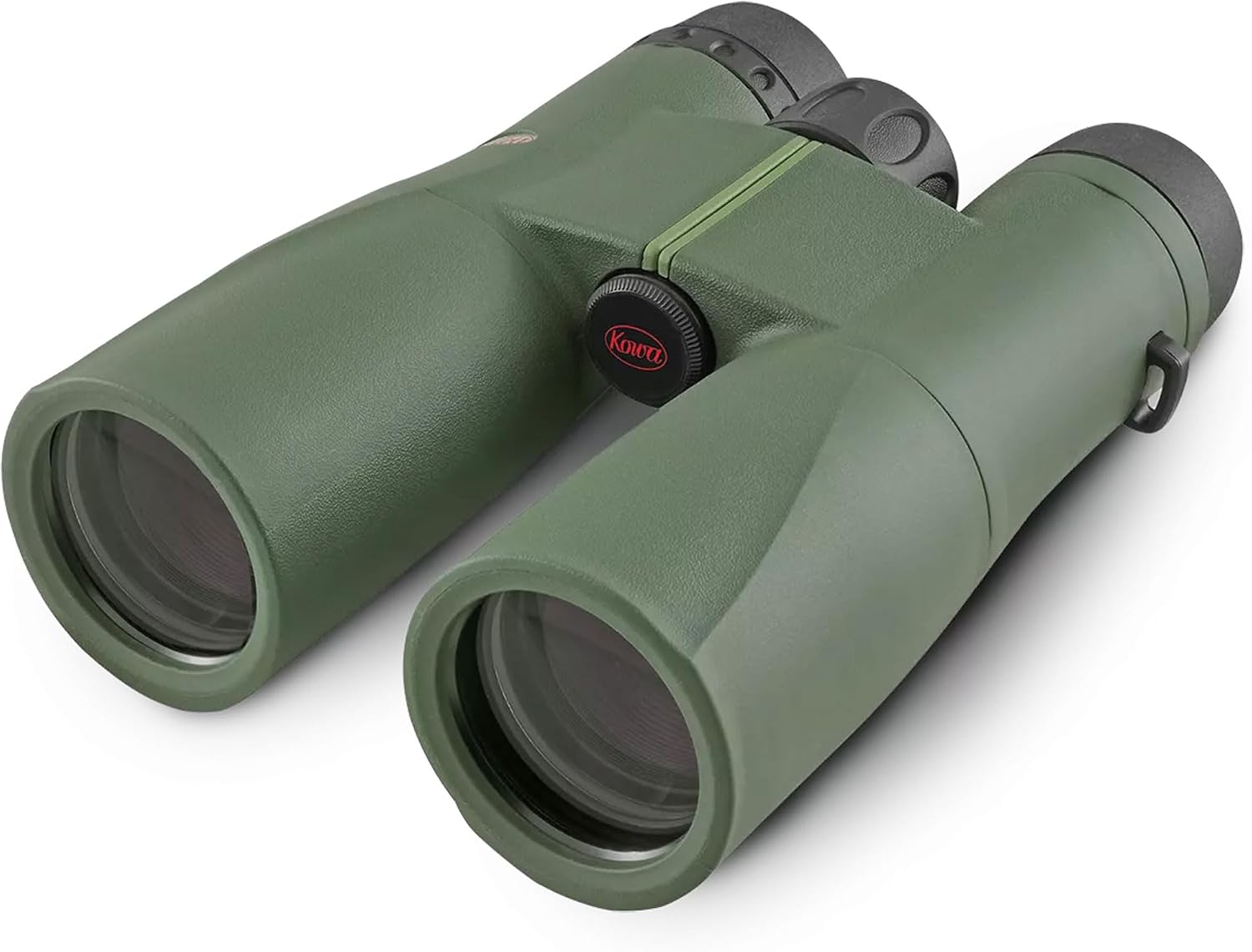
KOWA SV II 10x42 is a nitrogen-filled binocular with multi-coated lenses. Amazon lists it as a lightweight, compact model for bird watching and travel and includes lens caps, a strap, and a case. Its 10x42 configuration provides a concrete final candidate that still has to satisfy the same use, fit, carrying, and transaction checks described in the article.
Check on AmazonIf you click this link and buy, we earn a commission at no additional cost to you.
FAQs
First-time buyers often want one safe configuration or one budget that removes the need to think about fit. Those shortcuts are attractive, but the answer changes with distance, subject movement, glasses, stability, and carrying needs. The questions below focus on checks that can change a purchase decision. None requires the buyer to become an optics expert.
The practical goal is to know which facts must be verified and which preferences can stay flexible. One buyer may treat IPD and eye relief as fixed requirements, while another may prioritize compactness. Magnification and budget work the same way. Protect against the failure that would make the pair unusable first.
🔭 Is 10x too much for a first pair of binoculars?
Not automatically. Compare exact field of view, handheld stability, subject movement, and viewing duration. If 10x solves a real distance problem without creating unacceptable tradeoffs, it can be reasonable.
👓 Should I check eye relief if I wear glasses?
Yes. Published eye relief is a starting point, but eyecup design, glasses, and face geometry affect usable access to the field. Try the exact model when possible or make sure the return path is practical.
📏 Why does IPD matter before I buy?
The binoculars must adjust far enough for both barrels to align with your eyes. Check the manufacturer’s IPD range when it is published. A model outside your required range is a fit rejection, not a setup problem.
🎒 Are compact binoculars a bad first choice?
No. They can be an excellent choice when portability is non-negotiable and the viewing conditions suit the smaller body. Verify eye relief, IPD, field, and handling so pocket size is not the only reason for buying.
🔎 Is 8×42 always the safest beginner configuration?
No. It is a common starting format, but exact models still differ in field, eye relief, IPD, weight, focus behavior, and ergonomics. Use the configuration to narrow the search, then verify the model.
💵 Should I decide my maximum budget before comparing specifications?
Set a spending boundary, but define the non-negotiable requirements first. If the budget excludes every model that meets a critical requirement, change a secondary preference rather than buying a pair that fails the viewing job.
References and Sources
These sources are included because the article uses both recurring first-buyer mistake patterns and exact model specifications. The beginner guide supports the recurring problems around magnification, objective size, eye relief, and feature-driven shopping. Manufacturer pages provide field, eye relief, IPD, weight, zoom, and support details. None is used to claim that one configuration is universally best.
The model specifications are examples of why exact verification matters, not product recommendations. Do not copy a value to another variant because the name looks similar. Return and warranty terms can also differ by product type and seller relationship. Verify the exact listing and manufacturer documentation before checkout.
- Apresys beginner buying guide: supports recurring first-buyer mistakes involving magnification, objective size, eye relief, weight, and feature-driven shopping.
- Nikon ACULON A211 10 to 22×50 specifications: verifies the zoom range, field of view, eye relief, and weight used in the zoom example.
- Leupold BX-4 Pro Guide HD Gen 2 8×42 specifications: verifies field of view, eye relief, weight, and IPD for the 8×42 example.
- Leupold BX-4 Pro Guide HD Gen 2 10×42 specifications: provides the corresponding 10×42 specifications for the same-family comparison.
- Leupold binocular support: verifies the manufacturer’s binocular guarantee and service path used in the transaction example.