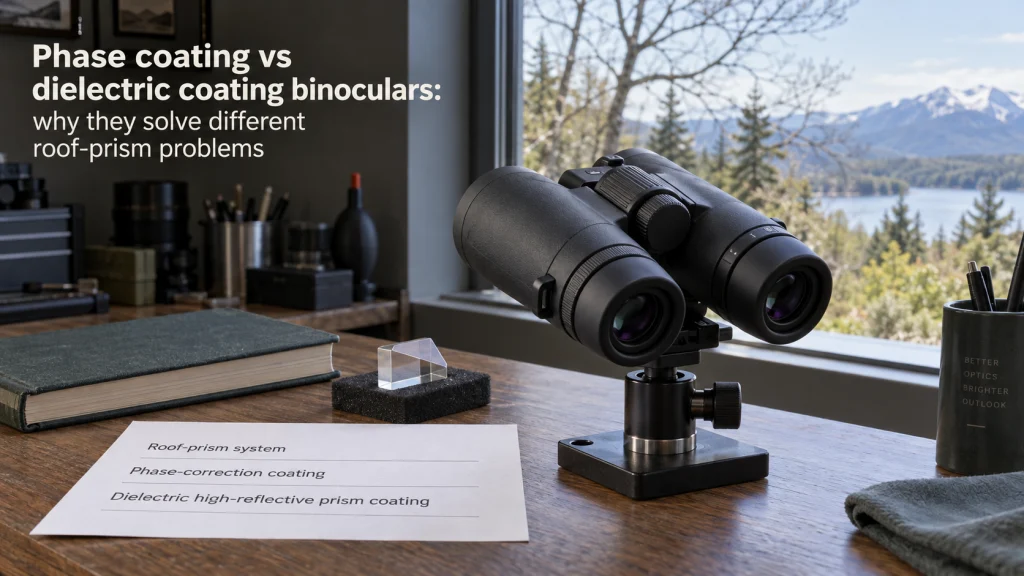
Phase correction and dielectric high-reflective prism coatings solve different optical problems inside roof-prism binoculars. Phase correction is concerned with phase shift at the roof surfaces and its effect on resolution and contrast, while a dielectric mirror coating is used to preserve reflectivity where a prism design needs a mirrored surface. A binocular can legitimately list both because the two treatments can work at different surfaces for different reasons. The useful buying question is therefore not which coating is better, but which prism architecture is being used and which optical loss each specification is meant to address.
Two prism-coating labels are not two rungs on one ladder
A roof-prism specification can list phase correction and dielectric high-reflective coating on the same binocular, which immediately tells you they are not interchangeable labels for one upgrade. Nikon, for example, lists both treatments on current roof-prism models, with phase correction tied to resolution and dielectric high-reflective coating tied to prism reflectivity. That distinction matters more than trying to decide whether phase coating or dielectric coating is the more premium phrase. Before ranking either term, place it within the broader question of what actually determines binocular optical quality.
The same discipline applies when a shortlist is full of ED, coating, prism-glass, and transmission claims. A buyer gets a cleaner answer by separating the optical problem, the part of the system involved, and the evidence a specification really provides. The binocular specifications that matter in actual use include field of view, eye relief, weight, and fit alongside optical treatments, so a coating label should never become a stand-alone verdict. Once that frame is clear, phase and dielectric coatings become much easier to read without turning the spec sheet into a ranking game.

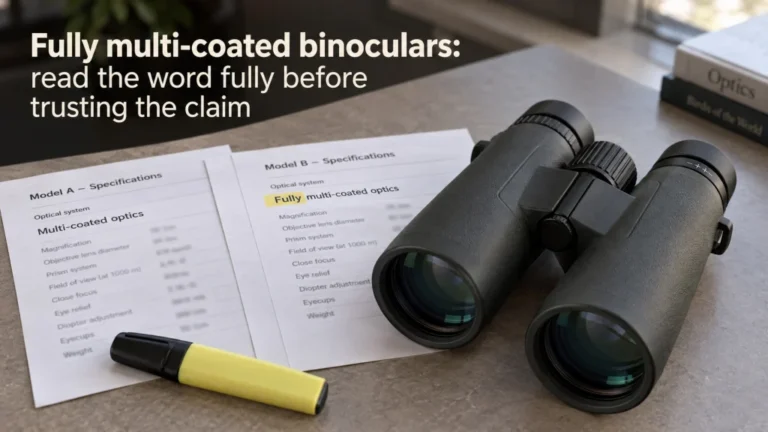
Regal ED pairs 8x42 roof-prism optics with ED objective glass and fully multi-coated lenses. Its BaK-4 prisms use both phase and dielectric coatings, separating phase correction from high-reflective prism treatment in one model. A 420-foot field of view at 1,000 yards and 22.5 mm eye relief add practical comparison points beyond coating labels.
Check on AmazonIf you click this link and buy, we earn a commission at no additional cost to you.
Start with where each coating sits in the roof-prism system
Roof prisms fold the optical path into a straight, compact binocular body, but the light does not encounter every prism surface in the same way. Some surfaces rely on total internal reflection, while certain roof-prism architectures include a surface that cannot rely on total internal reflection and therefore needs a reflective treatment. Separately, the roof geometry itself can introduce a phase difference between portions of the wavefront before those portions recombine. That means reflectivity loss and phase shift begin as different problems before any coating is added.
For a buyer, the easiest mental model is to track the job rather than the marketing adjective. Phase correction belongs to the roof-surface phase problem, while a dielectric high-reflective mirror coating belongs to a surface that needs stronger reflection. The word dielectric can make this confusing because dielectric materials can also be used in phase-correction coating designs, but consumer binocular specifications usually use dielectric coating as shorthand for the high-reflective prism mirror treatment. Reading the full wording around the label is therefore more useful than assuming every appearance of the word dielectric means the same optical function.

PROSTAFF P7 uses 10x42 roof-prism optics with multilayer-coated lenses and prisms. Nikon specifies both dielectric high-reflective multilayer prism coating and phase-correction coating, so each treatment can be evaluated by its separate optical job. The 10x42 version also combines a wide apparent field of view with long eye relief and waterproof construction.
Check on AmazonIf you click this link and buy, we earn a commission at no additional cost to you.
The phase-shift problem is about preserving detail and contrast
At a roof surface, the light path is split and reflected in a way that can leave the recombined wavefront out of phase. That mismatch does not need a dirty lens, a defective prism, or poor focus to exist because it comes from the roof-prism geometry itself. Optical references describe the result as a loss of resolution and contrast in the affected direction. Phase-correction coating is designed to compensate for that phase difference so the recombined light preserves more of the detail the optical system can otherwise deliver.
This is why phase correction should not be described as a brightness coating or as a cure for chromatic aberration. It is also why a phase-coated specification cannot tell you, by itself, that one binocular will look sharper than every unlisted alternative, since objective design, eyepiece design, manufacturing tolerances, focus behavior, and other coatings still matter. The specification does tell you that the manufacturer has addressed a known roof-prism phase issue. For a buyer comparing conventional roof-prism models, that is a meaningful piece of evidence, but it is still one piece of the complete optical system.

MONARCH M5 8x42 uses roof prisms with phase coating for resolution and dielectric coating for high reflectivity. ED glass is also included to control chromatic aberration, which is a separate optical issue from roof-prism phase shift. Its 335-foot field of view at 1,000 yards and 19.5 mm eye relief provide additional real-use specifications to weigh.
Check on AmazonIf you click this link and buy, we earn a commission at no additional cost to you.
Separate the coating effect from the final buying judgment
A useful shortlist check is to ask whether a specification is describing phase control, mirror reflectivity, lens reflection control, or chromatic-aberration control. Those outcomes can influence the final view in ways that overlap perceptually, especially when a buyer uses broad words such as brighter, clearer, or sharper. The underlying mechanisms are still different, so one label should not be used as a substitute for another. This keeps a feature list from becoming a false quality ladder.
The practical consequence is that the coating label should trigger a verification step rather than an automatic upgrade decision. Confirm the prism architecture, read the exact wording of the coating claim, and then return to the viewing conditions that matter to you. A daytime user tracking movement may care more about field of view and focus behavior than a small transmission difference, while a long low-light session can make optical efficiency more relevant. The coating earns weight in the decision only when its optical job matches a real limitation in the shortlist.
The reflective-surface problem is different from the phase problem
Some roof-prism systems include a surface that does not achieve total internal reflection, so that surface needs a mirror coating to keep more light moving through the prism. Traditional metallic coatings such as aluminum or silver can perform that job, while dielectric high-reflective multilayer coatings use interference effects to achieve very high reflectivity across the visible range. Nikon describes its dielectric high-reflective prism coating in exactly this reflectivity context. The important point is that this treatment addresses a mirror surface, not the phase mismatch created by the roof geometry.
Resolution and contrast are not the same specification as reflectivity
Phase correction is commonly discussed in relation to resolution and contrast because it works on phase coherence at the roof surfaces. Dielectric high-reflective mirror coating is commonly discussed in relation to reflectivity, transmission through that prism stage, and color consistency across the visible spectrum. Those effects can contribute to a better-looking image together, but a buyer should not collapse them into one brightness score. A specification that gives a very high reflectance value for a coated mirror surface is not reporting the transmission of the complete binocular.
Porro prisms do not create the same roof-edge phase problem
Porro-prism binoculars erect the image without the same roof edge that splits and recombines the wavefront in a roof-prism system. For that reason, they do not require the phase-correction treatment used to address roof-prism phase shift. This does not mean a Porro binocular is automatically optically superior, because lens design, coatings, alignment, eyepieces, build quality, and fit still determine the final experience. It simply means phase correction is not a meaningful box to demand when the prism architecture does not create that particular problem.

Diamondback HD 8x42 combines an HD optical system with fully multi-coated lenses, dielectric prism coatings, and phase correction. Vortex lists a 393-foot field of view at 1,000 yards and 17 mm of eye relief, giving useful handling and viewing metrics beyond the coating list. The argon-purged waterproof and fogproof body also shows why the final judgment should consider the complete binocular.
Check on AmazonIf you click this link and buy, we earn a commission at no additional cost to you.
Not every roof-prism design needs the same dielectric mirror treatment
The most important architecture distinction here is between roof-prism systems that require a mirrored surface and those that can keep the necessary reflections internal. The compact Schmidt-Pechan system includes a surface that requires a mirror coating, so the quality of that reflective treatment is directly relevant. An Abbe-Koenig system can use total internal reflection through its prism path and therefore does not need the same mirror coating to solve that particular loss. Both are roof-prism architectures, but their mirror-coating requirements are not identical.
This is the point at which a simple rule such as dielectric is always required becomes unreliable. If a specification omits dielectric mirror coating, first identify the prism architecture before treating the omission as a defect. A roof binocular can still need phase correction because roof-surface phase behavior is a separate issue, while its mirror requirement depends on the actual light path. Architecture comes first, and only then does the coating list become meaningful.

Cometron uses a 7x50 Porro-prism design rather than a roof-prism layout. Celestron specifies BK7 prism glass, multi-coated optics, and no prism coating for this model, making it a useful architecture contrast to phase-corrected roof binoculars. Its 50 mm objectives and 7.1 mm exit pupil are aimed at strong light gathering for nighttime and low-light viewing.
Check on AmazonIf you click this link and buy, we earn a commission at no additional cost to you.
Silver and aluminum belong to the mirror-coating question, not the phase question
Aluminum, silver, and dielectric high-reflective coatings can all appear in discussions of prism mirror surfaces because they are alternative ways to raise reflectivity where a mirror is required. They should not be placed in the same category as phase correction simply because all of them may be described as prism coatings. A buyer comparing two Schmidt-Pechan designs can reasonably ask what reflective treatment each uses, since that surface is part of the optical path. That is a narrower and more useful question than asking which binocular has the most premium coating vocabulary.
There is also no need to turn this distinction into a catalog of coating recipes. A current specification may not disclose every layer, material, or wavelength response, and those omissions do not justify guessing. The useful evidence is the documented function: a mirror treatment raises reflectivity where the prism needs a mirror, while phase correction addresses phase shift at the roof surfaces. Once those functions are separated, aluminum and silver can be understood as mirror-coating context rather than as missing versions of phase correction.

PROSTAFF P3 8x42 uses a high-reflectivity silver-alloy mirror coating on the prism mirror surfaces. Nikon also specifies multilayer-coated lenses, keeping the mirror treatment distinct from general lens coatings. The 8x42 roof-prism format is waterproof and nitrogen filled, providing a practical example of metallic mirror coating in a current binocular.
Check on AmazonIf you click this link and buy, we earn a commission at no additional cost to you.
Use a same-model coating list as two separate verification checks
A current Nikon PROSTAFF P7 roof-prism specification is useful here because it lists dielectric high-reflective multilayer prism coating and phase-correction-coated roof prisms on the same model. Read those entries as two completed checks rather than as duplicate praise: one tells you about the required mirror treatment, while the other tells you that the roof-prism phase effect has been addressed. That distinction makes a feature list more useful because each label can be tied to a specific optical job. It also gives you a cleaner way to compare a second model whose specification names only one of the two treatments.
After those two checks, stop using the coating list as a proxy for the whole binocular. Nikon notes that brightness and contrast depend on the complete optical system, so objective and eyepiece design, anti-reflection treatments, field of view, focus behavior, and physical fit still belong in the comparison. If a competing model omits one coating term, verify its prism architecture and documentation before treating the omission as a weakness. The useful question is no longer how many premium labels appear on the page, but whether the specification addresses the optical problems that architecture actually creates.
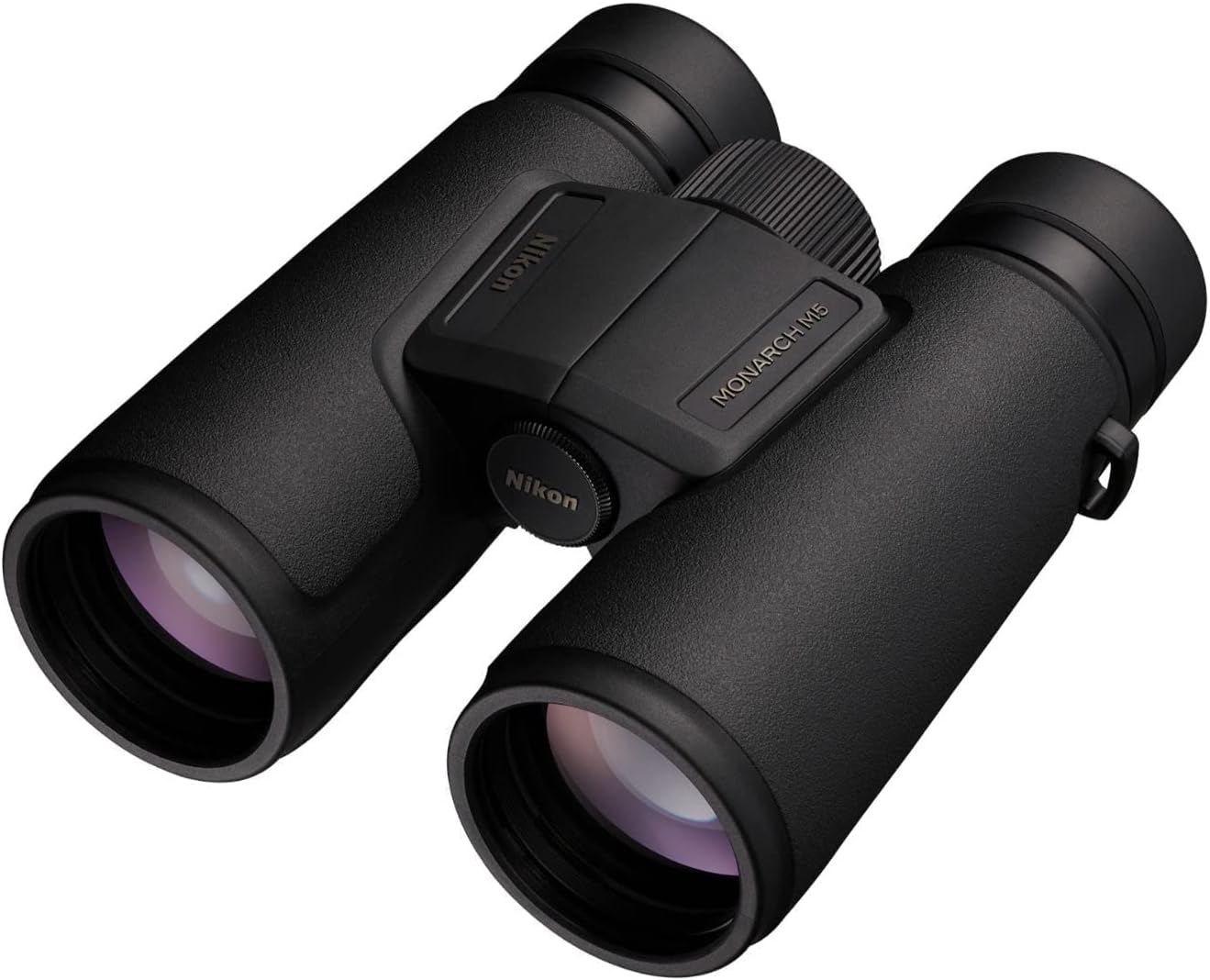
MONARCH M5 10x42 explicitly lists both phase coating and dielectric coating on its roof-prism system. It also uses ED glass, showing that chromatic-aberration control can coexist with two separate prism treatments. Nikon specifies a 293-foot field of view at 1,000 yards, 18.4 mm eye relief, and waterproof and fogproof construction.
Check on AmazonIf you click this link and buy, we earn a commission at no additional cost to you.
ED glass and prism coatings answer different shortlist questions
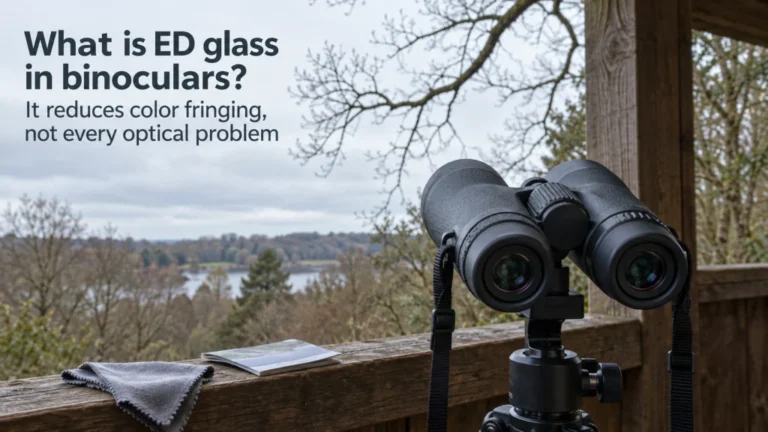
ED glass belongs mainly to control of chromatic aberration in the objective system, so it should not be used as a substitute for phase correction or dielectric mirror coating. A buyer who sees one model emphasizing ED glass and another emphasizing prism treatments is therefore comparing different optical interventions. The right next question is what visible limitation matters in the intended use, not which acronym sounds more advanced. Color fringing, phase-related contrast loss, and reflective loss are separate problems even though all can affect perceived image quality.
This is also where a simple feature-counting approach breaks down. A binocular with ED glass can still need appropriate roof-prism treatment, and a well-treated roof prism does not automatically correct chromatic aberration in the objectives. When exact model documentation is incomplete, do not infer that an unlisted feature is present or absent just because the price or market position suggests it should be. Verify the specification you can document, then weigh field of view, eye relief, weight, focusing, and fit before paying for a feature whose benefit may not address your actual viewing constraint.
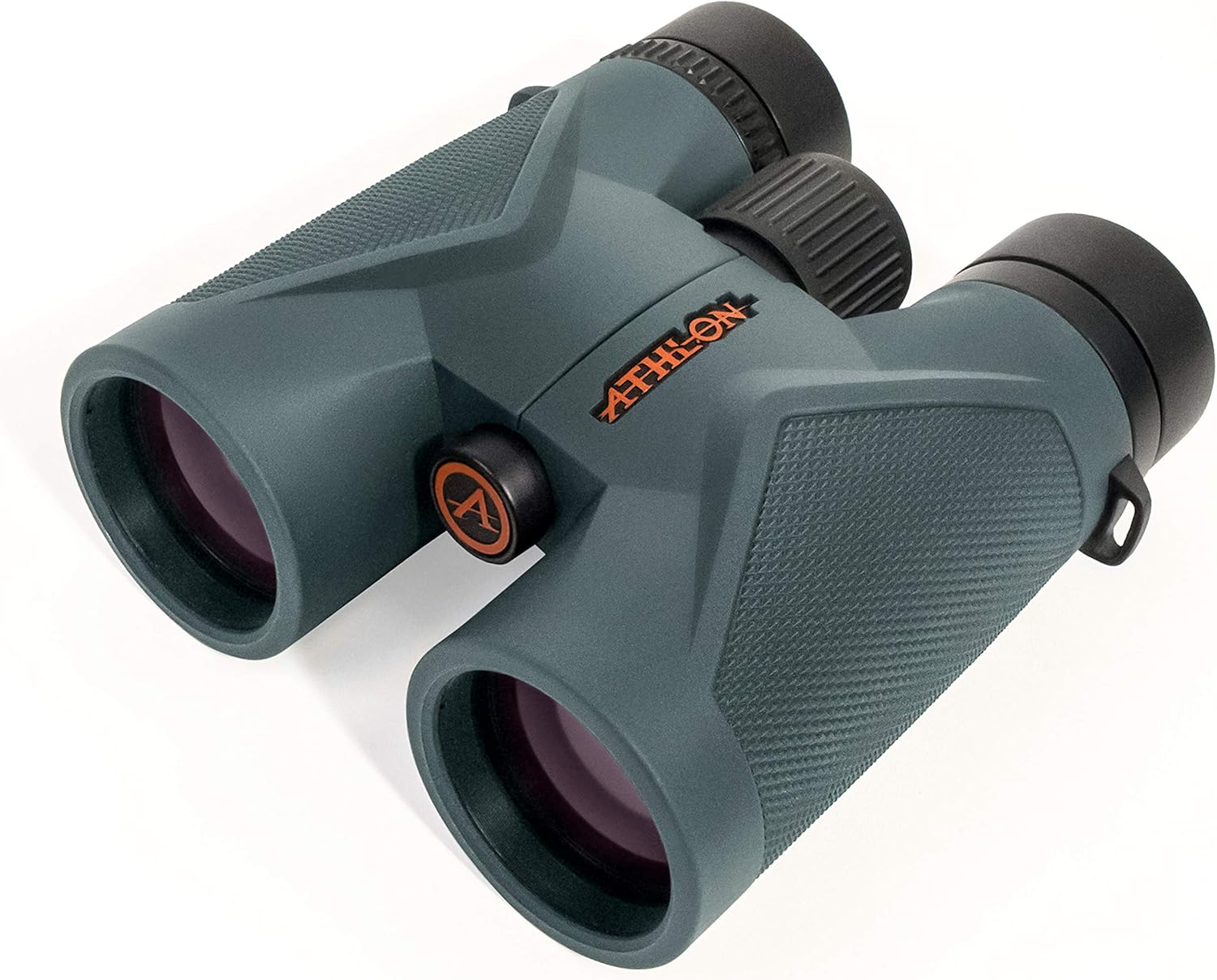
Midas UHD 8x42 combines extra-low-dispersion UHD glass with BaK4 roof prisms. Athlon separately specifies ESP dielectric coating and phase-corrected prisms, so ED glass, reflectivity treatment, and phase correction can be compared without collapsing them into one feature. The model provides a 426-foot field of view at 1,000 yards, 17.2 mm eye relief, and waterproof argon-purged construction.
Check on AmazonIf you click this link and buy, we earn a commission at no additional cost to you.
Sometimes the real question is prism glass, architecture, or low-light use instead
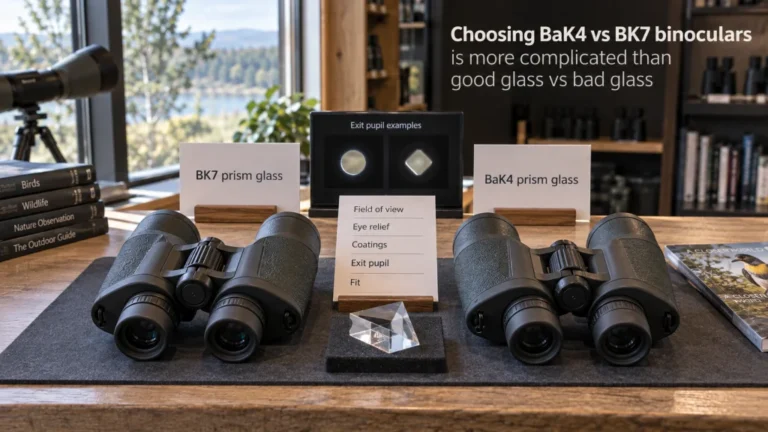
Coating language can become a distraction when the shortlist is actually being driven by a different question. If the concern is prism material, for example, move that decision to the documented differences in BAK4 vs BK7 binocular prism glass rather than asking a coating label to answer it. If the concern is body shape and handling, the larger roof-versus-Porro architecture decision matters more than a single coating term. If the concern is low-light viewing, objective size, exit pupil, transmission across the complete optical system, and the user’s own pupil and viewing conditions all matter together.
That broader check prevents a specification from being asked to prove more than it can. Dielectric mirror reflectivity is not whole-binocular transmission, phase correction is not a chromatic-aberration fix, and prism glass type is not a complete image-quality score. A disciplined shortlist keeps each claim attached to the problem it actually addresses. When a seller or manufacturer uses broad words such as premium, high definition, or high transmission without enough detail, the safest response is to narrow the claim rather than fill in the missing engineering yourself.
- Check the prism architecture before judging whether a mirror coating is required.
- Look for explicit phase-correction wording when comparing conventional roof-prism designs.
- Do not convert mirror-surface reflectance into an assumed whole-binocular transmission number.
- Keep ED glass, prism glass type, lens anti-reflection coatings, and prism coatings in their own optical roles.
- Return to field of view, eye relief, weight, focus behavior, and fit before making the final choice.
Used this way, the specification becomes a troubleshooting map for the optical design rather than a scoreboard. That is a much better basis for deciding whether a feature matters to the viewing situation in front of you.

Outland X 8x42 uses a roof-prism design with BaK-4 prism glass and multi-coated optics. Celestron lists no prism coating for this model, which makes prism material and architecture useful checks before treating one missing coating label as a complete quality verdict. The binocular is waterproof, nitrogen filled, and tripod adaptable for general outdoor observation.
Check on AmazonIf you click this link and buy, we earn a commission at no additional cost to you.
Final Thoughts: identify the optical problem before ranking the coating
Phase correction and dielectric high-reflective prism coating are easier to compare once you stop asking which one is better. Phase correction addresses phase shift associated with roof-prism geometry, while dielectric high-reflective coating addresses mirror-surface reflectivity where the prism design requires that mirror. A binocular can use both because those are separate jobs, and a roof-prism architecture that does not need the same mirror treatment can still have its own phase-correction requirement. Read the prism design first, then read the coating label in the context of the problem it is actually solving.
After that, return to the complete binocular rather than letting one optical term decide the purchase. Field of view, eye relief, weight, focus behavior, objective and eyepiece design, weather protection, and physical fit can matter more to daily use than a feature that solves a problem you were not experiencing. If the documentation does not identify the prism architecture or coating function clearly, treat that as an evidence limit instead of guessing. The best shortlist is the one in which every premium term has a defined job and a reason to matter for the way you actually observe.

Triumph HD 10x42 uses an HD optical system and fully multi-coated lenses in a roof-prism body. Its 334-foot field of view at 1,000 yards, 17 mm eye relief, adjustable eyecups, and center focus add practical factors beyond any single optical label. Nitrogen purging, waterproofing, fogproofing, shock resistance, and tripod adaptability round out the complete-use picture.
Check on AmazonIf you click this link and buy, we earn a commission at no additional cost to you.
FAQs
🔍 Is dielectric coating better than phase coating on binoculars?
They are not direct alternatives. Phase correction addresses roof-prism phase shift, while a dielectric high-reflective mirror coating addresses reflectivity on a surface that needs a mirror. Check the prism architecture and the function named in the specification before trying to rank them.
🧭 Can the same roof-prism binocular have both coatings?
Yes. Current roof-prism specifications can list both because the coatings perform different jobs at different parts of the prism system. Their coexistence is one of the clearest reasons not to treat them as two grades of one coating.
🌈 Does phase correction reduce chromatic aberration?
No. Phase correction is used to address phase shift in a roof-prism system, while chromatic aberration is a different optical problem associated with how different wavelengths are focused. ED glass is one tool designers may use for chromatic-aberration control.
💡 Does 99 percent prism reflectivity mean 99 percent binocular transmission?
No. A reflectivity figure for one coated prism surface describes that surface, not the transmission of the entire binocular. The complete result also depends on lenses, other prism surfaces, coatings, glass, and the rest of the optical design.
🔭 Do Porro-prism binoculars need phase-correction coating?
Not for the roof-prism phase problem discussed here. Porro prisms do not use the same roof edge that creates the phase-shift issue, so requiring a phase-correction label on a Porro model would be the wrong checklist item.
🧪 Should I choose ED glass or phase correction first?
Do not treat them as interchangeable upgrades. ED glass is mainly relevant to chromatic-aberration control, while phase correction addresses a roof-prism phase issue. Verify what each exact model includes, then decide which documented limitation matters in your viewing conditions.
References and Sources
- Nikon roof-prism coating technology: Separately explains dielectric high-reflective prism coating and phase-correction coating, including their different optical functions.
- Nikon PROSTAFF P7 8×42 and 10×42 specifications: Provides a current same-model example that lists both dielectric high-reflective multilayer prism coating and phase-corrected roof prisms.
- Edmund Optics phase-correction coating note: Explains the phase-shift mechanism in roof-prism geometry and how phase-correction coatings address it.
- ZEISS overview of roof-prism systems: Explains phase correction and notes that Schmidt-Pechan prisms require a mirror coating on one surface.
- Sky & Telescope on phase correction: Supports the distinction between roof-prism phase behavior and Porro-prism geometry.