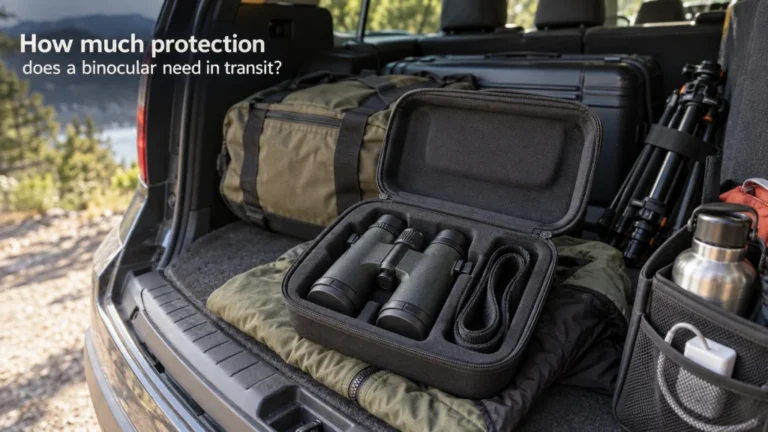
A binocular hard case is worth the extra bulk when the binocular faces real crush pressure, repeated impacts, or transport conditions that a soft pouch cannot control well. The shell matters, but interior fit matters just as much because a binocular that can slide, bounce, or press against the case walls is still poorly protected. A useful choice starts with the actual binocular dimensions, the space taken by its strap and caps, and the way padding or foam controls movement. Waterproofing is a separate claim that should be verified from the exact case specification rather than assumed from a rigid exterior.
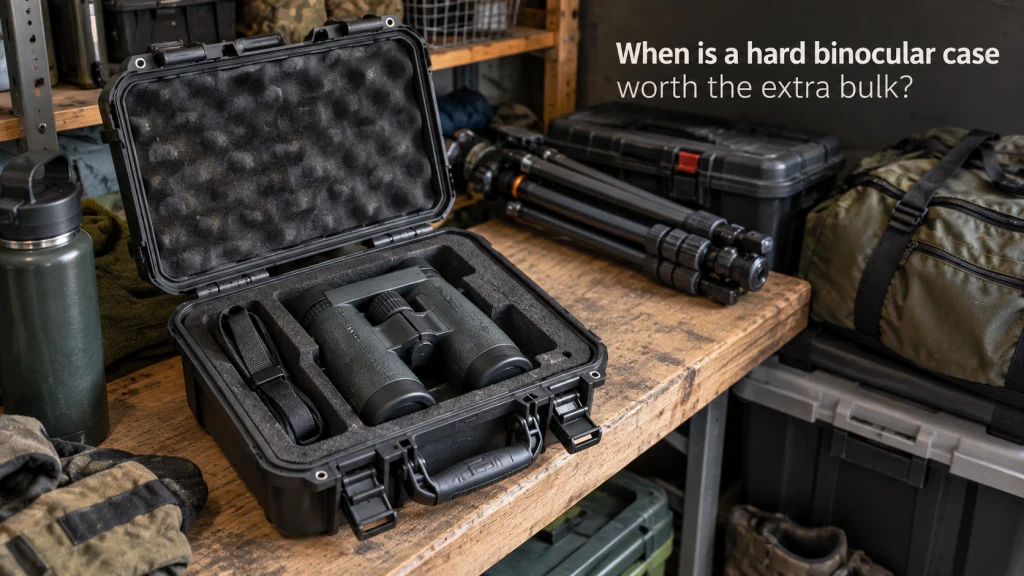
A hard shell only earns its bulk when it solves a real protection problem
A binocular hard case makes sense when the risk is more serious than ordinary scuffs or light bumps, but the first question is not how tough the outside looks. The first question is whether the binocular can be held securely inside without unwanted movement, pressure on the focus wheel, or hard contact around the eyepieces and objective ends. That makes case fit a protection issue, not a cosmetic preference. A rigid shell around a loose binocular can still turn every jolt into a smaller impact inside the box.
If you are still deciding which basic case style fits your use, start with the broader binocular case choices and trade-offs before moving to a rigid shell. If the case is only one part of a larger setup, the binocular accessory guide helps put protection beside straps, harnesses, adapters, and cleaning gear. The useful dividing line is simple: choose more structure when the handling risk actually calls for it, not because a hard exterior automatically means better ownership. Once that need is clear, interior control becomes the next filter.

This CASEMATIX binocular case uses a molded EVA shell with shock-absorbing foam above and below the main compartment. A netted accessory pouch separates small items from the binocular area. The dedicated binocular layout pairs a structured outer case with interior restraint around the stored optics.
Check on AmazonIf you click this link and buy, we earn a commission at no additional cost to you.
Decide whether the protection problem really justifies a rigid shell
A rigid case is strongest when the threat comes from pressure that could deform a soft bag or from handling that repeatedly exposes the binocular to harder knocks. Think about where the case sits, what can be stacked against it, who handles it, and whether it shares space with dense objects that can shift. A soft case can be entirely sensible when the binocular is carried gently and remains under your control. The shell becomes easier to justify when you cannot reliably control the surrounding load.
This is also where the extra bulk stops being an abstract disadvantage and becomes part of the decision. A case that protects well but is so large that you routinely leave it behind is not solving the ownership problem you actually have. Community discussions around binocular cases repeatedly circle the same tension: owners want more protection without turning a compact optical instrument into luggage. The right threshold is therefore exposure, not anxiety about the binocular simply being expensive.
Crush exposure changes the value of a rigid wall
Crush risk appears when the case may sit under other gear, be squeezed in a tightly packed compartment, or be stored where a person or heavy object can press against it. A padded soft pouch can absorb a bump, but it cannot create the same load-spreading structure as a rigid wall. That does not mean every hard case has a tested crush rating. It means the structure can be useful when compression is the problem, while any specific crush-performance claim still needs evidence from the exact case.
Impact exposure is about repeated handling, not dramatic drop stories
Hard cases are also easier to justify when the binocular is moved frequently between vehicles, shelves, storage areas, or shared gear spaces where knocks are plausible. The important distinction is between ordinary contact and a documented protection rating. A manufacturer may describe a shell as impact resistant or pair it with shock-absorbing foam, but that does not create a universal drop threshold for every binocular inside. Avoid converting marketing language into an undocumented promise about what height or force the case can survive.
Frequent handled transport can make consistency more valuable than minimum size
Repeated loading and unloading creates many small opportunities for the binocular to be set down hard, pinched between other items, or shifted inside a container. In that situation, a rigid case can make handling more predictable because the outer shape does not collapse around the binocular. The benefit is less about making the optics indestructible and more about controlling the environment around them. If the binocular usually stays around your neck or in a lightly loaded day bag, that same structure may be unnecessary weight.

This rigid MEIJIA case includes customizable foam for shaping a protected equipment pocket. Its listed exterior dimensions are 10.62 by 9.68 by 6.87 inches, giving the enclosure substantial depth for padding. The all-weather waterproof hard-shell format is intended for equipment transport where a soft pouch would provide less structural protection.
Check on AmazonIf you click this link and buy, we earn a commission at no additional cost to you.
Fit the binocular to the usable interior instead of shopping by outside dimensions
Exterior measurements tell you how much room the case consumes, but they do not tell you whether the binocular fits safely inside. The usable interior can be smaller because of wall thickness, molded corners, zipper structure, lid padding, foam, dividers, or a built-in accessory pocket. One current dedicated binocular hard case, for example, publishes an interior of 8.5 by 8.75 by 3.25 inches and separately lists its exterior dimensions. That separation is exactly what you want to see because the internal numbers are the ones that govern fit.
Measure the binocular in the configuration you actually intend to store, not as a bare optical body if the strap, caps, or folded eyecups will remain attached. Width can change with interpupillary distance, and a neck strap can create a bulky pressure point if it is forced against an eyepiece or focus wheel. The goal is not to eliminate every millimeter of free space, because padding needs room to do its job without squeezing controls. For a step-by-step sizing approach, use the binocular case sizing checks before treating any published case capacity as a guarantee.
- Measure overall length with the eyecups and objective caps in the stored position.
- Measure the widest body dimension at the interpupillary setting you normally use.
- Measure the deepest point, including focus-wheel or hinge projections that can contact padding.
- Account for the neck strap, rain guard, tethered caps, and any small accessory you insist on keeping inside.
- Compare those measurements with the published usable interior, not only the case exterior.
A good fit check ends with a movement check, not with the binocular merely fitting under the lid. Close the case normally, move it gently through the orientations it will see in transport, and listen or feel for obvious shifting without deliberately shaking it. If the binocular slides enough to strike a wall or repeatedly loads one control, the interior still needs better restraint. If the lid must be forced shut, the case is too tight or the packing arrangement is wrong.

The Pelican 1200 provides a 9.31 by 7.13 by 4.12-inch interior and includes configurable Pick N Pluck foam. Those usable interior dimensions can be checked directly against the binocular in its stored configuration. The foam lets the cavity be shaped while retaining cushioning between the equipment and the rigid walls.
Check on AmazonIf you click this link and buy, we earn a commission at no additional cost to you.
Control movement with padding or foam that supports the body without crushing controls
Padding has two jobs: reduce direct contact with the shell and limit the distance the binocular can accelerate before it meets something firm. Convoluted foam, shaped foam, pluck foam, fitted liners, and padded dividers can all serve that purpose, but they do not work equally well in every geometry. One current binocular case design uses foam above and below the binocular, while customizable hard cases may use removable foam blocks to create a closer outline. The useful question is not which architecture sounds more technical, but whether it holds the binocular in a stable, repeatable position.
Support should land on broad, sturdy areas of the binocular body rather than concentrating pressure on eyecups, diopter rings, focus controls, or small cap attachments. A strap should be folded into its own space instead of packed into a hard knot against an ocular housing. Leave enough clearance that the lid closes without compressing the bridge or forcing the barrels inward. If a case needs aggressive foam pressure to stop movement, the interior size or shape may be wrong for that binocular.
Key point: The shell protects the space around the binocular. The liner controls what the binocular does inside that space. You need both parts to work together.
Customizable foam can be helpful when a universal case is slightly larger than the optical instrument, but it should be treated as a fit tool rather than permission to buy an oversized box. Remove only enough material to create a controlled pocket and keep a meaningful cushion between the binocular and every hard wall. A cavity that reaches close to the shell defeats much of the reason for using foam in the first place. After shaping the liner, repeat the gentle movement and closure checks before trusting the arrangement.
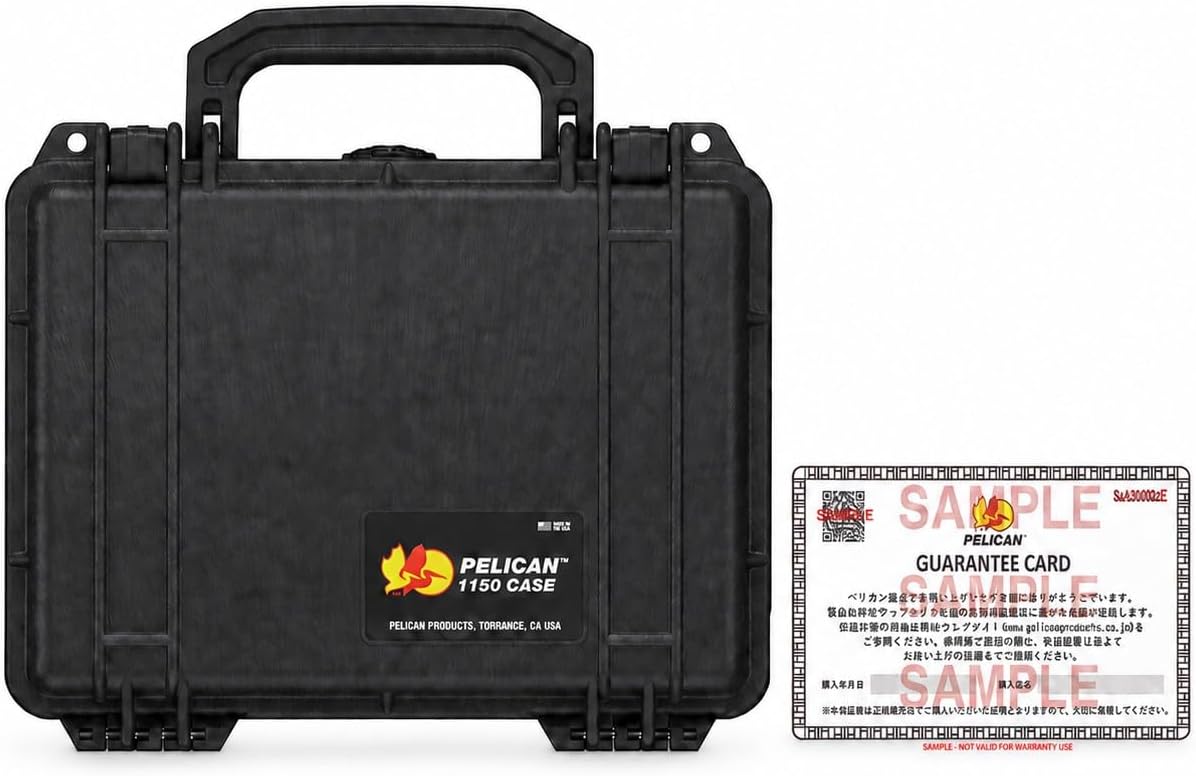
The Pelican 1150 uses Pick N Pluck foam with convoluted lid foam to build a fitted equipment pocket. Its interior measures 8.29 by 5.79 by 3.75 inches, so the foam can be shaped around smaller optical gear while preserving a protective buffer. An O-ring seal and automatic pressure equalization valve complete the rigid enclosure.
Check on AmazonIf you click this link and buy, we earn a commission at no additional cost to you.
Separate rigid construction from any claim about waterproofing or dust sealing
A hard exterior is visible, which makes it tempting to treat water resistance as part of the same package. It is not. A zippered EVA-style hard shell, a latched ABS case, and a gasketed protective case can all feel rigid while using very different closure systems. If water or fine dust protection matters, verify the exact seal design and any published ingress rating instead of inferring performance from shell stiffness.
Some protective case families publish an IP67 rating together with an O-ring seal and pressure-equalization hardware, which is useful because the claim is explicit and tied to a defined product line. Other binocular hard cases publish their material, latch style, padding, and dimensions without making that same ingress claim. Neither description should be silently upgraded into something it does not say. The deeper explanation in the waterproof binocular case guide is the better place to compare seal evidence if wet exposure is central to your use.
A waterproof binocular does not make case sealing irrelevant, and a waterproof case does not excuse putting a wet binocular away for long storage. Water on straps, caps, or the body can still create a damp closed environment even when the optics themselves are sealed. Dry the exterior according to the binocular maker’s care guidance before storage, and keep case interiors clean and dry. Protection from outside water and moisture management inside the case are separate ownership tasks.
Also resist vague labels that try to collapse many kinds of protection into one impressive phrase. A rigid shell can be useful without having a formal ingress rating, and an ingress rating does not tell you whether the interior fit is correct for your binocular. Treat each claim as one line of evidence, not as a substitute for the whole fit decision. That keeps the case choice grounded in what has actually been specified.

The Pelican 1300 has a published IP67 certificate, an O-ring seal, and pressure-equalization hardware. Its interior measures 9.17 by 6.99 by 6.15 inches and the foam version provides configurable cushioning. The explicit ingress rating makes its sealing claim verifiable instead of something inferred from a rigid shell.
Check on AmazonIf you click this link and buy, we earn a commission at no additional cost to you.
Compare model-specific and universal cases by how much fit work they leave to you
A model-specific case can reduce guesswork when its cavity was shaped around a known binocular or a tightly defined size family. That can be useful for controlling movement without much adjustment, but the fit still needs to account for accessories and the exact configuration you carry. A universal case gives you more flexibility, especially when foam or dividers can be configured around the instrument. The trade-off is that you become responsible for verifying dimensions and building the restraint system correctly.
Do not assume that a case labeled for 8×42 binoculars will fit every 8×42 body. Two binoculars can share magnification and objective diameter while differing in length, bridge shape, eyecup diameter, focus-wheel position, and folded width. The same warning applies to broad phrases such as fits most binoculars, which should be treated as a screening claim rather than a final fit verdict. Published internal dimensions are more useful than the optical configuration printed in a compatibility list.
A universal design starts to make more sense when you may change binoculars later, want to carry a few small accessories, or need one case architecture to serve different gear. A model-specific design starts to make more sense when compactness and predictable placement matter more than future flexibility. Neither option is automatically more protective because protection still depends on the shell, closure, liner, and actual fit. The best decision is the one that leaves the fewest unresolved fit assumptions for your real setup.
Be especially careful with accessory storage inside the same cavity. A cleaning tool, adapter, spare part, or strap buckle should not become a hard object that can strike the binocular when the case is moved. Use a separate pocket or isolated compartment when the case provides one, and keep hard accessories away from lenses and controls. A neat-looking layout is not enough if objects can migrate during transport.

USA Gear publishes a 4.75 by 3.25 by 2-inch interior for this compact binocular case. Its weather-resistant exterior, scratch-resistant lining, and accessory pocket are designed around compact binocular storage. The published dimensions make it useful for checking actual fit instead of relying only on a broad compatibility label.
Check on AmazonIf you click this link and buy, we earn a commission at no additional cost to you.
Count the bulk and weight cost before calling extra protection worthwhile
Rigid protection costs space before it costs anything else. The shell needs wall thickness, the padding needs clearance, and a handle or latch can make the packed shape less efficient than a soft pouch. A published case weight can also matter when the binocular itself is already substantial or when the case must be carried for long stretches. The right question is whether the added structure protects the binocular during the part of ownership where the real risk occurs.
If the hard case mainly rides in a vehicle, storage compartment, or other transport container, bulk may be a small penalty because it is not on your body for most of the day. If you expect to carry the case while actively observing, every extra inch and ounce competes with access, comfort, and the chance that you simply stop using the case. Protection that stays behind has limited value. That is why a rigid case often makes more sense for transport and storage than as the only field-carry solution.
| Case style | Where it tends to make sense | Main trade-off to check |
|---|---|---|
| Hard | Meaningful crush exposure, repeated handled transport, or storage around heavier gear | More bulk and weight, plus a stronger need to verify interior fit |
| Semi-rigid | Moderate bump protection when some structure is useful but full hard-shell bulk is not | Less resistance to external compression than a truly rigid wall |
| Soft padded | Controlled carrying, light bumps, dust protection, and fast access | Limited ability to resist crushing or hard surrounding loads |
The table is not a protection ranking because the best case changes with the handling environment. A soft or semi-rigid option can be the more rational choice when the binocular is never exposed to meaningful compression. A hard case earns its penalty when the surrounding conditions demand structure that padding alone cannot provide. Make the decision from the risk outward, not from the toughest-looking case inward.

This low-profile MEIJIA hard case uses customizable foam inside an 11.65 by 8.35 by 3.78-inch shell. The shallow format makes the protection footprint and carrying bulk easy to compare with deeper hard cases. Its waterproof protective construction is designed for compact equipment transport.
Check on AmazonIf you click this link and buy, we earn a commission at no additional cost to you.
Step down to padded or semi-rigid protection when the shell solves a problem you do not have
There is no ownership prize for carrying the bulkiest case. If your binocular moves from a shelf to your hands, rides in a lightly loaded day bag, or stays in a dedicated compartment where nothing heavy can press on it, a well-fitted padded case may already control the realistic risks. Semi-rigid designs add some structure without becoming a full equipment box. The practical win is often easier access and lower carrying burden rather than maximum theoretical protection.
This is where broader transport context matters more than shell construction alone. A case used for airline packing, vehicle transport, day hiking, and closet storage may face completely different stresses, so one case type does not have to own every role. The binocular travel case guide handles that broader transport decision without assuming a rigid shell is the default. If your main risk is simply scratching, dust, or light contact, stepping down can be the better fit.
Do not confuse stepping down with ignoring protection. Check that the softer case still covers the lenses, does not place hardware against the glass, closes without forcing controls, and keeps the binocular from falling out when carried normally. A soft case with good fit can be more useful than a large hard case with a loose interior. The case type should match the failure mode you are actually trying to prevent.
Likewise, do not treat price as a proxy for protection. Materials, closure, liner design, usable interior dimensions, and published ratings are more informative than a premium-looking finish. If a lower-bulk case meets the actual exposure, there is no need to pay a size and weight penalty for structure you will not use. The best protection system is one you can verify and will consistently carry.

The Vortex GlassPak weighs 8 ounces and measures 6.75 by 6.25 by 3.75 inches. Its adjustable harness straps and full-coverage lid keep binoculars close at hand without using a rigid equipment case. Two mesh side pockets and a zippered rear pocket provide separate storage for small accessories.
Check on AmazonIf you click this link and buy, we earn a commission at no additional cost to you.
Final Thoughts: choose hard-shell protection only when the risk justifies its bulk
A hard case is most convincing when you can name the threat it solves: external pressure, repeated rough handling, or a storage environment where softer protection can collapse. After that, fit is the deciding variable. Verify the binocular dimensions against the usable interior, make sure the liner limits movement, and keep pressure away from optical controls and lenses. If those checks fail, the shell alone does not rescue the case.
Waterproofing deserves its own verification, and so do any claims about impact or crush performance. When the exposure is modest, a padded or semi-rigid case can be easier to carry and entirely adequate. When the exposure is real, accept the extra bulk only after the interior layout is proven to work with your exact binocular. That keeps protection proportional to the risk instead of turning the case into unnecessary luggage.

This MEIJIA hard case combines an IP67-rated enclosure with customizable foam. Its listed exterior dimensions are 10.62 by 9.68 by 4.87 inches, providing a moderate-depth rigid transport option. The sealed hard-shell format suits situations where the protection benefit justifies more bulk than a soft binocular case.
Check on AmazonIf you click this link and buy, we earn a commission at no additional cost to you.
FAQs
🧳 Is a hard case better than a soft case for binoculars?
Not automatically. A hard case is more useful when external compression or repeated impact is a realistic risk, while a soft padded case can be better for controlled carrying and lower bulk. Fit inside the case still matters with either style.
📏 How much extra room should a binocular have inside a hard case?
Enough room for padding to isolate the binocular without forcing the lid shut, but not so much that the binocular can slide or strike the walls. Use the exact binocular dimensions and the published usable interior, then verify movement after packing.
🧩 Is pluck foam safe for storing binoculars?
It can work well when it creates a stable pocket with cushioning left between the binocular and the shell. Keep pressure off eyecups, focus controls, and lenses, and do not remove so much foam that the instrument sits close to a hard wall.
💧 Are all hard binocular cases waterproof?
No. Verify the exact closure, gasket design, and any published ingress rating for the specific case. A rigid or molded shell by itself does not prove waterproof performance.
🎒 Should the neck strap stay attached inside the case?
It can stay attached if the case has enough room to store it without pressing against eyepieces, focus controls, or the bridge. Fold it into a separate space or pocket when possible, and make sure hardware cannot strike the binocular during movement.
🔒 Is a model-specific hard case always safer than a universal one?
No. A model-specific cavity may reduce fit work, while a universal case can be equally useful when its dimensions and foam are configured correctly. Protection depends on actual restraint, shell construction, closure, and the exact binocular setup.
References and Sources
- Negrini binocular travel and storage case specifications: Supports the distinction between published interior dimensions, exterior dimensions, shell construction, latch type, padding, and case weight.
- CASEMATIX binocular hard-shell case specifications: Supports the discussion of molded EVA construction, top and bottom foam, and separate interior and exterior measurements.
- Pelican 1300 Protector case specifications: Supports the distinction between a rigid shell and an explicitly published IP67, O-ring-sealed waterproof and dustproof claim.