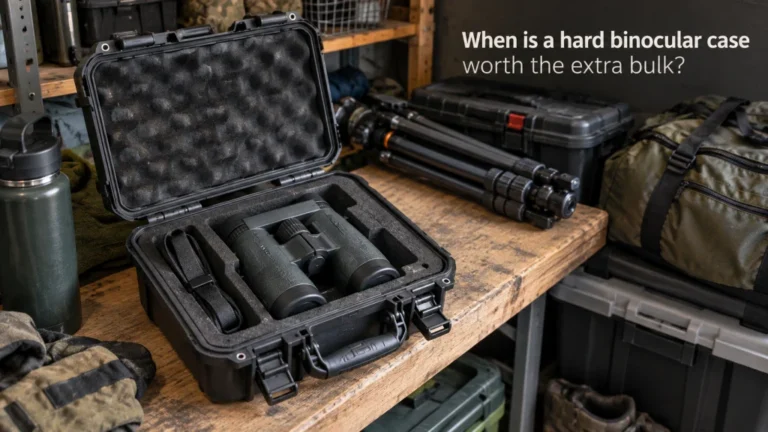
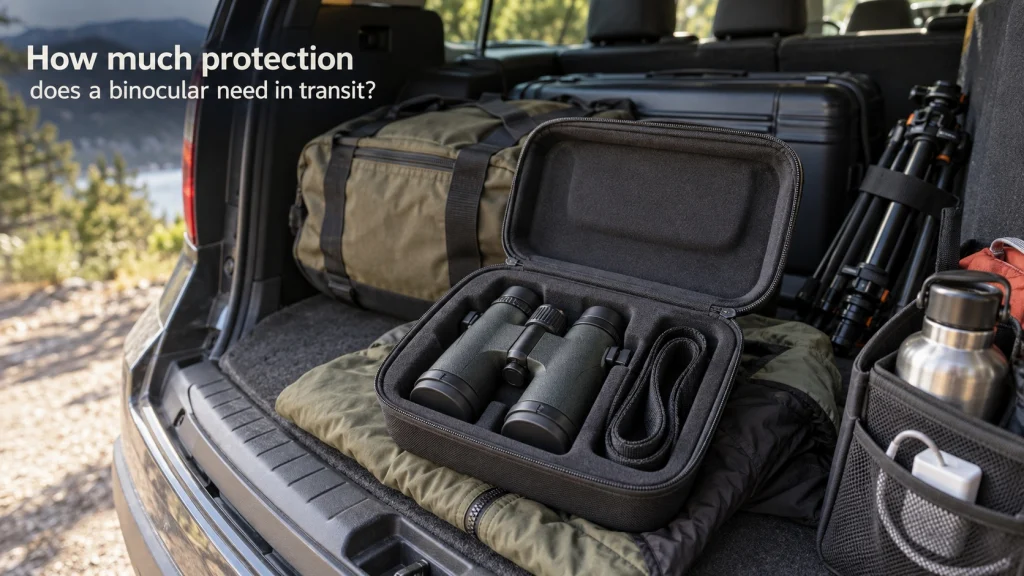
A travel case should protect binoculars from the risks they will actually face, not from every imaginable accident. Soft padding can be enough inside a controlled day bag, while tighter vehicle packing, repeated handling, or crush exposure can justify a more structured shell. The important checks are usable interior space, movement control, closure, exterior bulk, and any weather claim that matters to the trip. More protection is useful only when it solves a real transport risk without making the binoculars unnecessarily hard to carry.
Start with the transport environment before choosing the case
A binocular travel case only makes sense after you decide what is likely to happen around it. A pair riding in a lightly loaded day bag faces a different risk from one wedged between luggage in a vehicle, handled repeatedly during a long trip, or placed where other bags may press against it. That difference matters more than whether the case looks rugged on a product page. Start with impact, crush pressure, loose objects, space, and how often the case will be opened.
If the question is still broader than travel, use the binocular case guide to sort out case types before narrowing the decision to transport. It also helps to view a case as one part of the wider binocular accessories decision, because straps, lens covers, harnesses, and attached adapters can change how much interior room you need. A travel case for binoculars should protect the optical instrument without creating so much bulk that it stops fitting the way you actually carry it. The right starting point is therefore the environment, not the toughest shell you can find.

This hard-shell CASEMATIX binocular case uses an impact-absorbing foam interior to cushion optics during transport. Reinforced zippers secure the case, while a rubber travel handle provides a dedicated carry point. The included accessory bag gives small items a separate place instead of leaving them against the binocular body.
Check on AmazonIf you click this link and buy, we earn a commission at no additional cost to you.
Define the transit risk before choosing case construction
Think about what can physically reach the binoculars during transport. A soft garment beside the case is not the same hazard as a charger block, metal bottle, tripod head, or tightly packed stack of bags pressing from different directions. The useful distinction is not simply travel versus storage. It is low impact and low compression versus repeated bumps, concentrated pressure, and uncontrolled loading.
This is also where expensive optics can push buyers toward more protection than the situation really needs. Price can justify being cautious, but it does not change the shape of the transport risk. A hard shell that is too large for the bag can create a new problem by forcing the case into an awkward position or making the binoculars less likely to come along. Match the case to the expected abuse first, then decide how much margin you want beyond that.
Inside a day bag
A day bag usually favors compact protection because the binoculars share space with ordinary personal items and may be accessed often. If the bag is not tightly packed and the case sits away from hard objects, a padded soft case can be enough to prevent surface contact and soften routine bumps. The case should still keep lens caps, straps, and hard accessories from pressing directly into the binocular body. If the bag is habitually stuffed or dropped, move up in structure rather than assuming padding alone will solve the problem.
During vehicle transport
Vehicle transport changes the problem because bags can slide, tip, or become compressed by other equipment. A case that feels adequate when carried by hand may be less convincing when it is placed under another bag or beside hard gear that can shift. More structure can make sense here, especially when the binoculars stay packed for long periods or ride in a compartment where you cannot control every contact. The useful question is whether the case can keep its shape when something presses against it, not whether the outside merely feels thick.
With dedicated hand-carry
Dedicated hand-carry gives you more control over loading, orientation, and access, so the protection requirement can be lower than it would be inside handled luggage. The case still needs enough padding and structure to deal with routine bumps, door frames, seat edges, and brief placement on hard surfaces. Because you control the case directly, compactness and comfortable handling can matter more than maximum shell stiffness. Move toward a more rigid design only when the hand-carried case will also be stacked, squeezed into crowded storage, or exposed to other uncontrolled pressure.
With handled luggage or higher crush risk
When the binoculars will be inside luggage that other people handle or stack, crush resistance becomes more important than quick access. A structured shell can add a valuable barrier between the binoculars and pressure from neighboring contents, but only if the interior fit is correct. Extra empty space lets the binoculars accelerate before hitting the padding, while an overfilled case can transfer force through eyecups, focus controls, or attached hardware. Higher risk justifies more protection, but it also makes fit more important rather than less.
| Transport environment | Main risk to solve | Protection level to consider | What to verify |
|---|---|---|---|
| Lightly loaded day bag | Scuffs, minor bumps, contact with small items | Padded soft protection may be enough | Padding coverage, closure, and separation from hard objects |
| Tightly packed day bag | Compression plus repeated handling | More structured protection | Shell shape retention and usable interior clearance |
| Vehicle transport | Sliding, tipping, and pressure from nearby gear | Structured or rigid protection when loading is uncontrolled | Movement control, closure, and exterior bulk |
| Dedicated hand-carry | Routine bumps with more control over loading | Padded or structured protection based on crowding and pressure | Fit, closure, carry comfort, and unnecessary bulk |
| Handled luggage | Higher crush and impact exposure | Rigid protection is easier to justify | Interior fit, padding, closure security, and packing position |
The table is a starting point, not a rule that every trip must follow. A carefully packed vehicle can be gentler than an overfilled backpack, and a rigid case can still perform poorly if the binoculars are loose inside. Use the actual loading conditions to move up or down the protection ladder. Construction only becomes meaningful after the risk is defined.

The Pelican 1200 combines a rigid protective case with layered foam, including customizable Pick N Pluck foam in the base. Its documented interior dimensions let you compare usable case space against the packed binocular configuration. The foam layout supports movement control while the shell adds structure for higher-risk transit.
Check on AmazonIf you click this link and buy, we earn a commission at no additional cost to you.
Compare soft, semi-rigid, and hard protection by what each one controls
Soft cases mainly add padding, surface protection, and organization while preserving flexibility and low bulk. Semi-rigid designs add shape retention, so pressure from neighboring items is less likely to transfer directly to the binocular body. Hard cases go further by creating a shell that resists deformation more strongly, which is useful when crush exposure becomes credible. None of those categories is automatically superior because the penalty usually rises with structure, including size, weight, and slower access.
Current case designs show why labels alone are not enough. Manufacturers sell fabric cases with padded construction, molded EVA shells with foam interiors, and rigid ABS shells with latches and padded lining, all under the broad idea of protective binocular storage. That range is why I would treat the shell as one variable rather than the whole answer. If you already know you need stronger crush resistance, the separate binocular hard case guide is the better place to compare that specific architecture.
- Choose softer protection when space, access, and low weight matter more than resistance to outside pressure.
- Choose more structure when the case will be packed tightly or exposed to repeated compression from nearby gear.
- Choose rigid protection when meaningful crush risk exists and you can accept the extra bulk needed to create that barrier.
- Do not upgrade shell stiffness alone if the binoculars can still move freely inside the case.
The practical threshold is reached when the next level of structure addresses a risk that padding cannot control. If the only problem is light contact inside a calm day bag, a rigid box may be solving the wrong problem. If pressure from other luggage is realistic, extra structure can be justified quickly. The case should become tougher because the environment demands it, not because the word travel appears in the product name.

The Vortex GlassPak is a binocular harness with adjustable straps and storage space for small field items. Its pouch accommodates a range of full-size binoculars and is designed to keep them snug and secure. Mesh side pockets provide separate space for a lens pen and other small accessories.
Check on AmazonIf you click this link and buy, we earn a commission at no additional cost to you.
Fit the binoculars and attached accessories inside the usable interior
Exterior dimensions tell you whether a case fits the bag or storage space, but they do not tell you whether the binoculars fit safely inside. Usable interior dimensions can be smaller because shells, foam, lining, seams, hinges, and lid shapes all consume space. Current manufacturer listings make this distinction explicit by publishing different outside and inside measurements on some cases. That is why a case should be judged from the space the binoculars actually occupy, not from the overall footprint alone.
Measure the binoculars in the configuration you intend to transport. Include the strap if it stays attached, lens covers if they remain in place, and any adapter or accessory that will travel in the same compartment. Do not count on compressing eyecups, forcing a focus wheel against foam, or bending a strap buckle into the optical body just to make the lid close. For a more detailed measurement process, use the binocular case sizing guide before choosing a shell style.
- Check binocular length, width, and thickness in the packed configuration.
- Add room for padding rather than matching the instrument exactly to the bare interior.
- Confirm that protruding controls and eyecups are not carrying lid pressure.
- Separate hard accessories when they could strike or press into the binoculars.
- Close the case without forcing the shell, zipper, latch, or contents into tension.
A little clearance is useful, but excessive clearance creates its own problem because the binoculars can gain momentum inside the case. The goal is not a vacuum-tight fit. It is a supported fit that avoids pressure points while limiting movement. Once that balance is right, shell strength becomes much more useful.
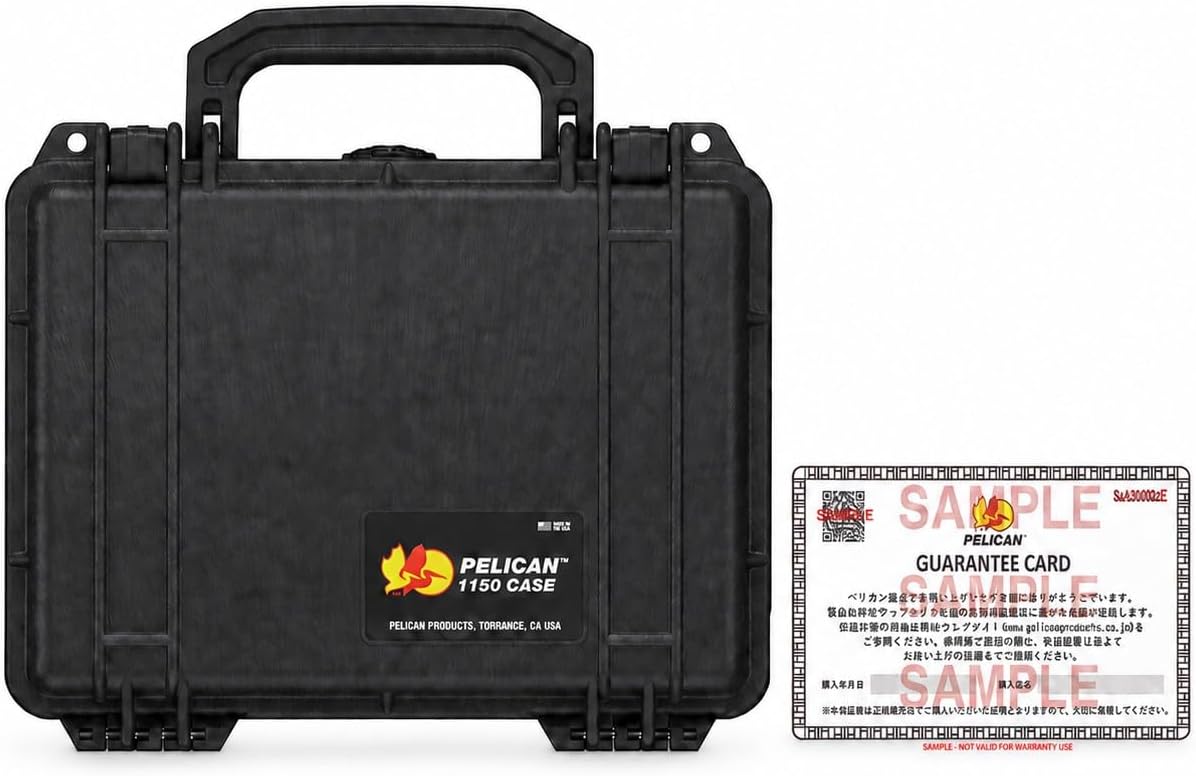
The Pelican 1150 is a watertight, crushproof, and dustproof hard case with customizable Pick N Pluck foam. Convoluted lid foam adds support above the packed equipment, while an O-ring seal helps keep water out. An automatic pressure equalization valve balances interior pressure while maintaining the sealed case design.
Check on AmazonIf you click this link and buy, we earn a commission at no additional cost to you.
Control movement instead of relying on shell toughness alone
A tough exterior cannot protect well if the binoculars are free to slide from one side of the case to the other. Internal movement turns a routine bump into a second impact when the instrument hits the case interior. Padding, shaped foam, dividers, or a close-fitting liner can reduce that movement, but the correct solution depends on the case design. The important test is whether the binoculars stay supported without concentrated pressure on delicate controls.
This is where a slightly less rigid case can sometimes outperform an oversized hard box for a specific packing setup. If the softer case keeps the binoculars centered and separated from hard objects while the rigid case leaves them loose, the shell label does not rescue the poor fit. Conversely, a well-fitted rigid case gives both movement control and crush resistance, which can be valuable in rougher transit. Judge the system as shell plus interior support plus closure, not as a single material choice.

The ITHWIU protective hard case pairs a rigid shell with a customizable DIY foam insert. The foam can be shaped around packed equipment to reduce unused space and limit free movement. Its shockproof and water-resistant construction adds another layer of protection around gear that fits the case.
Check on AmazonIf you click this link and buy, we earn a commission at no additional cost to you.
Compare exterior bulk and weight only after internal fit passes
Once the binoculars fit safely, compare what the case adds to the rest of the load. A rigid shell can take up much more room than the optical instrument itself, and that extra volume may matter more than a small difference in case weight. If the case forces you to move the binoculars into a larger bag, separates them from the gear you normally carry, or makes quick access awkward, the protection gain has a real cost. That cost may still be worth paying, but it should be intentional.
I would accept extra bulk when it buys protection against a risk I actually expect, such as compression from other luggage or uncontrolled loading. I would skip it when the binoculars already sit in a protected part of a day bag and the bigger case mostly duplicates protection provided by the bag itself. This is the point where buyers often overshoot because the hardest case feels safer in isolation. The better choice is the smallest case that provides the needed interior fit and the right level of structural protection.

The Etekcity EL11 is a digital hanging luggage scale with a hook and a 110-pound capacity. It lets you weigh the complete packed load after the binocular case has passed fit and protection checks. The silver version includes its battery, so the scale can travel with the rest of the packing kit.
Check on AmazonIf you click this link and buy, we earn a commission at no additional cost to you.
Verify weather and closure claims separately from impact protection
Impact protection, dust resistance, water resistance, and closure security are separate properties. A rigid shell may resist crushing without being intended for meaningful water exposure, while a zippered case may block ordinary debris without being sealed against rain. Do not infer a weather rating from the way a case looks or from words such as rugged, outdoor, or protective. If water exposure matters, verify the exact construction or documented claim for that case.
Closure design deserves the same separate check. A zipper, latch, buckle, or flap can be perfectly adequate for one transport environment and less reassuring in another, especially if the case may be squeezed or opened accidentally inside other luggage. Look for a closure that stays shut under the way you pack and carry the case, then judge weather protection on its own evidence. If water protection is a major requirement rather than a minor bonus, the waterproof binocular case guide covers that decision more directly.

The Pelican Storm iM2050 is a watertight hard case supplied with cubed foam for fitting protected equipment. A pressure valve manages pressure changes independently of the shell and closure. This combination makes it useful when weather protection and closure performance need to be checked separately from impact resistance.
Check on AmazonIf you click this link and buy, we earn a commission at no additional cost to you.
Keep destination rules and generic packing advice outside the binocular case decision
A binocular transport case does not prove that a bag meets carrier, venue, destination, or security rules. Those rules can depend on the trip, the operator, the location, and the exact baggage arrangement, so they should be checked separately when they matter. The case decision here is narrower: protect the binoculars from impact, pressure, movement, debris, and any weather exposure you can reasonably expect. Mixing those questions can lead to buying a case for a rule that the case itself cannot verify.
The same boundary applies to generic packing strategy. Keep heavy objects from pressing directly into the binocular case, position the case so it is not the main load-bearing object in the bag, and avoid packing hard loose items where they can strike the optics. Beyond that, destination-specific instructions belong to the relevant carrier or authority rather than a binocular case article. A good case is part of safe packing, not a substitute for checking the conditions of the trip.

The BAGSMART electronics travel organizer is a zippered pouch made for cords, cables, and other small tech accessories. Keeping those hard items in a separate organizer reduces the chance that they sit loose beside a binocular case. Its compact travel format supports organized packing without implying compliance with carrier or destination rules.
Check on AmazonIf you click this link and buy, we earn a commission at no additional cost to you.
Final Thoughts: match the case to the actual transit risk
Start with what can realistically hit, crush, press, or move around the binoculars, then choose the least bulky case that controls those risks. Soft protection can be enough in a controlled bag or dedicated hand-carry setup, while more structure makes sense as compression and uncontrolled handling increase. A rigid shell becomes easier to justify when the binoculars may be stacked under other luggage or exposed to stronger outside pressure. Protection should rise with the transport risk rather than with the travel label alone.
Once the protection level is clear, verify usable interior dimensions, movement control, closure, and any weather claim that matters. Make sure the binoculars are supported without pressure on eyecups, focus controls, straps, or attached hardware. Then compare exterior bulk and weight to the way you actually carry the case. The best choice is the case that fits the binoculars, controls the expected risks, and avoids protection you will pay for in space but never need.

The NANUK 909 is a hard protective case with customizable cubed foam and a lockable closure. Its waterproof, dustproof, and impact-resistant construction is aimed at trips where stronger environmental and transit protection is justified. The black case provides a compact rigid option when a softer case no longer matches the expected risk.
Check on AmazonIf you click this link and buy, we earn a commission at no additional cost to you.
Frequently asked questions
🎒 Is a soft case enough for binoculars in a backpack?
It can be if the bag is not tightly packed and hard objects cannot press or strike the binoculars. Move to a more structured case when compression, repeated dropping, or uncontrolled loading becomes realistic.
🧳 Do binoculars need a hard case for travel?
Not automatically. A hard case makes more sense when crush risk or rough handling is meaningfully higher than what a padded soft case can control.
📏 How much extra room should a binocular case have?
Enough for padding and attached items without forcing the lid closed, but not so much that the binoculars slide around freely. Check the packed configuration rather than the bare binocular body alone.
🧱 Is the hardest case always the safest choice?
No. A hard shell can add crush resistance, but poor interior fit can still let the binoculars move or create pressure points, and unnecessary bulk can make the case harder to carry.
🌧️ Does a hard shell mean the case is waterproof?
No. Shell stiffness and water protection are separate properties, so verify the exact weather claim and closure design rather than inferring it from appearance.
🔒 What matters more, the shell or the closure?
Both matter for different reasons. The shell controls deformation and outside contact, while the closure has to keep the case shut under the way you actually pack and carry it.
References and Sources
- Negrini protective binocular travel and storage case: Supports the discussion of rigid ABS construction, latch closure, padded interior, and published interior dimensions.
- CASEMATIX binocular case with foam interior: Supports the distinction between exterior and interior dimensions and the use of molded EVA with foam padding.
- Maven binocular case: Supports the example of a fabric binocular case with model-specific fit options and room for additional soft protection.