
Image stabilization is worth paying for when it fixes a repeated handheld limitation that a conventional binocular does not solve. Its main benefit is steadiness, not automatically better glass, more brightness, or better fit. Compare field of view, exit pupil, eye relief, weight, sealing, controls, and power requirements on the exact models involved. If a simpler 8x or 10x binocular already meets the job, stabilization may add complexity without enough practical gain.
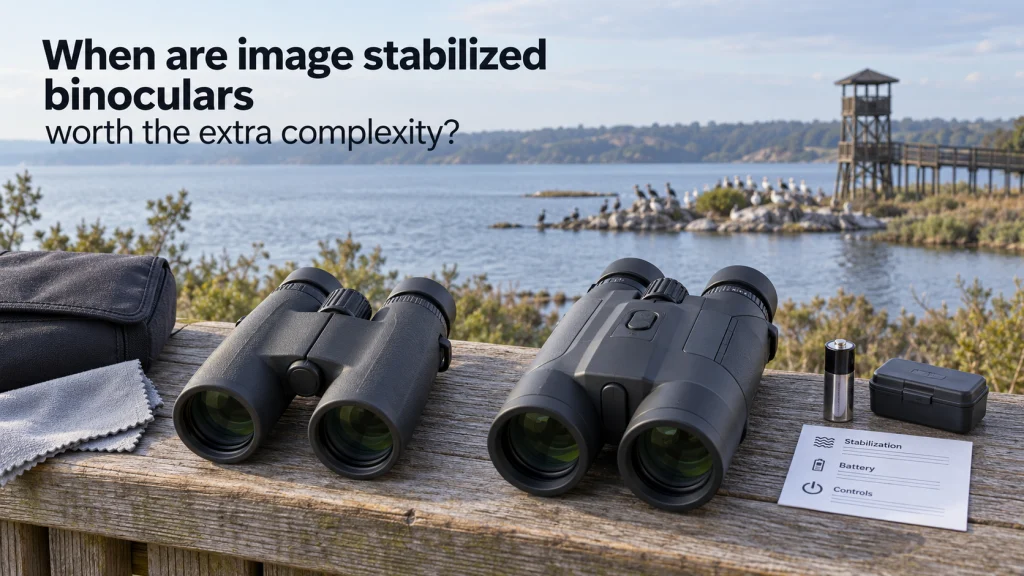
The premium is justified only if stabilization changes the usable view
Are image stabilized binoculars worth it? The answer starts with what changes when you raise the binocular to your eyes, not with the presence of an IS button. If normal hand motion repeatedly keeps you from seeing detail that the optics should otherwise deliver, stabilization can solve a real viewing constraint. If your conventional binocular already gives you a steady enough view at the distances and magnification you use, paying more for electronics may solve a problem you do not actually have.
This is why I would compare the purchase against one specific conventional alternative rather than against an abstract idea of “regular binoculars.” The broader guide to how image stabilized binoculars fit into real viewing decisions explains the technology in context, while the overview of different binocular types and their trade-offs helps frame what you give up or gain when the architecture changes. That keeps the comparison centered on the viewing problem rather than the feature itself. Stabilization should earn its premium by removing a repeated limit in your actual use. It should not receive automatic credit for optical quality, fit, or versatility that has to be verified separately.
Start with the conventional binocular you would actually buy instead
A useful comparison begins with a real fallback option. Record the magnification, objective size, field of view, eye relief, weight, sealing, and price level you would accept in a conventional binocular. That gives stabilization a baseline instead of treating it as a free-floating premium feature. It also exposes cases where a steadier view comes with a narrower field, smaller exit pupil, worse fit, or more ownership complexity.
The conventional choice does not have to be cheaper or less capable. A 10×42 roof binocular may offer a large exit pupil, wide field, weather sealing, and no battery dependence, while a compact stabilized model may be lighter but optically less forgiving. Those are different packages, not a clean upgrade ladder. The correct baseline is the binocular you would genuinely carry if stabilization were removed from the decision.
| Comparison question | Conventional alternative | Stabilized alternative |
|---|---|---|
| What magnification would I choose without IS? | Record the exact configuration. | Record the exact stabilized configuration. |
| What repeated problem am I fixing? | Note whether the current view is already steady enough. | Name the motion or magnification limit IS should reduce. |
| What changes elsewhere? | Check field, exit pupil, eye relief, weight, and sealing. | Check the same specs plus batteries and controls. |
| What happens without power? | The optical view remains unchanged. | The paid stabilization benefit is unavailable. |
Fill this out with exact specifications before deciding which package is better. Once both alternatives are concrete, the worth-it question becomes much easier to answer. Do not award points for a feature that does not solve the stated problem. The baseline keeps the comparison tied to a real purchase choice.

The 10x42 Crossfire HD uses fully multi-coated lenses and a roof-prism design. Twist-up eyecups, a center focus wheel, and a right-eye diopter support fit and focus adjustment. Nitrogen purging and O-ring seals provide waterproof and fogproof performance, and the body is tripod adaptable.
Check on AmazonIf you click this link and buy, we earn a commission at no additional cost to you.
Identify the repeated limitation that stabilization is supposed to solve
Stabilization makes the most sense when the same limitation appears repeatedly. Normal hand motion may keep fine edges moving or make distant detail difficult to inspect without support. The important word is repeated because a frequent constraint can justify extra cost and electronics far more easily than an occasional inconvenience. If the problem rarely changes what you can see, the premium is harder to defend.
Keep the diagnosis narrow. Do not treat IS as a medical answer, a fatigue treatment, or a guarantee that every user will see more. Ask whether ordinary handheld movement is the main reason the current setup fails to deliver the detail or steadiness you need. If the real problem is eye relief, poor fit, limited brightness, a narrow field, or focus behavior, stabilization can leave the actual constraint untouched.
- Check whether detail is present but difficult to hold still long enough to inspect.
- Separate hand motion from poor focus, glare, eye placement, and low-light limitations.
- Notice whether the problem appears only at one magnification.
- Ask whether simple bracing or physical support already solves it well enough.
This keeps the feature tied to a real viewing failure. If you cannot name that failure clearly, stabilization has not yet earned the premium. Recheck the problem during the situations where it actually occurs. A specific limitation is easier to compare than a general desire for an upgrade.
Stabilization can make more existing optical detail usable without upgrading the glass
A steadier image and better optical quality are not the same thing. Glass, coatings, aberration control, contrast, transmission, focus behavior, and alignment determine what the optical system can form. Stabilization works on motion in the viewed image, so it can make existing detail easier to inspect without changing the underlying glass. A stabilized binocular with modest optics can therefore feel easier to read at distance than a cleaner conventional image that moves more in the hands.
This is why “sharper” needs careful language. Reduced movement may let a user resolve detail that was difficult to use before, but it does not prove the stabilized binocular has superior lenses. Compare optical quality and stabilization as separate variables. The value question is whether steadiness matters more for your task than the optical advantages available in the conventional alternative.
Higher magnification may become practical sooner, but the rest of the optical package still changes
Higher magnification enlarges the subject and the effect of small hand movements, so stabilization becomes more relevant as power rises. Current stabilized designs extend well beyond magnifications many people prefer to handhold conventionally. That does not mean every buyer should jump from 8x or 10x to 16x or 20x. Field of view, exit pupil, eye relief, target acquisition, light, and fit still decide whether the higher-power package is actually useful.
A compact 12×25 stabilized binocular can provide more image scale while remaining small, but its exit pupil is far smaller than that of a 10×42 conventional model. A 16×42 stabilized design adds even more scale while often pairing it with a field near four degrees, so eyeglass fit and target acquisition deserve attention. The comparison of 12x versus 16x stabilized configurations is useful when magnification itself becomes the decision. Stabilization can move the handheld ceiling, but it does not erase higher-power trade-offs.

The 12x50 Crossfire HD pairs 12x magnification with 50mm objective lenses and fully multi-coated optics. Adjustable eyecups, a center focus wheel, and a right-eye diopter support normal viewing and focus setup. Nitrogen purging and O-ring seals provide waterproof and fogproof performance, and the binocular is tripod adaptable.
Check on AmazonIf you click this link and buy, we earn a commission at no additional cost to you.
Conventional binoculars preserve the widest choice of optics, ergonomics, simplicity, and price
The strongest argument for a conventional binocular is the range of choices available without adding power to the viewing workflow. You can prioritize field of view, eye relief, objective size, weight, close focus, focus behavior, sealing, or price across far more configurations. That freedom matters when fit or optical character is more important than eliminating motion. A buyer who needs generous eye relief, a wide field, a large exit pupil, or minimal maintenance may find the conventional option better aligned from the start.
Conventional binoculars are also simpler to evaluate and own. You still need to verify focus feel, hinge tension, eyecups, sealing, and optical quality, but there is no stabilization mode, battery routine, or powered failure state to consider. Simplicity matters when the binocular is carried often, stored for long periods, or shared among people who want immediate use. If the conventional model is already steady enough, IS must prove it improves the actual viewing job rather than merely adding capability.

The Copperhead HD combines 10x magnification with 42mm objective lenses and a fully multi-coated optical system. Adjustable eyecups and a diopter help tailor the viewing position and focus. Its body is waterproof, fogproof, shockproof, and tripod adaptable.
Check on AmazonIf you click this link and buy, we earn a commission at no additional cost to you.
Current stabilized binoculars are not universally heavy or poorly sealed, so verify the exact product
Broad rules about stabilized binoculars fail because current designs cover very different packages. Nikon lists its 12×25 S at 13.9 oz without its battery, while SIG lists the 16×42 ZULU6 HDX at 21.9 oz with an IPX7 rating. KITE’s APC stabilized 12×42 is about 25.4 oz without batteries and is also rated IPX7. Fujifilm sells both compact 28 mm designs and much larger 40 mm systems, so the IS label alone does not predict size or sealing.
Optical specifications vary just as much. Nikon lists a 4.5 degree field, 2.1 mm exit pupil, and 12.3 mm eye relief for the 12×25 S, while KITE lists a 3.85 degree field, 3.5 mm exit pupil, and 17 mm eye relief for its 12×42 APC. Fujifilm’s 16×28 waterproof model pairs a 4 degree field with a 1.8 mm exit pupil and 16 mm eye relief. These are evidence examples, not recommendations, and they show why each model must be judged as a complete binocular.
| Current example | Configuration | Weight | Power | Weather protection |
|---|---|---|---|---|
| Nikon STABILIZED 12×25 S | 12×25 | 13.9 oz without battery | Battery powered | Non-waterproof |
| SIG ZULU6 HDX | 16×42 | 21.9 oz | One AA, 30-hour listed runtime | IPX7 |
| KITE APC stabilized | 12×42 | 25.39 oz without battery | AA system with spare compartment | IPX7 |
| Fujifilm TECHNO-STABI compact | 16×28 | 550 g without battery | One CR2 | IPX7 |
Retire category-level assumptions as soon as you have a model name. Copy the exact weight, fit, sealing, field, and battery details from the current specification page before comparing value. Small specification differences can change which compromise matters most. Treat the category label as a starting point, not a verdict.
Batteries and electronics create an ownership burden that regular binoculars avoid
A conventional optical binocular does not need power for its core view. A stabilized binocular adds a powered system that must be switched on, supplied, and understood, even if the optics still work with stabilization off. Runtime can be generous, but battery type varies by model. Some designs use AA cells, others use CR2 cells, and some newer systems add rechargeable options.
The burden is not necessarily large, but it is real. You need a plan for spare cells or charging and should understand auto-off or low-battery behavior before relying on the feature. Electronics also add a layer of long-term service complexity that a purely optical binocular avoids. If the viewing gain is small, that extra ownership work supports staying conventional; if the gain is substantial, managing power may be an easy trade.
Compare eye relief, interpupillary range, close focus, and controls before rewarding the steadier image
A stabilized view can be impressive enough to distract from ordinary fit problems. Eyeglass wearers still need sufficient usable eye relief, the hinge still has to reach the user’s interpupillary distance, and the eyecups still need stable positions that place the eyes correctly. Close focus can matter if the binocular is used at shorter distances, and the focus wheel still has to be easy to operate without disturbing eye placement. None of those fit questions become less important because the image moves less.
Controls deserve equal attention because stabilization adds another interaction to the binocular. Some systems use a simple on and off control, while others provide multiple stabilization modes or automatic power management. Check whether activation requires holding a button, flipping a switch, or selecting a mode, and consider whether that workflow suits quick observations as well as longer viewing. A model that stabilizes beautifully but constantly breaks your grip, eye position, or focusing rhythm can still be the wrong tool for you.
Pay for IS when it solves a repeated limitation, and skip it when the conventional alternative already does the job
I would pay for stabilization when three conditions line up. Handheld motion must be a repeated limit rather than an occasional annoyance. The stabilized model must still provide acceptable field, eye relief, brightness, sealing, weight, and controls. Finally, the improvement has to matter often enough that the added cost and power dependence remain worthwhile after the first impressive demonstration.
I would skip stabilization when the conventional alternative is already steady enough at the magnification I need. I would also skip it if the stabilized option forces poor fit, a restrictive field, an unsuitable exit pupil, or a power routine I do not want. If bracing or physical support solves the same problem more simply, compare image stabilized binoculars versus a tripod. Stabilization earns its keep by changing a repeated viewing outcome, not by winning a feature count.
Treat stabilization as a complement when a conventional 8x or 10x still handles another viewing requirement better
The decision does not have to end with one binocular replacing every other binocular. A stabilized higher-power model can make sense for distant detail while a conventional 8x or 10x remains better for wider scanning, faster target acquisition, lower-light work, simpler carrying, or situations where battery dependence is undesirable. That is not duplication if the two configurations solve different problems. It is more useful to think in terms of jobs than to force one feature set to dominate every viewing condition.
This complement approach is especially sensible when the stabilized option reaches a magnification you would not otherwise handhold. You can preserve the broad, easy view of the conventional binocular and add stabilization only where extra image scale and reduced motion actually matter. The downside is obvious: two binoculars cost more, take more storage, and require a deliberate choice before use. The upside is that you stop asking one compromised configuration to be wide, bright, light, simple, high powered, and stabilized at the same time.
Existing owners should name the limitation before paying for stabilization
If you already own a decent conventional binocular, start with what it fails to do. “I want something better” is too vague to support a useful comparison. “At this distance, 10x gives enough image scale but I cannot keep fine detail still long enough to inspect it” is actionable. So is wanting more magnification without a tripod while still needing sufficient eye relief and weather protection.
Once the limitation is written down, check whether stabilization addresses it without breaking something else you value. A compact IS model may sacrifice exit pupil or eye relief, while a larger 42 mm system may add bulk or a narrower field. If the current binocular already fits well and only one specialized job is missing, keeping it and adding a complementary stabilized configuration can be rational. The upgrade should answer a named failure, not the novelty of watching the image settle.
A worth-it decision card
Put every advantage and compromise into the same frame. Start with the repeated viewing limitation, then compare the exact conventional and stabilized candidates against it. Do not score stabilization as a free benefit while treating field, brightness, fit, weight, and batteries as unrelated details. The whole package has to work in the conditions where you will actually use it.
A rejection threshold is more useful than a feature score. If IS clearly solves the repeated limitation and the remaining compromises are acceptable, the premium has a reason to exist. If the benefit is occasional, the fit is worse, or the conventional option already meets the job, stay with the simpler system. When the result is mixed, wait until the missing capability becomes specific enough to evaluate.
Repeated limitation, conventional alternative, and stability gain
Describe the limitation in one sentence without naming a product. Then write the exact conventional and stabilized configurations being compared. Ask whether stabilization changes usable detail or makes a genuinely useful magnification practical. If you cannot describe that gain plainly, do not assume the technology has earned the premium.
Product compromises and price
List what changes outside stabilization: field of view, exit pupil, eye relief, close focus, IPD range, weight, sealing, controls, battery type, runtime, and price. Mark anything that would be a deal breaker even with a steadier image. A stabilized model should not receive a pass on poor fit or unsuitable optics because its IS effect is impressive. The decision is complete only when the steadier view remains valuable after those compromises are counted.
| Decision point | Pay for stabilization | Stay conventional |
|---|---|---|
| Hand motion limits useful detail | IS materially changes what you can inspect. | Normal steadiness is already adequate. |
| Higher magnification is useful | Field, exit pupil, and fit remain acceptable. | Added power narrows the view too much. |
| Power dependence | The viewing gain is frequent and meaningful. | Simplicity matters more than the gain. |
| Exact model fit | Eye relief, IPD, controls, and weight work. | The conventional model fits better. |
Use this as a rejection threshold, not a scorecard designed to make IS win. One clear failure on fit or usefulness can outweigh several minor advantages. A purchase does not become better just because it has more technology. The feature should survive the same rejection tests you would apply to any other binocular.
Final Thoughts: pay for stabilization only when it changes what you can use
Image stabilization is not a universal upgrade over conventional binoculars. It is a specific solution to image motion, and its value rises when that motion repeatedly blocks useful detail or keeps a genuinely useful magnification from being practical in your hands. The technology can be transformative in that narrow sense without making the glass, field of view, eye relief, brightness, or ergonomics automatically better. That is why the exact conventional alternative has to stay in the comparison from the first paragraph to the final decision.
Before buying, name the repeated limitation, verify the complete specifications of both candidates, and decide what you are willing to trade for a steadier view. If the conventional option already meets the job, keeping the simpler binocular is a valid outcome. If stabilization clearly changes the detail you can use and the rest of the package still fits, the premium has a practical justification. The right answer is not whether IS is impressive, but whether it changes your actual viewing result often enough to deserve another layer of cost and ownership.
Frequently asked questions
Most questions about stabilized binoculars reduce to the same comparison: what does the steadier image solve, and what changes elsewhere? There is no single magnification or weight where IS becomes automatically worthwhile. Exact specifications matter because the category includes compact designs and much larger high-power systems. Use these answers as decision checks rather than universal purchase rules.
Image stabilization is a product feature for normal motion in the viewed image, not a medical treatment or a promise that everyone will see more. It does not remove the need to check eye relief, IPD, field, exit pupil, focus behavior, sealing, and weight. If one of those is the true limitation, solve that first. The exact model still decides the final answer.
🔭 Are image stabilized binoculars worth it for 10x magnification?
They can be, but 10x does not automatically require IS. If a conventional 10x is steady enough, the premium may be better spent on fit or optics. Compare the exact candidates before treating stabilization as necessary.
🔋 Do image stabilized binoculars work without batteries?
Many still work optically with stabilization off, but the paid IS benefit requires power. Battery type and runtime vary by model. Check the exact manual or specification.
🌧️ Are image stabilized binoculars waterproof?
Some are and some are not. Current models range from non-waterproof compacts to IPX7 designs. Verify the exact rating instead of inferring sealing from appearance.
👓 Are stabilized binoculars good for eyeglass wearers?
They can be if the model provides enough usable eye relief and the eyecups position your eyes correctly. Eye relief varies substantially. Check fit rather than assuming steadiness guarantees comfort with glasses.
📏 Is 12x or 16x better with image stabilization?
Choose based on needed detail and acceptable trade-offs. A 16x view adds image scale, but field, exit pupil, eye relief, and target acquisition may be less forgiving. IS helps motion, not those optical differences.
🎒 Are stabilized binoculars always heavier than regular binoculars?
No. Some current stabilized compacts are lighter than many full-size conventional binoculars, while other IS systems are much heavier. Compare exact weights and dimensions.
References and Sources
Model-specific examples use manufacturer specifications because weight, field, eye relief, sealing, and battery systems vary by exact configuration. These links support the concrete comparisons rather than recommend products. Manufacturer stabilization claims are treated as product claims, not universal results. Community discussion is used only to confirm recurring buyer questions about batteries, fit, complexity, and conventional alternatives.
Specifications can change when a model is revised. Check the current product page again before purchase. The decisive comparison is still between the exact stabilized model and the exact conventional model you would otherwise choose. Fit, light, distance, motion, and carrying preferences remain user-specific.
- Nikon STABILIZED 12×25 S specifications: supports the 12×25 weight, field, exit pupil, and eye relief examples.
- Nikon PROSTAFF P3 10×42 specifications: supports the conventional 10×42 comparison.
- SIG ZULU6 HDX 16×42 specifications: supports weight, field, eye relief, battery, runtime, and IPX7 details.
- KITE APC stabilized 42 specifications: supports fit, weight, power, field, and waterproofing details.
- Fujifilm TECHNO-STABI specifications: supports the compact and larger configuration examples.
- Binoculars community discussion on image stabilization: supports recurring buyer concerns around batteries, sealing, and conventional alternatives.