Western hunting binoculars make more sense when you treat them as one part of a carried viewing system instead of chasing the highest useful magnification. A primary chest binocular has to balance image scale, field of view, low-light behavior, physical fit, weight, and how often you will actually support it. Moving from 8×42 or 10×42 to 10×50, 12×50, or a much higher-power optic can solve a real viewing problem, but each step also changes bulk, steadiness, field of view, and overlap with a second optic. The best choice is the lightest, simplest combination that covers the viewing jobs you repeatedly need.
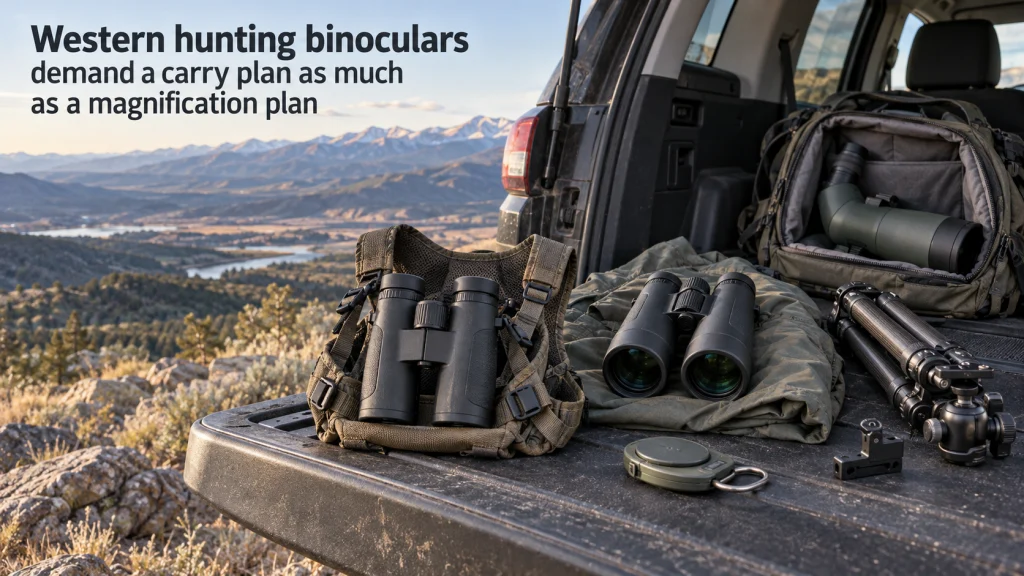
Western hunting optics start with a role, not a power number
The useful question for western hunting binoculars is not whether 10x, 12x, or a 50 mm objective sounds more serious. It is whether the binocular on your chest can cover the repeated viewing you expect without forcing the rest of your optical system to carry duplicate capability. Open country can reward more image scale, but long carry, broad scanning, mixed terrain, dim light, and supported viewing all pull the decision in different directions. That is why a magnification number by itself is a weak starting point.
Start by defining the primary viewing role, then decide what must stay immediately accessible on your chest and what can remain a separate tool. Our hunting binoculars guide covers the broader hunting use case, while our guide to choosing binoculars by use and fit explains the wider fit variables that still matter here. Neither route makes one configuration mandatory, because eye relief, field of view, hand fit, carry tolerance, weather exposure, and observation duration can change the answer. The Western-specific choice begins only after those constraints are clear.

The PROSTAFF P3 uses 10x magnification with 42 mm objective lenses in a full-size binocular. Nikon lists a 367-foot field of view at 1,000 yards, 15.7 mm eye relief, and a 20.6-ounce weight. Its waterproof, fogproof, rubber-armored construction makes it a useful baseline for a primary outdoor binocular.
Check on AmazonIf you click this link and buy, we earn a commission at no additional cost to you.
Define the job of the primary chest binocular before adding more optics
The primary chest binocular should cover the viewing you do most often, not win a spec-sheet contest. It needs useful image scale, enough field of view for broad scanning, and a body you are willing to carry for the full outing. If a larger configuration stays buried because it is bulky or awkward, its theoretical advantage is not helping the main role. A less ambitious binocular that remains accessible can be the better system anchor.
This is where the carry ledger starts. The binocular is only one line item if you later add a harness, case, tripod adapter, support, or second optic. Those additions should solve a recurring problem rather than compensate for a poor primary choice. Treat every extra component as added weight, volume, setup, and cost that must justify itself.
| Decision route | Job it should own | Carry or setup cost | Boundary for keeping it |
|---|---|---|---|
| Primary chest binocular | Most repeated viewing with immediate access | Constant chest weight and harness space | Keep this as the anchor while it covers most normal observation efficiently |
| High-power binocular | More image scale than the chest binocular can provide efficiently | More bulk, narrower field in many models, and greater support sensitivity | Route here only when the added image scale solves a recurring gap rather than duplicating the chest role |
| Spotting scope | A materially higher magnification ceiling than a chest binocular can offer | A second optic plus its own support and pack space | Route here when the needed job has become high-magnification detail rather than chest-binocular viewing |
| Tripod adapter and support | Stable extended viewing with the binocular you already chose | Adapter hardware, support weight, and setup time | Add it only when supported viewing is frequent enough to justify carrying the complete support system |
| Rangefinding binoculars | An integrated electronic ranging function in addition to conventional viewing | Batteries, controls, interface complexity, and usually more cost | Treat this as a separate technology choice, not the default optical upgrade |
The table is a routing test, not a shopping list. Stay with the chest binocular while it still owns the job, move to a higher-power binocular for a recurring image-scale gap, and move to a spotting scope when the need becomes materially higher-magnification detail. Tripod hardware and rangefinding electronics sit on different branches because they change support or function rather than simply adding optical power. This keeps one attractive specification from expanding into a heavier system without a clear reason.

The GlassPak uses an enclosed binocular case with adjustable harness straps for chest carry. Integrated tether straps secure the binocular, while side mesh pockets and a rear zippered pocket hold small field items. Its carry-system format makes harness weight, protection, and access part of the primary-binocular decision.
Check on AmazonIf you click this link and buy, we earn a commission at no additional cost to you.
Why 10×42 is common without being mandatory
A 10×42 configuration sits in a useful middle ground for many open-country buyers because it combines ten-power image scale with a body size that many manufacturers can keep reasonably compact. That does not make it the automatic Western answer, and it does not mean every 10×42 behaves the same. Field of view, eye relief, focus behavior, optical transmission, balance, and actual weight can vary enough to change the ownership experience. Two models with the same 10×42 label can therefore fit the same person very differently.
The better reason to choose 10×42 is that it matches your viewing role without forcing a second compromise somewhere else. If you can hold the image acceptably for the periods you expect, the field is wide enough for how you scan, and the body fits your face and hands, the configuration can be a strong system anchor. If one of those conditions fails, the fact that 10×42 is common should carry very little weight. Common configurations are useful reference points, not rules.

The Diamondback HD pairs 10x magnification with 42 mm objectives in a tripod-adaptable body. Vortex lists a 330-foot field of view at 1,000 yards and a 21.3-ounce weight for this configuration. Waterproof, fogproof, and shockproof construction plus the included GlassPak keep the common 10x42 format tied to an exact model.
Check on AmazonIf you click this link and buy, we earn a commission at no additional cost to you.
When 8×42 still makes more sense
An 8×42 can be the more rational primary binocular when field width, easy handheld steadiness, mixed terrain, or long periods of casual scanning matter more than the extra image scale of 10x. Lower magnification does not automatically mean a wider field in every model, so the actual field specification still needs to be checked. The same caution applies to weight, because an 8×42 and 10×42 in one product family may share nearly identical housings. What changes reliably is magnification itself, while the rest of the package remains model-specific.
That distinction matters because buyers often treat 8x as a compromise that must be outgrown in open country. It is better to ask whether the extra scale of 10x reveals useful detail often enough to justify the steadiness and field trade you experience with the exact models under consideration. Our comparison of 8×42 versus 10×42 binoculars for hunting handles that fork directly. If 8x already covers the primary role, more power should have to prove a separate benefit.

The MONARCH M5 uses 8x magnification with 42 mm objectives and ED glass. Nikon specifies dielectric multilayer prism coatings, phase-correction coatings, and 19.5 mm eye relief for this model. Waterproof and fogproof construction gives the 8x42 branch a full-size outdoor reference without treating lower magnification as a lesser tier.
Check on AmazonIf you click this link and buy, we earn a commission at no additional cost to you.
What 10×50 changes besides objective diameter
Moving from 10×42 to 10×50 keeps magnification constant while increasing the objective diameter, which changes the exit pupil from 4.2 mm to 5.0 mm by simple division. That larger exit pupil can be useful in dimmer viewing conditions when the rest of the optical system is capable of delivering the light well. It does not guarantee a brighter or better image by itself, because coatings, glass, internal baffling, transmission, alignment, and the viewer’s own pupil still matter. The larger objective is therefore one optical variable, not a shortcut to a low-light verdict.
The ownership trade is easier to miss because 50 mm bodies vary widely in how much weight and bulk they add. Some designs remain close to familiar 42 mm proportions, while others require a larger harness pocket and feel more substantial on the chest. That means the buyer should compare actual weight, dimensions, balance, and field of view rather than assuming every 10×50 carries the same penalty. If the larger exit pupil solves a real repeated problem and the body still fits the carry plan, the step can make sense without changing magnification at all.

The Diamondback HD 10x50 keeps 10x magnification while moving to 50 mm objectives and a 5 mm exit pupil. Vortex lists 17 mm eye relief and a 315-foot field of view at 1,000 yards for this configuration. Its tripod-adaptable body makes the larger-objective trade visible without changing magnification.
Check on AmazonIf you click this link and buy, we earn a commission at no additional cost to you.
What 12×50 adds and what it asks back
A 12×50 increases image scale again, but its exit pupil is about 4.2 mm, almost the same numerical size as a 10×42. The reason to move to 12×50 is therefore not simply that the objective is larger. The meaningful gain is magnification, and that gain comes with greater sensitivity to movement plus a field-of-view trade that must be checked on the exact model. In practice, 12×50 becomes more compelling when the additional scale solves a repeated viewing job that 10x leaves unresolved.
This is where support burden becomes part of the binocular decision even though support technique belongs elsewhere. A 12×50 that is often used from stable support may function as a different system from the same binocular used only handheld. Our 10×42 versus 12×50 hunting binocular comparison goes deeper into that specific trade. The useful checkpoint is whether the extra power creates a distinct capability or merely makes the primary binocular harder to carry and use.
The Diamondback HD 12x50 combines 12x magnification with 50 mm objectives and an approximately 4.2 mm exit pupil. Vortex lists a 271-foot field of view at 1,000 yards and 14 mm eye relief for this model. Its tripod-adaptable design makes support part of the higher-power ownership decision.
Check on AmazonIf you click this link and buy, we earn a commission at no additional cost to you.
A current 50 mm family shows why labels do not tell the whole story
Current ZEISS SFL specifications provide a clean example because the same family includes 8×50, 10×50, and 12×50 configurations. The 8×50 is listed at 30.2 ounces with a 393-foot field of view at 1,000 yards, while the 10×50 and 12×50 are both listed at 30.8 ounces. Their fields narrow to 366 feet and 315 feet respectively as magnification rises. The point is not to recommend this product family, but to show how power, field of view, exit pupil, and body weight can move differently inside one design platform.
This example also blocks a common shortcut: a buyer cannot assume that every step from 8×50 to 10×50 to 12×50 adds a predictable amount of weight. In this family, the published weight difference between 10×50 and 12×50 is effectively zero, yet the field of view and exit pupil still change. Another brand can package the same magnification classes differently, so the lesson is to verify the exact model rather than generalize from the label. The configuration name tells you optical geometry, not the whole ownership cost.
| ZEISS SFL example | Exit pupil | Field of view at 1,000 yd | Published weight |
|---|---|---|---|
| 8×50 | 6.3 mm | 393 ft | 30.2 oz |
| 10×50 | 5.0 mm | 366 ft | 30.8 oz |
| 12×50 | 4.2 mm | 315 ft | 30.8 oz |
Use a spec strip like this to test assumptions before you generalize across brands. Verify actual field of view, eye relief, weight, dimensions, and accessory interface for the exact model you are considering. A configuration class narrows the search, but it does not finish the fit decision. Repeat the check whenever you move to another brand or body design, because the same numbers on the badge can hide a different carry experience.

The Crossfire HD uses 10x magnification with 50 mm objective lenses in a tripod-adaptable binocular. Vortex lists HD optics plus waterproof, fogproof, and shockproof construction for this configuration. The included GlassPak also shows why an exact model needs to be checked as a complete ownership package rather than by its 10x50 label alone.
Check on AmazonIf you click this link and buy, we earn a commission at no additional cost to you.
Know when the next step is a different optic, not more chest power
There is a point where increasing binocular magnification changes the role of the instrument rather than simply improving the chest binocular. A current ZEISS Conquest HDX example makes the scale change visible: its 10×42 is listed at 25.2 ounces with a 345-foot field at 1,000 yards, while the 15×56 version is around 45 ounces with a 240-foot field. That is not a small numerical upgrade inside the same carry role. It is a larger, heavier, narrower-viewing architecture that asks for a different place in the system.
If the unresolved need is a materially higher magnification ceiling, a spotting scope becomes the adjacent alternative because it is designed around that different role. This article does not turn into a spotting-scope buying guide, and it does not assume one is required. The decision boundary is simply whether you still need a chest binocular or whether you are now trying to make one instrument do the job of a second optic. When the job changes, forcing more power into the chest role can create more duplication than value.

The Ultima 80 uses an 80 mm objective with a 20-60x zoom eyepiece and a 45-degree angled body. Celestron specifies multi-coated optics, waterproof construction, and a tripod-mounting interface for supported observation. Its much higher magnification range makes the category boundary from chest binocular to spotting scope concrete.
Check on AmazonIf you click this link and buy, we earn a commission at no additional cost to you.
Rangefinding binoculars are a separate technology decision
Rangefinding binoculars combine conventional viewing optics with integrated electronics, so they should not be treated as the automatic next tier after standard glass. The current Epic Outdoors chest-carry guide explicitly separates conventional binoculars from rangefinding and image-stabilized systems, which is a useful ownership distinction. Electronics can add functions that matter to some buyers, but they also add batteries, controls, interface complexity, and usually cost. Those additions should be evaluated for their own role rather than assumed to improve the optical choice.
For this page, the boundary stays narrow: choose the optical configuration first, then decide whether an electronic function is independently necessary. Do not let a feature bundle conceal a poor fit in eye relief, field of view, weight, balance, or basic image quality. A conventional binocular can remain the better system anchor when the electronics do not solve a repeated requirement. If electronics do matter, evaluate that as a separate technology decision instead of calling it a universal upgrade.

The Fusion X combines a 10x42 binocular with an integrated laser ranging system in one body. Its ActivSync display presents ranging data, while ARC technology adds angle compensation. Bushnell also specifies IPX7 waterproofing, keeping the electronic function separate from the underlying binocular format.
Check on AmazonIf you click this link and buy, we earn a commission at no additional cost to you.
Low light is an optical quality problem as well as an objective size problem
A larger objective can increase exit pupil at a given magnification, but that does not make objective diameter a complete low-light score. Transmission, coatings, contrast, internal stray-light control, exit pupil, and how well the binocular fits the viewer all affect what the image looks like in dim conditions. A 10×50 can therefore have a useful geometric advantage over a 10×42 while still needing the rest of the optical system to deliver on that advantage. The label tells you how the light cone is sized, not how well every part of the instrument handles it.
If dim-light performance is a primary requirement, compare the exact binoculars instead of assuming 50 mm automatically wins. Our guide to low-light hunting binoculars separates objective size from the other variables that affect practical viewing. That is also where a better 42 mm design can remain competitive against a larger but less capable alternative. Buy the larger body only when the optical gain is real enough to justify carrying it.

The Razor UHD RZB-1042 uses a 10x42 configuration with XR Plus lens coatings and a magnesium chassis. Vortex lists 16.7 mm eye relief and a 346-foot field of view at 1,000 yards for this model. It provides a concrete 42 mm reference for the section's point that optical design matters alongside objective diameter.
Check on AmazonIf you click this link and buy, we earn a commission at no additional cost to you.
Species labels do not automatically change the binocular decision
Questions framed around elk, mule deer, or another Western species often sound like they require a species-specific binocular answer. Usually the more important variables are the viewing distance, openness of the terrain, amount of movement in the scene, light level, observation duration, and how much equipment the user is willing to carry. If those conditions are the same, changing the species name does not magically change the optics. A configuration should be justified by the viewing job, not by a label attached to the animal.
This keeps the advice from multiplying into nearly identical recommendations that hide the real decision logic. A buyer moving between mixed timber and broad open country may have a stronger reason to reconsider field of view or magnification than a buyer simply changing species while keeping the same viewing conditions. The system should therefore be built around repeatable observation constraints. That approach also makes it easier to see when one primary binocular is enough across several Western use cases.

The Nature DX uses 8x magnification with 42 mm objectives and a 7.4-degree field of view. Celestron specifies BaK-4 prisms, fully multi-coated optics, and waterproof and fogproof construction. Its general outdoor format supports choosing from viewing conditions and fit instead of attaching a different binocular to each species name.
Check on AmazonIf you click this link and buy, we earn a commission at no additional cost to you.
Audit the whole Western viewing system before buying
The final check is a role audit, not a ranking. Ask whether each piece solves a real problem and whether the combined carry burden still makes sense. An attractive upgrade can still be rejected when its specifications are impressive. The parts should complement one another instead of competing for the same job.
Run the audit from the chest binocular outward, not from the most powerful optic backward. Start with the viewing role you cannot avoid, then add support, a second optic, or electronics only when a separate need remains. This keeps magnification from becoming the default answer. It also makes total cost and weight visible before the purchase.
Chest role, magnification, and objective
Write down what the primary binocular must do and how long it will remain on your chest. Then compare 8x, 10x, and 12x only against that role, not against each other in the abstract. Treat 42 mm and 50 mm as body and exit-pupil choices with model-specific weight, not as simple quality tiers. If a configuration cannot explain its extra burden in terms of a repeated viewing benefit, remove it from the shortlist.
Field of view, weight, and support
Check the published field of view and weight for the exact model because magnification alone does not tell you either one precisely. Higher power often narrows the field and makes movement more visible, but the size of those changes depends on design. If you expect frequent supported viewing, count the adapter and support in the system rather than pretending the binocular’s listed weight is the whole story. If support would rarely leave the pack, reconsider whether the higher-power choice is earning its place.
Second optic, support, and electronics boundaries
Give each adjacent category a hard ownership boundary before adding it. High-power binoculars belong only when extra image scale is a recurring job, a tripod adapter belongs only when supported viewing is common enough to justify the support burden, and rangefinding binoculars belong only when the integrated electronic function is itself required. A spotting scope sits beyond the chest-binocular role when the unresolved need is a materially higher magnification ceiling. These boundaries keep accessories and second optics from becoming automatic upgrades.
Weather and price belong in the same audit
Western use can expose optics to dust, temperature swings, precipitation, and repeated handling, so verify the exact model’s sealing, operating limits, lens protection features, and warranty terms when those details matter to you. Do not infer weather resistance from price or appearance. Price should be judged against the role the binocular fills, not against the prestige of the line. A less expensive configuration that fits your carry and viewing constraints can be the better system choice.
- Primary chest boundary: can it handle most repeated viewing without another optic?
- High-power boundary: does more magnification solve a recurring image-scale gap rather than duplicate the chest role?
- Tripod adapter boundary: is supported viewing frequent enough to justify the adapter, support, and setup burden?
- Rangefinding boundary: is the integrated electronic function actually required, rather than merely bundled into a premium configuration?
- Verification boundary: have you checked field of view, eye relief, weight, dimensions, weather claims, and total carried accessories for the exact model?
If the answers are clear, the system usually becomes simpler. The audit removes gear that cannot justify itself and gives future purchases a clear gate: identify the unresolved job first, then choose the category that owns it. That is more useful than treating every increase in power, support, or electronics as the next rung of one upgrade ladder.

This lightweight tripod extends to 60 inches and supports equipment up to 6.6 pounds. It weighs about 2.7 pounds and includes a carrying bag for transport. Counting the support itself makes added weight and pack volume visible when a binocular setup will also require a compatible adapter.
Check on AmazonIf you click this link and buy, we earn a commission at no additional cost to you.
Final Thoughts: add power only when it solves a separate viewing role
Western binocular selection becomes much easier once the primary chest role is fixed. An 8×42, 10×42, 10×50, or 12×50 can all be rational choices when the field of view, exit pupil, fit, weight, and carry burden match the actual viewing job. None of those labels is a universal upgrade path. The configuration that stays useful across the most repeated situations should anchor the system.
After that, route each unresolved need to the category that solves it. More image scale may justify higher-power binoculars, a much higher magnification ceiling may justify a spotting scope, frequent supported viewing may justify support, and an electronic requirement may justify rangefinding binoculars. Verify exact specifications instead of generalizing from magnification and objective diameter. The goal is the least duplicated system that still covers the work.

This adjustable harness uses shock cord and a swivel-hook connection to carry binoculars close to the body. The listed item weight is 2.24 ounces, keeping the open carry system compact. Its simple harness format supports the final section's preference for adding only the equipment that solves a clear ownership need.
Check on AmazonIf you click this link and buy, we earn a commission at no additional cost to you.
FAQs
🔭 Is 10×42 enough for Western hunting?
It can be when its field of view, steadiness, fit, and image scale match your repeated viewing needs. Do not treat 10×42 as mandatory, and do not assume another power is better without identifying the job it improves.
👀 Is 8×42 too weak for open country?
Not automatically. An 8×42 can make sense when wider field, easier handheld use, or mixed terrain matters more than the extra image scale of 10x.
🏔️ Is 12×50 better than 10×42 for long-distance viewing?
It provides more image scale, but that comes with greater support sensitivity and often a narrower field. Choose it only when that extra scale solves a repeated viewing need that 10x does not.
🌅 Does a 50 mm objective always perform better in low light?
No. A larger objective can increase exit pupil at the same magnification, but transmission, coatings, contrast, optical design, and the viewer’s own pupil still affect practical brightness.
🎒 Should I count tripod gear when comparing binocular weight?
Yes, when supported viewing is part of your plan. Compare the carried system, including adapter and support, rather than the binocular’s listed weight alone.
⚙️ Are rangefinding binoculars the natural upgrade from standard binoculars?
No. They add a separate electronic function and should be judged as a different technology choice, not as an automatic optical upgrade.
References and Sources
- Epic Outdoors chest-carry binocular guide: Supports the distinction between conventional chest binoculars and separate rangefinding or stabilized systems, and shows current Western chest configurations.
- ZEISS SFL technical data: Provides current 8×50, 10×50, and 12×50 exit pupil, field of view, and weight specifications used in the comparison strip.
- ZEISS Conquest HDX technical data: Provides current 10×42 and 15×56 specifications used to illustrate the shift from chest-binocular dimensions toward a larger high-power architecture.