
The safest purchase channel is the one that resolves the uncertainty you still have after choosing a binocular. If fit is still unknown, physical access or a real trial path matters more than a small price difference; if fit is already settled, seller identity, returns, region, and support become easier to verify remotely. Marketplaces deserve a separate seller and fulfillment check because the product page alone does not tell the whole transaction story. A good purchase decision therefore starts with the risk that remains, not with a permanent ranking of stores.
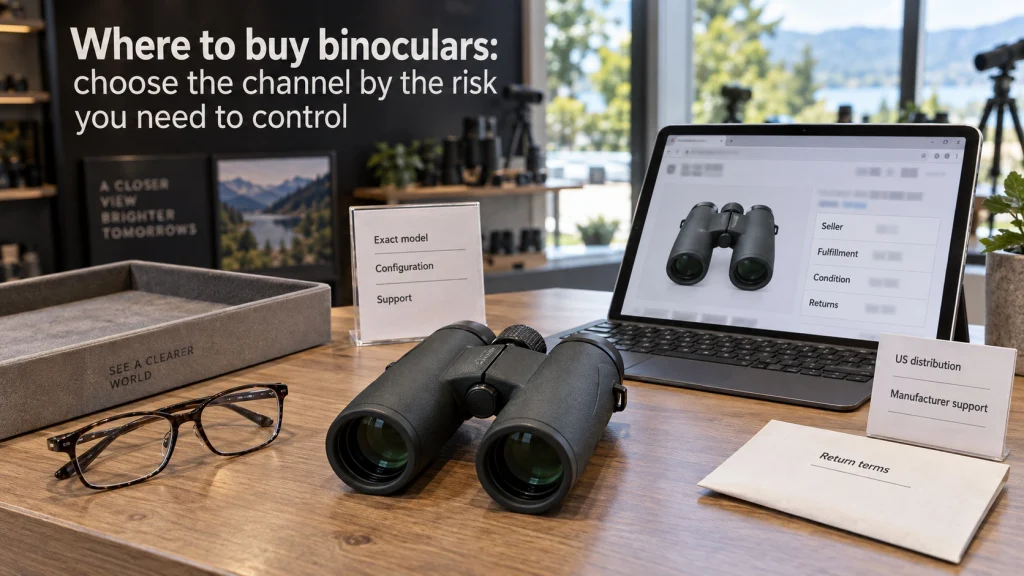
The same binocular can create different purchase risk
Once the model is chosen, deciding where to buy binoculars is not mainly about finding the biggest storefront or the lowest listed price. The same binocular can be offered by the manufacturer, a specialist optics retailer, an outdoor retailer, or a marketplace seller, yet each route preserves different evidence about product identity, returns, physical fit, and post-purchase support. A channel that works well for a buyer who already knows the exact model may be a poor choice for someone who still needs to judge eyecup comfort, grip, balance, or focus behavior. If the model itself is not settled yet, step back to the binocular buying guide, or use the first-binoculars decision path if this is your first purchase.
I would treat the purchase channel as the last uncertainty-control decision, not as a shortcut for product quality. Buying direct can make the source of the product clearer, but it does not automatically tell you whether the binocular fits your face. A store with physical inventory can help with fit, but local stock may be limited and the return path still needs to be checked. A marketplace can be convenient, but convenience does not replace verification of who is selling, who is fulfilling, what region the unit belongs to, and how a return would actually work.

The Monarch M5 8x42 uses ED glass and dielectric high-reflective prism coatings for clear, color-accurate viewing. It is waterproof and fogproof for outdoor use. Its 8x42 configuration and long eye relief make it a practical full-size binocular for birding and wildlife viewing.
Check on AmazonIf you click this link and buy, we earn a commission at no additional cost to you.
Start with the uncertainty that is still unresolved
The purchase decision becomes simpler when you name the thing you still do not know. Physical fit is one category: eye relief may look adequate on paper, yet eyecup shape, nose clearance, hinge position, grip width, and balance can still make a binocular uncomfortable. Transaction risk is another category: the model may be perfect, but the seller, return path, region, or warranty eligibility may still be unclear. Do not use one channel to solve a different problem than the one you actually have.
For a buyer with a known model and known fit, online buying can be entirely reasonable when the listing clearly identifies the exact configuration, condition, seller, return route, and support status. For a buyer who has only compared specifications, physical access may be more valuable because fit cannot be fully inferred from magnification, objective size, or eye relief alone. A meaningful discount can justify more verification work, but it should not make missing seller or region information disappear. The practical goal is to reduce uncertainty until the remaining risk is small enough that you can explain exactly what you are accepting.
| If this is still unknown | Then favor this route | Before moving on |
|---|---|---|
| Eyecup comfort, eye placement, grip, balance, or focus feel | In-person access or a real demo or trial path | Confirm that the exact configuration can actually be handled or returned after evaluation. |
| Seller identity, condition, or return mechanics | A retailer or online offer with clear transaction details | Identify who sells the unit, who fulfills it, and where a return would go. |
| Region or manufacturer support | A channel that clearly documents distribution status | Check the manufacturer’s current regional support policy before valuing the discount. |
| Whether a product claim is real | No channel yet | Verify the claim first. Store choice cannot repair weak product evidence. |
This decision tree keeps price from taking over too early. A buyer who already handled the exact model does not need the same route as someone who is still unsure whether the eyecups work with glasses. Choose the channel that answers the remaining question, then compare price and convenience after that risk is under control.

The NL Pure 8x42 combines an 8x42 optical configuration with a 477-foot field of view at 1,000 yards. Its magnesium housing is built for field use. The full-size design gives buyers a concrete fit and handling reference when physical comfort remains unresolved.
Check on AmazonIf you click this link and buy, we earn a commission at no additional cost to you.
Compare purchase channels by the evidence they preserve
Purchase channels are useful because they preserve different kinds of evidence before money changes hands. Buying direct from the manufacturer may give you a clean path to the current product and official support information, while a specialist retailer may add staff familiarity, side-by-side access, or a clearer optics-specific return conversation. Outdoor retailers can be useful when local inventory happens to include the model you need, and online retailers can be efficient when your fit decision is already settled. None of those advantages is automatic, so the channel label should start a verification process rather than end it.
The right comparison is not direct versus specialist versus marketplace in the abstract. It is product identity, physical access, seller accountability, return mechanics, region, support, and price for the exact transaction in front of you. A channel that preserves more of the evidence you need is usually worth more than a channel that simply looks familiar. That framework also explains why two listings for the same binocular can carry different practical risk even when the model name is identical.
Buying direct from the manufacturer can simplify product identity without solving fit
Buying from the manufacturer can reduce ambiguity about product source and make official specifications and support contacts easier to verify. It cannot prove that the binocular fits your face, gives comfortable eye placement, or feels balanced in your hands. If fit remains unresolved, direct purchase is only stronger when the return or trial path lets you answer those questions after delivery.
Specialist and outdoor retailers may add physical access or product support
A specialist optics or camera retailer can help when you need to compare handling rather than specifications, and an outdoor retailer can do the same when the exact models are in stock. The useful evidence is whether you can check eye placement, focus control, grip, weight, and the configuration you intend to buy. Confirm inventory and return terms before an in-person visit because inspecting the wrong variant solves nothing.
Online buying requires a remote transaction audit
Online buying works best when the binocular choice is stable and the transaction facts are visible before checkout. Check the exact model, configuration, condition, included items, seller identity, return path, and any region or warranty language that could matter later. If a field is missing, resolve it before treating the offer as equivalent to another seller’s, then use the guide to buy binoculars online without losing the verification trail.
Amazon requires a separate seller and fulfillment check
An Amazon product page can combine one product title with offers from different sellers and fulfillment paths. Amazon’s published return guidance distinguishes third-party seller returns, so inspect the active seller and fulfillment fields instead of treating every offer as the same transaction. Use the guide to audit an Amazon binocular listing before buying when price, seller identity, or return routing differs across offers.
International or non-authorized distribution can change support
A genuine binocular can still be a poor transaction if it was intended for another region and local manufacturer support does not apply. Nikon states that its gray market products are not covered by Nikon USA warranty service, showing why authenticity and support eligibility are separate questions. If distribution status is unclear, weigh the discount against that consequence and use the gray market binoculars checklist before paying.
Demo or trial access can resolve physical fit before commitment
A trial route is most valuable when the remaining uncertainty is physical rather than technical. Maven publishes a demo program that sends a lightly used, like-new optic for evaluation and allows the buyer to keep or return it under the stated terms, showing how a direct brand can provide hands-on access. When eyecups, balance, grip, focus feel, or viewing comfort still block the decision, follow the try-before-you-buy decision path instead of treating specifications as a substitute for fit.

The Terra ED 8x42 uses SCHOTT ED glass with a hydrophobic multi-coating and 88 percent light transmission. It provides 18 mm eye relief and a 375-foot field of view at 1,000 yards. The waterproof roof-prism design uses a large center focus wheel for quick adjustment.
Check on AmazonIf you click this link and buy, we earn a commission at no additional cost to you.
Audit listing evidence regardless of channel
Good channel selection does not rescue a weak listing. A manufacturer site, retailer page, or marketplace offer can still leave out the exact configuration, bundle contents, return condition, or support detail you need to make a clean decision. Read the active offer, not just the search result snippet or product title, and separate facts published by the manufacturer from claims made only by the seller. When a material detail is unclear, the correct next step is verification, not optimism.
I would pay special attention to claims that sound valuable but are hard to connect to a measurable or documented feature. Phrases about professional quality, extreme clarity, military grade construction, or exceptional range can sound persuasive while telling you little about field of view, eye relief, weight, close focus, coatings, or actual support. A listing should survive a few basic checks before price becomes the focus.
- Confirm the exact model and configuration.
- Identify the active seller and stated condition.
- Read the return path instead of assuming it.
- Verify any claim that materially changes the buying decision.
If a listing becomes less convincing when those checks are applied, that is useful information before checkout. The goal is not to investigate every sentence on the page, only the claims and transaction facts that could change whether you buy or reject the offer.
Treat unsupported claims as an evidence problem, not a bargain
Price does not make an unsupported optical claim more credible. Check whether the manufacturer publishes the claimed feature for the exact model and compare that with what the seller promises. If a decision-changing claim cannot be verified, rely only on documented facts or walk away, then use the guide to spot misleading binocular claims when the listing itself is the problem.
Verify seller identity, return path, region, and support when they affect the transaction
Seller identity, return path, region, and manufacturer policy catch many channel-specific problems without requiring a retailer ranking. B&H publishes return eligibility and packaging conditions, while Amazon publishes separate mechanics for third-party seller returns, showing why return routing should be read rather than assumed. Policies can change, so verify the active terms before purchase instead of relying on a remembered rule.

The Diamondback HD 8x42 uses an HD optical system with fully multi-coated lenses and dielectric prism coatings. Adjustable eyecups accommodate viewing with or without eyeglasses. O-ring seals and argon purging provide waterproof and fogproof protection.
Check on AmazonIf you click this link and buy, we earn a commission at no additional cost to you.
Do not overfit the decision to one retailer or one location
A permanent retailer ranking ages badly because inventory, seller participation, return terms, regional distribution, and local availability can change. The useful question is not whether retailer A is always better than retailer B, but whether the current transaction preserves the evidence you need. A search for a binocular store near me can be useful for finding hands-on access, yet it cannot tell you whether the store has your exact configuration or whether its return terms fit your risk. Treat location as access information, not as a quality verdict.
The same restraint applies to channel comparisons that look different but resolve the same uncertainty. Buying direct versus using a specialist retailer matters when it changes fit access, product identity, support, or returns; it matters far less when both routes provide the same evidence and practical protections. Avoid creating a complicated decision from differences that do not affect the transaction. Spend your attention on the uncertainties that could actually make you reject the purchase.
Separate used or refurbished condition from new-product channel choice
Used and refurbished binoculars add condition questions that a new-product channel framework cannot solve. Alignment, internal haze, mechanical wear, eyecup condition, missing accessories, and seller grading may matter more than the storefront type. If the unit is not new, use the used binoculars inspection and buying framework so product condition and purchase channel remain separate decisions.
Separate purchase routing from full warranty interpretation
Warranty eligibility can influence where you buy, but complete coverage depends on more than a channel label. Region, seller status, proof of purchase, registration, transfer rules, exclusions, and current manufacturer terms can all matter. Use the binocular warranty guide when actual coverage matters so purchase routing does not become a promise about service outcomes.

The H2O Xtreme uses a 10x42 configuration with BaK-4 prisms and fully multi-coated optics. Its IPX7 waterproof construction and nitrogen purging are designed for wet outdoor conditions. The rubber-armored roof-prism body provides a secure grip for travel, birding, and boating.
Check on AmazonIf you click this link and buy, we earn a commission at no additional cost to you.
Use a channel worksheet before you pay
A short worksheet is more useful than a universal winner because it forces the transaction to answer the risk you actually have. Write down the one or two facts that could still make you reject the purchase, then choose the channel that exposes those facts most clearly. If two routes resolve them equally well, price and convenience can become sensible tie breakers.
The table below is deliberately channel neutral. Use it as a rejection screen: if the route cannot resolve the row that matters to you, keep looking before paying. A cheaper transaction that leaves a critical field blank is not yet a better transaction.
| Remaining uncertainty | Channel feature that can help | What to verify before paying |
|---|---|---|
| Physical fit | In-person stock, demo access, or a real trial path | Exact model, eyecup comfort, eye placement, grip, balance, focus feel, and return conditions |
| Exact product identity | Buying direct or using a retailer with clear model and configuration data | Model name, magnification, objective size, condition, included items, and region |
| Remote transaction risk | Online retailer with visible seller and return information | Seller identity, fulfillment, return route, packaging expectations, and support |
| Marketplace ambiguity | An offer that clearly exposes seller and fulfillment fields | Active seller, who ships the order, who receives a return, and whether the offer matches the intended region |
| Unusually low price | Any channel with enough documentation to explain the discount | Condition, region, seller status, support eligibility, bundle contents, and return limitations |
The table should push you toward one next action. If fit is unresolved, find physical or trial access. If seller or support status is unclear, audit the transaction. If a discount cannot be explained without guessing, reject that offer.
Use a marketplace seller audit before comparing price
On a marketplace, record the active seller, fulfillment party, condition, return route, region if disclosed, and manufacturer support status when relevant. Check those fields on the offer you are actually buying, not another offer on the same product page. If switching sellers changes the price, repeat the audit because the transaction changed even though the product title did not.
Marketplace audit: Product title, exact configuration, condition, active seller, fulfillment, return route, region, support status, and included items should all be understandable before checkout.
Use a demo or trial when physical fit remains the last unknown
A trial is unnecessary when you have already handled the exact configuration and know it fits. It becomes useful when eye placement, eyecups, balance, grip, or focus behavior could still make you reject an otherwise suitable binocular. Read the current condition, return, shipping, and keep-or-return terms, then use the trial only to answer those remaining fit questions.
Let price matter only after status is clear
Price matters after the offers are truly comparable. A lower number can reflect a promotion, different seller, different region, different condition, missing accessories, or a support trade-off, so it needs context before it becomes savings. I would accept a modestly higher price for a materially clearer return path or support status, but not because one channel simply looks more prestigious.

The Endurance ED 8x42 uses extra-low-dispersion glass and fully multi-coated optics. It provides 18 mm eye relief and a 7.4-degree field of view. The waterproof roof-prism design includes a center focus system and a standard tripod interface.
Check on AmazonIf you click this link and buy, we earn a commission at no additional cost to you.
Final Thoughts: buy through the channel that lets you verify the remaining risk
Where you buy matters because each channel exposes different evidence before and after the transaction. Prioritize access when fit is still uncertain, and prioritize transaction clarity when the binocular itself is already settled. Do not reward a low price for hiding the fact you most need to verify.
That logic also keeps the decision from becoming a permanent store ranking. Direct sales, specialist retail, outdoor retail, marketplaces, and demo paths can all work when their current mechanics match the problem you still need to solve. Compare like with like, reject offers that require guessing about material terms, and let price and convenience matter only after the important facts are clear.

The SkyView Ultra HD 8x42 combines ED glass with fully multi-coated optics and phase-corrected prisms. It offers a 393-foot field of view at 1,000 yards and 17.8 mm eye relief. The nitrogen-purged body is waterproof and uses a center focus system.
Check on AmazonIf you click this link and buy, we earn a commission at no additional cost to you.
Choose the next purchase check that matches your uncertainty
The purchase channel is only the routing decision. Each path below handles a narrower uncertainty that deserves its own verification steps, especially when the listing, seller, region, or physical fit is still unclear. Use the row that matches the question you still have rather than reading every route as a checklist you must complete. That keeps the process proportional to the transaction.
If you already know the exact model and fit, the online or marketplace paths will usually be more relevant than a trial. If support status is the issue, start with the gray market path before comparing price. If fit is still unknown, move toward a trial or hands-on route. If the listing itself looks exaggerated, resolve the claim before deciding whether the seller deserves further attention.
| Topic | What you will find |
|---|---|
| Buying binoculars online | A remote transaction audit for exact model, condition, returns, seller information, and support. |
| Buying binoculars on Amazon | A marketplace-specific check for active seller, fulfillment, return routing, and offer changes. |
| Gray market binoculars | A way to separate genuine product identity from region, distribution, and manufacturer support consequences. |
| Trying binoculars before you buy | A fit-first path for eyecups, eye placement, grip, balance, focus feel, and trial terms. |
| Spotting misleading binocular claims | A verification method for suspicious specifications, unsupported marketing language, and evidence gaps. |
The narrow guide should take over once you know which uncertainty remains. That prevents the main channel decision from becoming an oversized checklist for every possible transaction. It also makes it easier to stop shopping when the evidence is already sufficient. The goal is a clear purchase, not maximum browsing.

The Carson RD Series 8x42 uses BaK-4 prisms and fully multi-coated optics in an open-bridge body. It provides a 372-foot field of view at 1,000 yards and 17 mm eye relief. Nitrogen filling and O-ring sealing make the binocular waterproof and fogproof.
Check on AmazonIf you click this link and buy, we earn a commission at no additional cost to you.
FAQs
These questions come up after the binocular itself is mostly settled but the purchase route still needs checking. Price alone cannot answer a fit problem, identify the active seller, or establish support eligibility. Use the answer that matches the remaining issue rather than treating every purchase as the same checklist.
For physical fit, look for access. For marketplace ambiguity, inspect the active offer. For region or support questions, read the manufacturer’s current policy. If the listing itself makes an unverifiable claim, resolve that before choosing a seller.
🔭 Where can I buy binoculars if I already know the exact model?
Manufacturer direct, specialist retailers, outdoor retailers, and established online sellers can all work when the exact model and fit are already known. Compare seller identity, return mechanics, region, condition, support, and total price for the active transaction.
👓 Should I try binoculars in person before buying?
It is especially useful when eye relief, eyecup shape, nose clearance, grip, balance, or focus feel is still uncertain. If you have already handled the exact configuration and know it fits, a well-audited online purchase may be enough.
📦 Is buying binoculars online risky?
Online buying is manageable when the exact model, condition, seller, return route, region, and support status are clear. Risk rises when one of those facts is missing or when the listing uses vague claims instead of verifiable specifications.
🛒 Is Amazon a good place to buy binoculars?
It can be, but the marketplace needs an offer-level audit rather than a platform-level yes or no. Check the active seller, fulfillment, condition, return route, region, and manufacturer support before treating the offer as equivalent to another seller’s listing.
🌎 Why does the product region matter?
Some manufacturers tie warranty or service eligibility to authorized regional distribution. A genuine imported product may therefore have different support from a unit distributed for the US market, so verify the manufacturer’s current policy when that matters to you.
💵 Should I choose the cheapest binocular listing?
Only after the offers are comparable on model, condition, seller, return path, region, support, and included items. A lower price is not a saving if it buys a transaction with a critical unknown you would reject if it were stated clearly.
References and Sources
Purchase policies can change, so the transaction should be checked against the current page before payment. The sources below are included because they support specific channel, return, trial, and distribution points used in this article. They are not a retailer ranking and they do not guarantee the outcome of an individual return or warranty claim. When the active offer conflicts with an older assumption, use the current published terms.
The trial example comes from the brand operating the program, marketplace return mechanics come from Amazon, and the gray market consequence comes from Nikon USA. B&H provides a specialist-retailer example with published return conditions. These sources show why channel mechanics must be verified rather than guessed. They support the framework, not a seller or product endorsement.
- Maven FAQ: Documents the current demo program and the option to evaluate qualifying optics before deciding whether to keep or return them.
- Amazon return policy: Explains return mechanics for third-party sellers that fulfill and ship their own inventory.
- Nikon gray market warning: Explains how non-US distribution can affect Nikon USA warranty and repair eligibility.
- B&H return policy: Publishes return eligibility, packaging expectations, and return process details.