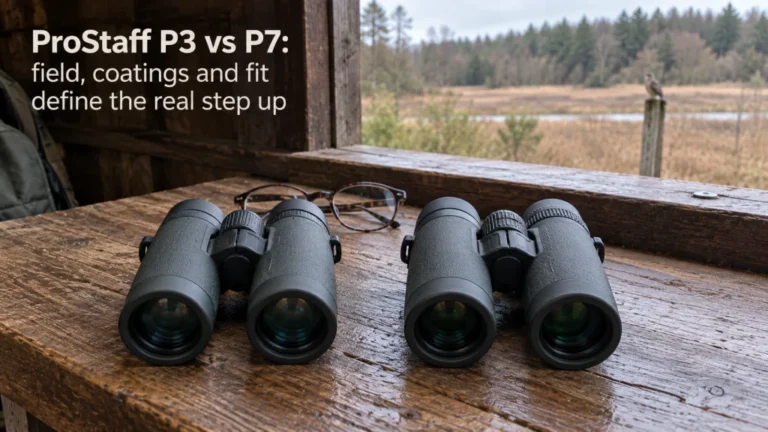
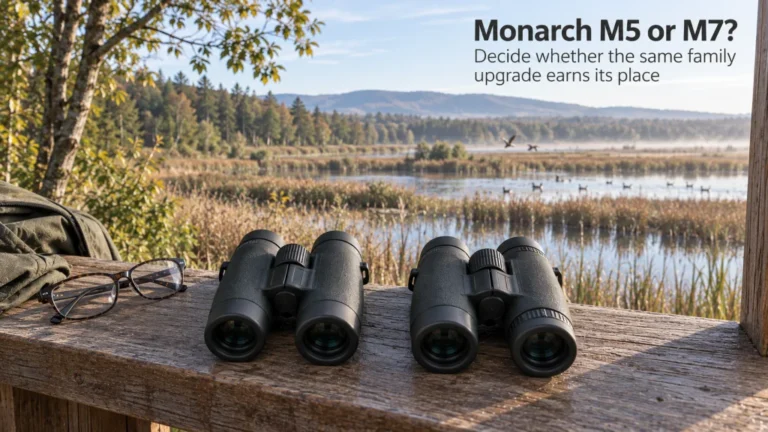
The ProStaff P7 8×42 and Monarch M5 8×42 do not form a simple good, better ladder. Nikon gives the Monarch M5 ED glass and a shorter published close-focus distance, while the ProStaff P7 is lighter and shows a wider published field of view. The useful choice is therefore not which family sits higher, but which documented difference fixes a problem you actually have. Eyeglass fit, handling, visible color fringing, and the live price gap still need to be checked rather than inferred from the family name.
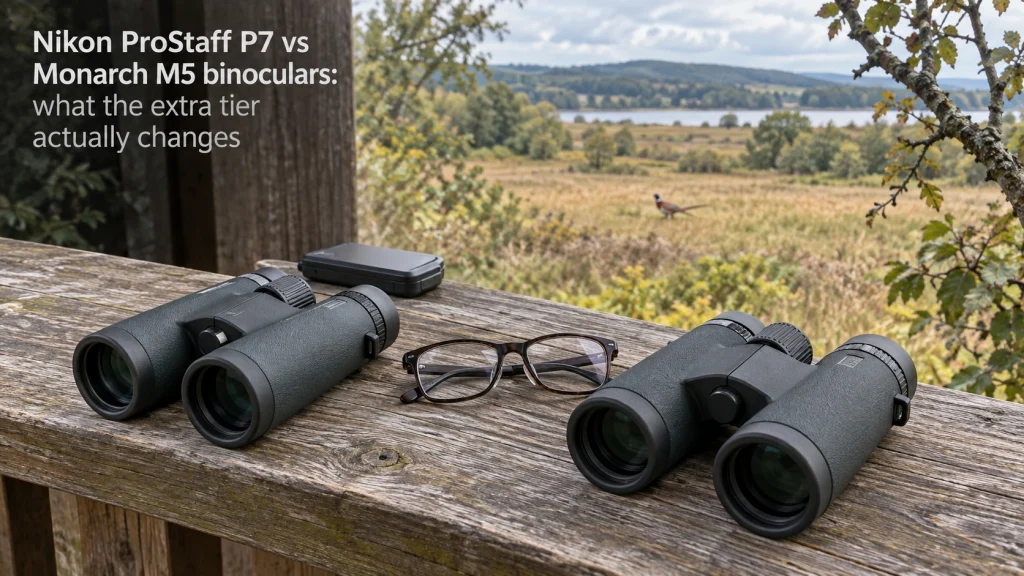
Define the constraint Monarch M5 must fix over ProStaff P7
A ProStaff P7 versus Monarch M5 comparison becomes useful only after the higher-priced family is given a specific job. If your first hard constraint is finding and following moving subjects in a broad scene, the 8×42 Monarch M5 does not automatically earn the upgrade because Nikon publishes a wider field of view for the 8×42 ProStaff P7. That is the kind of non-monotonic difference that makes family labels less useful than the exact specification in front of you. If you are still deciding whether this brand fits your broader needs, the Nikon binoculars guide keeps that decision separate from this two-model fork.
The same discipline applies if your real concern is optical refinement rather than scene width. The Monarch M5 has a documented feature the P7 page does not list, ED glass, so that is a legitimate reason to investigate the higher family when color fringing in high-contrast scenes matters to you. It is not a reason to assume every other part of the view, fit, or handling is superior. If you have not committed to Nikon at all, compare the brand-level trade-offs first in the guide to the best binocular brands, then return to this matched 8×42 comparison.
Key point: The Monarch M5 needs to solve a named problem for you. If its documented differences do not address that problem, paying more for the higher family has no decision value.

This exact 8x42 Monarch M5 uses ED glass and Nikon lists a 335-foot field of view at 1,000 yards. Published eye relief is 19.5 mm and close focus is 8.2 feet. The 22.2-ounce binocular is waterproof and fogproof, matching the configuration discussed in this comparison.
Check on AmazonIf you click this link and buy, we earn a commission at no additional cost to you.
Compare the stable published differences first
Start with facts that Nikon publishes for the exact 8×42 versions, not with assumptions borrowed from another magnification or objective size. Both are 8×42 roof-prism binoculars with a 5.3 mm exit pupil, central focusing, phase correction, dielectric prism coating, and waterproof and fogproof construction. The differences appear in field of view, eye relief, close focus, weight, length, and the presence of ED glass on the Monarch M5. Those differences are enough to change the decision without pretending the spec sheet can describe the entire image.
The table below is deliberately narrow because sibling versions can change the balance. A buyer comparing 10×42 versions would face different eye-relief and field-of-view numbers, so mixing those numbers into an 8×42 decision would create a false comparison. The safest habit is to match magnification and objective diameter before judging which family gives up what. Once that is done, the higher family looks more specialized rather than universally better.
| Published item | ProStaff P7 8×42 | Monarch M5 8×42 | Decision meaning |
|---|---|---|---|
| Field of view at 1,000 yards | 377 ft | 335 ft | P7 shows more scene width on paper. |
| Eye relief | 20.2 mm | 19.5 mm | Both are long on paper, but glasses fit still needs a real fit check. |
| Close focus | 9.8 ft | 8.2 ft | M5 reaches a closer published focus distance. |
| Weight | 20.8 oz | 22.2 oz | P7 is lighter by 1.4 oz. |
| Published size | 5.9 x 5.1 in. | 5.7 x 5.1 in. | M5 is slightly shorter, while width is the same. |
| ED glass | Not listed by Nikon for this model | Yes | M5 has the clearer documented optical distinction. |
| Locking diopter | Yes | Not listed on Nikon’s 8×42 M5 specification page | P7 has a documented control feature that can matter if your diopter gets bumped. |
Use these numbers as rejection tools rather than score points. If 335 feet at 1,000 yards already feels too narrow for the way you acquire moving subjects, ED glass does not erase that mismatch. If a slightly closer focus and the ED element address more important needs, the M5 has a clearer case. The table tells you what changed, while the next checks tell you whether those changes matter in use.
Field of view: ProStaff P7 versus Monarch M5
The P7 8×42 gives you 42 more feet of published scene width at 1,000 yards than the M5 8×42. That matters most when the viewing job rewards fast subject acquisition, following movement, or searching a busy scene instead of staring at a fixed subject already centered in the image. A wider number does not guarantee better edge sharpness, distortion control, or overall optical quality, so it should not be turned into a universal verdict. It does mean the buyer should not assume the more expensive family also gives the broader view.
Eye relief and eyeglass fit: ProStaff P7 versus Monarch M5
Nikon publishes 20.2 mm of eye relief for the P7 8×42 and 19.5 mm for the M5 8×42, which puts both into a range that deserves attention from eyeglass wearers. The P7 number is slightly longer, but a specification alone cannot guarantee that every wearer will see the full field because eyecup geometry, lens position, glasses shape, and facial structure also affect fit. If you wear glasses, set the eyecups appropriately and check whether the field remains complete without pressing the binoculars hard into your frames. Treat the published number as a screening tool, not a promise of comfort.
Check where the higher tier does not improve the headline specification
The most important surprise in this comparison is that moving up to the Monarch M5 does not move every number in the expected direction. The M5 is heavier, has a narrower published field of view, and has slightly less published eye relief than the P7 in the matched 8×42 configuration. It is a little shorter and focuses closer, but those gains solve different problems from scene width and carry weight. That makes the upgrade case conditional from the start.
This is also why a single feature such as ED glass should not become a score multiplier that cancels unrelated trade-offs. If you spend long periods scanning for movement, the extra scene width may affect the viewing workflow more often than a reduction in color fringing does. If you spend more time inspecting high-contrast detail on already located subjects, the optical distinction may deserve more weight. Neither use pattern makes the other buyer wrong, and neither family name can substitute for that use pattern.
The practical check is simple: list the first thing that would make either binocular unacceptable before comparing price. That could be a field that feels too narrow, eyeglass fit that cuts off the view, a carry weight you dislike, or visible color fringing in the scenes you watch most. A model that fails the first hard constraint should not be rescued by a feature that solves a different problem. This keeps the decision about use rather than status.

This black E-Z Comfort Strap is designed for binoculars or cameras weighing up to 7 pounds. It adjusts from 22 to 44 inches and uses two 3/8-inch flat cord connectors. The padded neoprene design gives the reader a relevant carry option when section-level differences in weight and handling matter.
Check on AmazonIf you click this link and buy, we earn a commission at no additional cost to you.
Separate what the spec sheets prove from what they cannot settle
Nikon’s specifications can prove that the M5 8×42 uses ED glass and that both models use phase-correction and dielectric high-reflective prism coatings. Nikon also describes ED glass as a tool for reducing chromatic aberration and color fringing, which gives the M5 a credible optical reason to exist above the P7. The specification does not tell you how much difference your eyes will see in every scene, nor does it quantify edge sharpness, glare behavior, focus feel, or the size of the usable sharp area. Those claims need controlled comparison or attributed testing, not inference from the family badge.
Owner discussions are useful here mainly because they show why the unresolved parts matter. Some observers report that the M5’s optical refinement is worth the narrower field, while others place more value on the P7’s wider view and lower weight. That disagreement is not a technical measurement and should not be turned into one. It is evidence that the decision depends on what the observer notices, what they watch, and which trade-off interrupts the viewing session first.
Note: Stable facts include published dimensions, weight, field of view, eye relief, close focus, listed coatings, and listed ED glass. Test-dependent claims include perceived sharpness, color rendering, glare control, focus feel, edge behavior, and how distracting chromatic aberration looks to a particular observer.

The LensPen NLP-1 combines a retractable dust brush with a non-liquid cleaning element. Its round cleaning tip measures 12 mm across, and the full-size pen is 11 cm long. It is intended for optical surfaces including binocular lenses, making it useful before judging test-dependent image differences.
Check on AmazonIf you click this link and buy, we earn a commission at no additional cost to you.
Keep ProStaff P7 when the first hard constraint is already cleared
The P7 8×42 makes the stronger case when your first requirement is a wider published view without moving to a heavier body. Its 377-foot field at 1,000 yards gives more room for acquiring and following movement than the M5’s 335-foot figure, while its published weight is 1.4 ounces lower. Nikon also lists a locking diopter, which is a practical control feature if you want the right-eye setting to stay where you put it. None of those advantages are glamorous, but they can affect use every time the binoculars come out of the case.
Stay with the P7 if those strengths already solve the job and you do not have a demonstrated reason to pay for ED glass. The correct question is not whether ED glass is desirable in isolation, because desirable features can still be unnecessary upgrades. Instead, ask whether color fringing in high-contrast scenes is a recurring limitation for you and whether you are willing to exchange some field width and a little weight for the M5’s optical package. If the answer is no, the lower family is not a compromise just because it costs less.

This elastic Bino/Cam Harness is made to support cameras or binoculars against the body while keeping them accessible. OP/TECH says it fits most binoculars and uses two Uni-Loop connection points with quick disconnects. The self-adjusting design is relevant when lower carry burden is part of the reason to stay with the P7 tier.
Check on AmazonIf you click this link and buy, we earn a commission at no additional cost to you.
Move to Monarch M5 only for a documented benefit that matters
The cleanest reason to move to the M5 8×42 is its documented ED glass, especially if your viewing often includes dark branches against bright sky, pale subjects against dark backgrounds, or other high-contrast boundaries where color fringing can become noticeable. Nikon states that the ED element is intended to correct chromatic aberration, so this is not a vague premium claim. The M5 also has a shorter published close-focus distance, which can matter if you routinely observe nearby subjects. Those are concrete differences, not a generic argument that a higher line must look better.
Even then, verify that the benefit matters to your eyes and your viewing distance before treating the upgrade as settled. ED glass can reduce one class of optical error, but it does not guarantee a wider field, lower weight, perfect edge performance, or a universally more comfortable view. The fact that both models already use phase-correction and dielectric prism coatings also means the M5 is not upgrading from an uncoated or basic roof-prism design. I would pay more for the M5 only when the ED-glass advantage or closer focus solves a problem I could name before seeing the price.

This ZEISS kit provides both wet and dry tools for cleaning optical surfaces. The kit includes an air blower, dust brush, 30 ml cleaning solution, microfiber cloth, and 10 moist cleaning wipes. It is suitable for binocular optics, making it useful when the reader wants a clean optical surface before judging the M5's high-contrast image behavior.
Check on AmazonIf you click this link and buy, we earn a commission at no additional cost to you.
Put the price gap behind the product differences
Do not start this comparison by asking whether the Monarch M5 is worth its usual premium. Retail pricing changes, discounts can compress the gap, and a temporary sale can make a normally expensive choice look artificially obvious. First decide whether the M5 gives you a documented benefit that matters more than the P7’s wider field, lower weight, and locking diopter. Only then should the live checkout difference enter the decision.
If the gap is small and ED glass addresses a limitation you actually notice, the M5 becomes easier to justify because you are paying for a relevant difference rather than a family name. If the gap is large and your first constraints are scene width, carry weight, or retaining the locked diopter setting, the P7 case becomes stronger even before optical preference is considered. This method also prevents a discount from persuading you to buy a configuration that does not fit. Price should break a close decision, not define the viewing problem.
Give yourself one clear reason to skip both
There are situations where choosing between these two 8×42 models is the wrong problem. Skip both if the 8×42 format itself fails your first constraint, such as a need for a much lighter carry, a different magnification, a substantially wider field, or a closer focusing requirement than either published specification provides. The same applies if neither eyecup setup lets you see the full field comfortably with your glasses. A comparison can be perfectly researched and still be irrelevant if the configuration is wrong.
Physical fit deserves the same veto power as an optical specification. Check whether the barrels sit naturally in your hands, whether the focus wheel is comfortable to reach, whether the interpupillary adjustment can give you one clean circular view, and whether the weight still feels reasonable after a longer viewing session. Those checks are user-specific, so no spec sheet can finish them for you. If either model fails there, stop forcing a two-model choice and reopen the configuration decision.
| Decision | Choose it when | Skip it when |
|---|---|---|
| Choose ProStaff P7 8×42 | Wider published field, lower weight, and the locking diopter matter more than ED glass. | You have a specific high-contrast viewing problem that makes ED correction more valuable. |
| Choose Monarch M5 8×42 | ED glass or the shorter published close focus solves a real, recurring constraint. | The narrower field or extra weight works against the way you scan and carry. |
| Skip both | The 8×42 format, fit, field, weight, or close focus misses your actual requirement. | Do not skip both merely because one marketing feature sounds more advanced. |
This decision card is intentionally asymmetric because the models are asymmetric. The P7’s case is built around field, weight, and a control feature, while the M5’s case is built around ED glass and closer focus. If neither set maps to your need, there is no prize for forcing a winner. The better next step is to redefine the configuration before comparing families again.

This PROSTAFF P7 uses an 8x30 format instead of the 8x42 configuration compared above. Nikon lists a 456-foot field of view at 1,000 yards, 15.4 mm of eye relief, and a 17.1-ounce weight for the 8x30. It gives a concrete same-family alternative when the reader decides the 8x42 size or carry burden is the problem.
Check on AmazonIf you click this link and buy, we earn a commission at no additional cost to you.
Final Thoughts: pay for the difference you can name
The ProStaff P7 8×42 and Monarch M5 8×42 make a useful comparison precisely because the more expensive family does not improve every published specification. The P7 gives you the wider field, lower weight, slightly longer published eye relief, and a listed locking diopter, while the M5 adds ED glass and a shorter published close-focus distance. That is enough to reject the idea of a universal upgrade. Choose the model whose documented strengths line up with the problem that actually interrupts your viewing.
Before buying, verify the exact 8×42 listing, put on the glasses you normally wear if applicable, and check whether the full field is easy to see without awkward pressure or positioning. Then decide whether the M5’s ED glass addresses a visible problem often enough to outweigh the P7’s field and weight advantages for you. If it does, the premium has a job. If it does not, the P7 already clears the more important constraint and the comparison can end there.
FAQs
🔭 Is the Monarch M5 8×42 automatically better than the ProStaff P7 8×42?
No. The M5 adds ED glass and has a shorter published close-focus distance, while the P7 is lighter and has a wider published field of view. The better choice depends on which difference affects your actual viewing.
🌲 Which has the wider field of view?
Nikon publishes 377 feet at 1,000 yards for the ProStaff P7 8×42 and 335 feet for the Monarch M5 8×42. That gives the P7 more scene width for finding and following moving subjects, although field width alone does not prove better edge quality.
👓 Which is the safer choice for eyeglass wearers?
The P7 has slightly more published eye relief at 20.2 mm versus 19.5 mm for the M5, but either model still needs a fit check with your own glasses. Eyecup geometry, glasses shape, and facial fit can change how much of the field you actually see.
🌈 Does ED glass make the Monarch M5 worth paying more for?
It can if chromatic aberration and color fringing in high-contrast scenes are problems you notice and care about. ED glass is a documented difference, but it does not make the M5 lighter or wider in field, so the premium should be tied to that specific optical need.
🎒 Is the Monarch M5 8×42 lighter than the ProStaff P7 8×42?
No. Nikon lists the P7 8×42 at 20.8 ounces and the M5 8×42 at 22.2 ounces. If carry weight is a hard constraint, that published difference favors the P7.
📏 Which model focuses closer?
Nikon publishes a close-focus distance of 8.2 feet for the Monarch M5 8×42 and 9.8 feet for the ProStaff P7 8×42. If nearby subjects are a regular part of your viewing, that is a concrete reason to give the M5 more weight in the decision.
References and Sources
The model-specific numbers in this comparison come from Nikon’s current U.S. product pages for the exact 8×42 configurations. Nikon’s Monarch M5 family page is used only for the manufacturer’s explanation of what its ED glass is intended to address. The independent field-of-view reference is used for the practical point that a broader view can help with finding and following moving subjects. Claims that require controlled optical testing are deliberately left as test-dependent rather than presented as settled facts.
- Nikon ProStaff P7 8×42 specifications: Verifies field of view, eye relief, close focus, weight, coatings, waterproof and fogproof status, and the locking diopter.
- Nikon Monarch M5 8×42 specifications: Verifies field of view, eye relief, close focus, weight, coatings, waterproof and fogproof status, and ED glass.
- Nikon Monarch M5 optical overview: Supports Nikon’s stated purpose for ED glass and its roof-prism coating descriptions.
- Cornell Lab field-of-view guide: Supports the practical role of field width when finding and following moving subjects.
These sources establish the measurable comparison without turning manufacturer language into a hands-on verdict. They do not prove which binocular will feel better in your hands or which image you will prefer. Fit, focus feel, edge behavior, and visible color fringing still require an exact-model evaluation under conditions that matter to you. That evidence boundary is part of the buying decision, not a missing score.