The Monarch M5 and Monarch M7 share more optical fundamentals than their tier names suggest, so the useful comparison starts with the differences that can actually change what you see and how the binocular fits. In matched 8×42 form, the M7 gives a much wider published field of view and adds a locking diopter plus oil and water repellent lens coatings, while the M5 provides longer published eye relief, lower weight, the same exit pupil, and the same listed close focus distance. The better value depends on whether the wider viewing window and added controls solve a real constraint for you. If neither model fits your eyes, hands, viewing distance, or budget, the correct decision is to skip both rather than force the family ladder.
Make the M7 label prove that it changes the view
Treat the M7 suffix as a hypothesis, not a verdict. A comparison between the Nikon Monarch M5 and M7 binoculars becomes useful only when the M7 changes something you can actually see, fit, or operate more effectively. The first question is not which model sits higher in the lineup, but which documented difference changes the viewing window enough to matter in your normal use. If you are still orienting yourself within the brand, the Nikon binocular lineup guide gives that wider context without turning this comparison into a tour of unrelated models.
The same rule applies to brand reputation. A familiar name does not settle whether 17.1 mm or 19.5 mm of eye relief fits your glasses, whether an extra 100 feet of field helps, or whether more weight matters after a long session. The broader binocular brand comparison is useful if Nikon itself is still an open question. Here, the job is narrower: match the same configuration, separate shared fundamentals from real differences, then decide whether the M7 premium earns its place.

The Nikon Monarch M7 8x42 combines ED glass with multilayer coatings in a waterproof and fogproof binocular. Nikon lists a 435-foot field of view at 1,000 yards for this exact configuration. Its 8x42 format matches the article's controlled comparison.
Check on AmazonIf you click this link and buy, we earn a commission at no additional cost to you.
Match Monarch M5 and Monarch M7 on one configuration before judging the family step
Comparing an M5 8×42 with an M7 10×42 would mix two decisions at once, because magnification changes field of view, exit pupil, eye relief, and handling expectations before the family difference is even considered. The cleanest starting point is 8×42 against 8×42, where magnification and objective diameter stay fixed. Nikon publishes both models with ED glass, roof prisms, dielectric prism coatings, phase correction coatings, waterproofing, and a 5.3 mm exit pupil. That removes several marketing labels from the decision because they are shared rather than exclusive to the higher tier.
Once the configuration is controlled, the useful differences become easier to see. Nikon lists the M5 8×42 at 335 feet of field of view at 1,000 yards, 19.5 mm of eye relief, 22.2 ounces, and 8.2 feet of close focus. The M7 8×42 is listed at 435 feet, 17.1 mm, 23.6 ounces, and the same 8.2 feet of close focus. Those numbers do not tell you which image looks better, but they identify three real decision points: viewing width, eyeglass fit margin, and holding burden.
| Matched 8×42 fact | Monarch M5 | Monarch M7 | Why it can matter |
|---|---|---|---|
| Field of view at 1,000 yd | 335 ft | 435 ft | M7 shows a wider scene that can help find or follow moving subjects. |
| Eye relief | 19.5 mm | 17.1 mm | M5 offers more published eye relief for eyeglass fit. |
| Weight | 22.2 oz | 23.6 oz | M5 is lighter on paper, though fit and balance still matter. |
| Close focus | 8.2 ft | 8.2 ft | No published advantage for either model in this matched configuration. |
| Exit pupil | 5.3 mm | 5.3 mm | The M7 does not gain an exit pupil advantage simply by moving up a tier. |
| ED glass | Yes | Yes | ED glass alone cannot justify the upgrade because both models already have it. |
The table keeps the comparison tied to measurable differences. The 10×42 pair follows a similar pattern, with the M7 again publishing a wider field while the M5 publishes more eye relief and a little less weight. Check the exact magnification you intend to buy rather than transferring the 8×42 result automatically. The point is to hold configuration constant before you attach value to the family name.

The Nikon Monarch M5 8x42 uses ED glass and dielectric prism coating in a waterproof and fogproof body. Nikon lists 19.5 mm of eye relief and a 335-foot field of view at 1,000 yards. This exact 8x42 variant provides the clean baseline for comparing the family step.
Check on AmazonIf you click this link and buy, we earn a commission at no additional cost to you.
What actually changes from Monarch M5 to Monarch M7
The largest published change in the matched 8×42 comparison is field of view, not ED glass, objective size, or close focus. The M7 expands the scene by 100 feet at 1,000 yards compared with the M5, which is large enough to affect how the view feels and how much searching is required across the image. Nikon also gives the M7 a locking diopter and an oil and water repellent coating on the objective and eyepiece lens surfaces. Those are practical differences, but they solve different problems, so they should not be bundled into one vague idea of optical superiority.
The M5 answers back in practical ways. It is lighter in the matched 8×42 comparison and has more published eye relief, while keeping the same magnification, objective diameter, exit pupil, waterproof claim, ED glass, prism type, dielectric coating, phase correction coating, and published close focus. That means the M7 upgrade is selective rather than comprehensive. A buyer who benefits from the wider scene may have a strong reason to pay more, while a buyer who values eye relief margin or lower weight may find that the cheaper model is not a compromise in the area that matters most.
Field of view: Monarch M5 versus Monarch M7
Field of view is where the M7 makes its clearest case. A wider scene can make it easier to acquire a moving subject, keep context around it, and scan without repeatedly shifting the binocular. Independent testing from the Cornell Lab also described the M7 8×42 as having a very wide viewing field, while its M5 review identified the narrower field as a notable limitation. That testing supports the practical importance of the published difference, but it should not be stretched into a claim that every observer will prefer the M7 image in every condition.
Eye relief and eyeglass fit: Monarch M5 versus Monarch M7
Eye relief reverses the simple assumption that the higher tier must win every line of the spec sheet. Nikon publishes 19.5 mm for the M5 8×42 and 17.1 mm for the M7 8×42, so the M5 gives more nominal distance for positioning the eye behind the eyepiece. Eyeglass fit still depends on eyecup geometry, facial structure, prescription frames, and how much usable field you can actually see with the cups set correctly. If glasses are part of your normal viewing, treat the published numbers as a screening tool and verify that you can see the full field without pressing the binocular awkwardly into the frames.

The Nikon Monarch M7 10x42 uses ED glass with phase-corrected dielectric-coated prisms in a waterproof and fogproof body. Nikon lists a 362-foot field of view at 1,000 yards for this configuration. It is a same-series example showing that M7 specifications must be checked by magnification.
Check on AmazonIf you click this link and buy, we earn a commission at no additional cost to you.
What Monarch M5 already provides that the upgrade does not need to replace
The M5 is not the stripped version of the comparison. In 8×42 form it already has ED glass, dielectric high reflective prism coating, phase correction coating, a roof prism design, waterproof and fogproof construction, turn and slide eyecups, and the same 5.3 mm exit pupil as the M7 8×42. It also shares the same published 8.2 foot close focus distance. If those are the features you were hoping to gain by moving to M7, the spec sheet says you already have them at the M5 level.
This matters because buyers often pay twice for a label they already possess. ED glass can be valuable, but it is not an M7 exclusive, and neither is dielectric or phase corrected prism treatment in this pair. The M5 also offers the longer published eye relief and lower listed weight, which can be more useful than an extra control feature for some users. Ask which M7-specific difference would improve your viewing often enough to justify the premium.
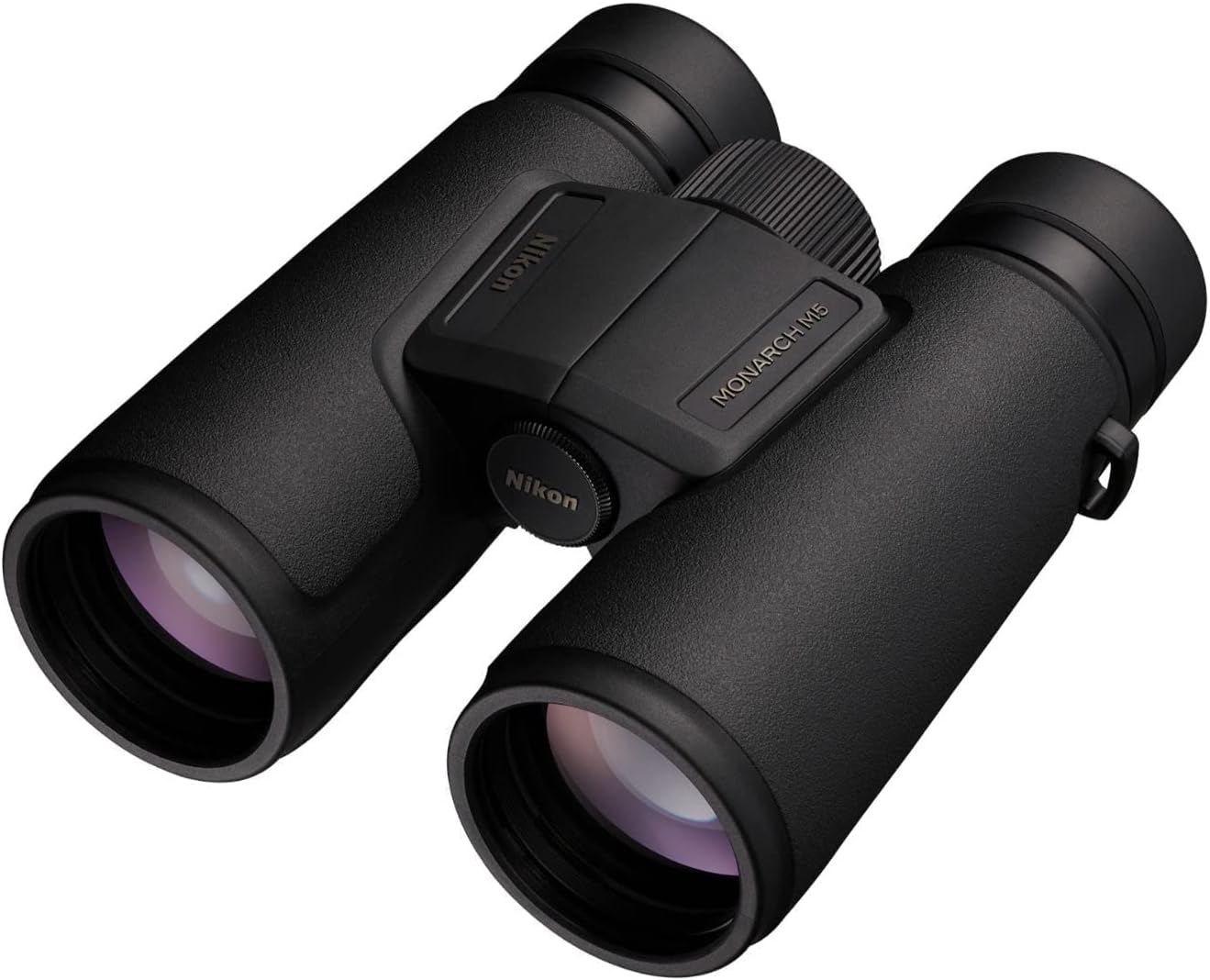
The Nikon Monarch M5 10x42 uses ED glass and dielectric prism coating in a waterproof and fogproof body. Its 10x magnification and 42 mm objectives make it a distinct configuration from the 8x42 comparison. Check this exact variant rather than transferring 8x42 specifications to it.
Check on AmazonIf you click this link and buy, we earn a commission at no additional cost to you.
Which Monarch M7 claims are documented and which still need independent performance evidence
Some differences are stable facts because they come directly from Nikon’s model pages and series documentation. The M7 has the wider published field, shorter published eye relief, slightly higher listed weight, a locking diopter, and oil and water repellent exterior lens coatings. The M5 and M7 both list ED glass, dielectric coatings, phase correction coatings, waterproofing, and fogproofing. Those facts are enough to discuss fit and feature differences without pretending that a specification automatically predicts every aspect of image quality.
Claims such as edge sharpness, glare behavior, color rendering, focus feel, and perceived brightness under difficult light are different. They depend on the optical system, sample, test conditions, observer, and sometimes the comparison method, so manufacturer wording alone should not settle them. Cornell’s independent 8×42 reviews provide useful evidence that the M7’s wide field is perceptible in use and that the M5’s narrower field can feel restrictive, but those observations remain test results from a specific review program. Use independent testing to judge visible performance, and use official specifications to judge published dimensions, fit variables, controls, and construction claims.
This separation keeps the comparison grounded. A spec can prove the M7 has a wider published scene, but not that your eyes will prefer its image or focus feel. One independent review can strengthen a performance claim without making it universal. Keep the evidence type attached to the claim type, especially when the recommendation could change because of fit.

The Nikon 7072 Lens Pen is a dedicated cleaning system for optical lenses. It is a maintenance accessory rather than a change to binocular optical specifications. That makes it relevant when separating documented exterior lens treatments from claims about visible image performance.
Check on AmazonIf you click this link and buy, we earn a commission at no additional cost to you.
Test the upgrade against close focus before treating it as a broader viewing upgrade
Close focus is a useful reality check because it is an area where the matched 8×42 models do not separate on Nikon’s published specification. Both are listed at 8.2 feet, so the M7 price premium does not buy a closer official focusing limit in this configuration. If your use includes nearby subjects at feeders, around a yard, or at short observation distances, that removes one possible justification for paying more. It also shows why a family upgrade should be tested one requirement at a time rather than assumed to improve every viewing dimension.
An independent review may measure a sample focusing closer than the manufacturer rating, but that does not change the safe buying baseline. Published close focus is the repeatable specification you can compare before purchase, while a reviewer measurement belongs to that particular sample and method. If a short minimum distance is a hard requirement, verify the exact model and do not substitute an anecdotal result for the manufacturer’s stated limit. In this M5 versus M7 decision, close focus is essentially neutral, which pushes the real choice back toward field of view, eye relief, controls, weight, and price.

The Nikon Monarch M7 8x30 uses ED glass and multilayer coatings in a waterproof and fogproof compact binocular. Nikon lists a 6.6-foot close-focus distance for this exact configuration. It shows why close-focus requirements should be verified at the specific model and size.
Check on AmazonIf you click this link and buy, we earn a commission at no additional cost to you.
Let current price change the value verdict, not the product facts
Price is the variable most likely to move while the core specifications stay put. That means a sale can make the M7 easier to justify, but it cannot turn 17.1 mm of published eye relief into 19.5 mm or make the M5 field suddenly equal the M7 field. Compare the current checkout prices only after you know which documented difference you actually value. The right question is how much you are paying for the wider view, locking diopter, lens surface treatment, and any independently supported performance advantage that matters to you.
A large price gap favors the M5 when its narrower field does not interfere with your viewing and its fit works well. A small gap makes the M7 easier to defend if you regularly follow moving subjects, scan broad scenes, or simply know that a wider viewing window materially reduces frustration. Neither conclusion should be tied to a price copied into an article and left to age. Use the current price difference, then judge whether it buys a benefit you will use repeatedly.
- Verify that you are comparing the same magnification and objective size.
- Check the current price difference rather than relying on an old list price.
- Identify the one or two M7 differences that solve an actual viewing or handling constraint.
- Do not pay more for ED glass, waterproofing, or prism coatings as though the M5 lacks them.
This makes value conditional without making it vague. If the wider field changes your viewing often, the premium can be rational even when the M5 is well equipped. If the wider field is merely nice to have and the M5 fits your glasses better, the lower tier can be the stronger decision. Price should scale the importance of the differences, not rewrite what those differences are.

The Vortex Triumph HD 10x42 is a waterproof, fogproof, tripod-adaptable binocular with HD optics. The Amazon listing includes a GlassPak harness with this model. It provides a separate 10x42 value reference when current price matters after the required features are defined.
Check on AmazonIf you click this link and buy, we earn a commission at no additional cost to you.
Choose Monarch M5 when its remaining limits do not affect the buyer
The M5 makes the most sense when the narrower viewing window is acceptable and the buyer would rather keep more eye relief, a little less weight, and more money in the budget. It already includes the core optical features that often sound like upgrade reasons, including ED glass and the published prism coatings. If your subjects are generally easy to acquire and you do not feel constrained by 335 feet at 1,000 yards in the 8×42 version, the M7’s most obvious advantage may not solve a real problem. In that situation, choosing M5 is not settling for an unfinished Monarch.
The strongest M5 case is therefore constraint-based. A glasses wearer who needs every bit of available eye relief should pay close attention to the M5’s longer published number, while a buyer sensitive to carrying weight may also prefer its lower listed mass. If you are deciding whether the M5 itself is worth stepping up to from Nikon’s lower line, the ProStaff P7 versus Monarch M5 comparison addresses that separate fork. Keep this decision clean by asking only whether the M7 solves something the M5 still leaves unresolved.

The Nikon Monarch M5 12x42 uses ED glass and dielectric prism coating in a waterproof and fogproof body. It keeps the 42 mm objective size while moving to 12x magnification. This exact variant is appropriate only when the higher magnification fits the buyer's viewing and stability needs.
Check on AmazonIf you click this link and buy, we earn a commission at no additional cost to you.
Pay for Monarch M7 only when a named constraint is actually solved
The M7 earns its place most clearly when field of view is the constraint. In matched 8×42 form, 435 feet at 1,000 yards is not a cosmetic change from 335 feet, and independent testing supports the idea that the wider scene is noticeable in real viewing. That can matter when subjects move unpredictably, when you want more context around the target, or when repeated reacquisition is what makes the M5 feel restrictive. The locking diopter also has practical value for someone who frequently moves the binocular in and out of a case or shares storage space where the adjustment might be disturbed.
The oil and water repellent lens surface treatment is a smaller but legitimate ownership benefit if you often deal with fingerprints, light moisture, or frequent exterior cleaning. It still should not be inflated into a claim that the M7 is universally sharper, brighter, or more durable in every condition. The M7 also asks you to accept less published eye relief and a little more weight in the 8×42 pair. Pay more when the wider scene and added controls solve recurring problems, not because the model number implies that every part of the experience must be better.

The Nikon Monarch M7 10x30 combines 10x magnification with 30 mm objectives in a compact waterproof and fogproof body. The Amazon listing identifies ED glass and multilayer coatings. It is a distinct M7 configuration for buyers who specifically want a smaller 10x format.
Check on AmazonIf you click this link and buy, we earn a commission at no additional cost to you.
Skip both when the matched configuration misses the required fit or role
A comparison between two related models can create a false sense that one of them must be the answer. If neither gives enough usable eye relief with your glasses, both feel awkward in your hands, the 8.2 foot close focus is too long for your normal subjects, or the current prices exceed the value you place on the differences, skip both. The same applies if 8×42 itself is the wrong configuration for your viewing distance, light, portability, or stability needs. Family loyalty should not override a bad physical or optical fit.
Skipping both can also mean that you have reached the wrong point on Nikon’s ladder rather than the wrong brand. A buyer who wants to know whether another step above M7 buys a different set of advantages can use the Monarch M7 versus Monarch HG comparison for that separate decision. The important discipline is to name the missing requirement first, then compare the models that can actually satisfy it. That keeps the purchase tied to viewing needs instead of turning a product family into a compulsory upgrade path.
| Decision | Choose it when | Do not choose it just because |
|---|---|---|
| Monarch M5 | The narrower field is acceptable, longer published eye relief helps, lower weight matters, and the lower current price is meaningful. | It has ED glass and premium-sounding coatings. The M7 shares those fundamentals too. |
| Monarch M7 | The much wider field, locking diopter, and lens surface treatment solve recurring viewing or handling constraints. | It is the higher tier or costs more. |
| Skip both | Neither configuration meets fit, viewing distance, close focus, portability, or budget requirements. | You feel one model in the family must be the answer. |
Use this decision card only after checking the exact configuration you intend to buy. The 8×42 evidence gives a clean example, but another magnification can change eye relief, field of view, exit pupil, and weight. Try to reject a model with one concrete fact before you try to justify it with a list of features. That is a more reliable way to keep a familiar badge from making the decision for you.

The Vortex Diamondback HD 8x42 is an 8x42 binocular with HD optics. The Amazon listing identifies it as waterproof, fogproof, shockproof, and tripod adaptable, and it includes a GlassPak carrier. Its matched 8x42 format makes it a practical alternative when neither Monarch meets the required fit or value.
Check on AmazonIf you click this link and buy, we earn a commission at no additional cost to you.
Final Thoughts: let the constraint earn the upgrade
The Monarch M7 is the stronger choice when its wider viewing window and added controls solve problems you will encounter often. The M5 remains the better fit when longer published eye relief, lower weight, and a lower current price matter more. Sharing ED glass is exactly why the tier name cannot do the reasoning for you. The useful question is not which badge ranks higher, but which difference changes your actual viewing enough to justify the trade-off.
Match the same configuration before deciding, then verify the fit variables that can reverse the recommendation. Keep documented specifications separate from test-dependent image claims, especially when brightness, edge sharpness, glare control, or focus feel enter the discussion. If you cannot name the M7 benefit that solves a recurring constraint, the M5 is probably doing enough. If neither model fits the way you observe, carry, or use glasses, skip both rather than forcing the family ladder.

The Vortex GlassPak is a binocular harness system designed to carry field optics. It provides a dedicated carry setup without changing magnification, field of view, eye relief, or other optical specifications. It is useful after the model decision when carry comfort and field access still matter.
Check on AmazonIf you click this link and buy, we earn a commission at no additional cost to you.
FAQs
🔭 Is the Monarch M7 optically better than the Monarch M5?
The M7 has documented differences such as a wider field of view, a locking diopter, and oil and water repellent exterior lens coatings, but both models already use ED glass plus dielectric and phase corrected prism coatings. Visible qualities such as edge sharpness, glare behavior, and focus feel need appropriate independent testing rather than a tier label.
👓 Which is better for eyeglass wearers, Monarch M5 or M7?
In the 8×42 pair, Nikon publishes more eye relief for the M5 at 19.5 mm versus 17.1 mm for the M7. Actual fit still depends on your frames, face, eyecup position, and whether you can see the full field comfortably.
🌲 How much wider is the Monarch M7 8×42 field of view?
Nikon lists 435 feet at 1,000 yards for the M7 8×42 and 335 feet for the M5 8×42. That wider scene can help with subject acquisition and tracking, but its value depends on what and how you observe.
⚖️ Is the Monarch M7 8×42 lighter than the M5 8×42?
No. Nikon lists the M7 8×42 at 23.6 ounces and the M5 8×42 at 22.2 ounces, so the M5 is lighter on the published specification. Balance and hand fit still affect how heavy either model feels during use.
💵 Is the Monarch M7 worth paying more for?
It is easier to justify when the wider field, locking diopter, or lens surface treatment solves a recurring constraint for you. If the M5 field is already sufficient and its longer eye relief or lower weight fits you better, paying more may add features without improving the part of the experience you care about.
References and Sources
- Nikon Monarch M5 8×42 specifications: verifies the M5 8×42 field of view, eye relief, close focus, weight, ED glass, prism coatings, and weather protection claims used in the comparison.
- Nikon Monarch M7 8×42 specifications: verifies the matched M7 8×42 field of view, eye relief, close focus, weight, ED glass, prism coatings, and locking diopter.
- Nikon Monarch M5 and M7 series documentation: supports the shared feature list and the M7 oil and water repellent lens coating distinction.
- Cornell Lab Monarch M5 8×42 review: provides independent context for how the M5 field of view was experienced in a controlled review program.
- Cornell Lab Monarch M7 8×42 review: provides independent context for the M7 viewing window and handling observations without treating those findings as universal.