A binocular size and weight comparison becomes more useful when the configuration label is treated as a starting point, not a weight class. In this current official-spec sample, models with the same 8×42 or 10×42 label differ by several ounces, while selected 10×50 models overlap parts of the 42mm range. The dataset keeps manufacturer weight values visible, adds normalized grams and ounces, and preserves each brand’s own dimension format instead of pretending the documentation is more consistent than it is. The practical takeaway is simple: check the exact published weight of the exact model before using objective size or magnification as a shortcut for carrying load.
Same configuration label, different load
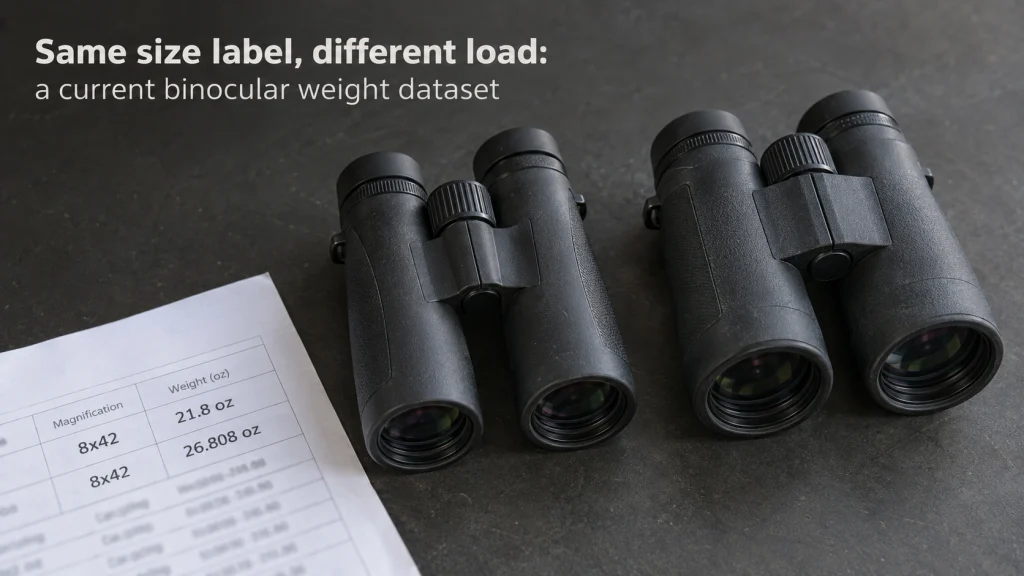
Put two current 8×42 spec sheets side by side for a binocular size and weight comparison, and the label looks identical while the listed weight does not. Vortex publishes 21.8 oz for the Diamondback HD 8×42, while Maven publishes 26.808 oz for the B1.2 8×42. That is a difference of about 5.0 oz, or roughly 142 g, before changing magnification or objective diameter. A useful comparison therefore has to separate the familiar configuration label from the physical weight printed on the exact model page.
The same pattern appears when the sample widens. The 10×42 entries range from 21.3 oz to 26.808 oz, while the selected 10×50 entries range from 22.2 oz to 30.0 oz. Those numbers do not make one configuration better, and they do not tell us which binocular will feel balanced in a particular person’s hands. They do show that a buyer who treats 8×42, 10×42, or 10×50 as a reliable weight category can miss a meaningful difference before the binocular ever reaches a case or harness.
The current sample and normalization rules
I kept this dataset deliberately narrow so the comparison stays reproducible. It uses current official manufacturer pages for Maven, Nikon, and Vortex, and it records the exact model configuration, published weight, normalized weight, and the dimension entry shown by the manufacturer. The sample is not a market average, a ranking, or a claim about every binocular sold in the United States. It is a controlled cross-brand check designed to show how much physical weight can move even when the nominal configuration stays the same.
Weights published only in ounces were converted with the standard ounce-to-gram conversion and rounded to the nearest gram for the normalized column. When a manufacturer already supplied both ounces and grams, the manufacturer’s own values remain visible rather than being silently replaced. Dimensions are preserved in the order used on the official page because brands do not all document length, width, height, and depth the same way. That choice matters later, because apparent dimensional similarity can be misleading when one page gives two axes and another gives three.
| Configuration | Model | Official published weight | Normalized weight | Official dimension entry |
|---|---|---|---|---|
| 8×30 | Maven B.3 | 16.6 oz | 16.6 oz / 471 g | 4.7 x 4.6 x 1.6 in, W x H x D |
| 8×30 | Nikon MONARCH M7 | 16.4 oz / 465 g | 16.4 oz / 465 g | 4.7 x 4.9 in, L x W |
| 8×42 | Maven B1.2 | 26.808 oz | 26.808 oz / 760 g | 5.2 x 5.7 x 2.2 in, W x H x D |
| 8×42 | Nikon MONARCH M7 | 23.6 oz / 669 g | 23.6 oz / 669 g | 5.6 x 5.1 in, L x W |
| 8×42 | Vortex Diamondback HD | 21.8 oz | 21.8 oz / 618 g | 5.7 x 5.1 in, H x W |
| 10×42 | Maven B1.2 | 26.808 oz | 26.808 oz / 760 g | 5.2 x 5.7 x 2.2 in, W x H x D |
| 10×42 | Nikon MONARCH M7 | 24.0 oz / 680.3 g | 24.0 oz / 680 g | 5.6 x 5.1 in, L x W |
| 10×42 | Vortex Diamondback HD | 21.3 oz | 21.3 oz / 604 g | 5.7 x 5.1 in, H x W |
| 10×50 | Nikon PROSTAFF P7 | 22.2 oz / 630 g | 22.2 oz / 630 g | 6.7 x 5.2 in, L x W |
| 10×50 | Vortex Diamondback HD | 30.0 oz | 30.0 oz / 850 g | 6.6 x 5.3 in, H x W |
The table is most useful as a set of documented examples, not as a substitute for checking the model you are actually considering. Specifications can change, variants can differ, and a similarly named binocular may not share the same chassis or published weight. If a model is not in this frozen sample, its weight should be verified on its own official page instead of inferred from the nearest row. That same discipline applies to other numbers explained in the site’s binocular specifications guide.
Separate configuration from physical weight
A label such as 8×42 tells you magnification and objective diameter, not the mass of the finished binocular. It says nothing by itself about housing material, prism packaging, bridge design, armor thickness, focusing hardware, or how compactly the optical system is packaged. Those construction choices can move the scale while leaving the two numbers on the badge unchanged. That is why I would use configuration to narrow optical and use-case questions, then use exact published weight as a separate buying filter.
This separation also prevents weight from becoming a proxy for unrelated optical decisions. Choosing between 8x and 10x still involves field of view, steadiness, target distance, and other viewing conditions that weight alone cannot answer. The site’s comparison of 8x and 10x binocular field of view handles that distinction directly. Once magnification is chosen for the viewing task, the weight line on the exact model page deserves its own check instead of being assumed from the configuration.
How much weight varies inside the same nominal configuration
The clearest result appears when the models are grouped by exact configuration and only the lightest and heaviest published values are compared. The compact 8×30 pair is tightly grouped, but the 42mm groups spread by about five ounces, and the selected 10×50 pair spreads even farther. That means the configuration label sometimes corresponds to a narrow weight band and sometimes does not. A shopper cannot know which case applies until the exact models are checked.
The percentage column below uses the lightest model in each group as the reference point, so it is a measure of spread inside this sample rather than a statement about the whole market. The sample is too small to declare a universal average for any configuration, and that is not its purpose. Its purpose is to make the hidden variation visible with traceable current specifications. The larger the within-group spread, the weaker the configuration label becomes as a shortcut for physical load.
| Exact configuration | Lightest published weight | Heaviest published weight | Observed spread | Spread versus lightest |
|---|---|---|---|---|
| 8×30 | 16.4 oz / 465 g | 16.6 oz / 471 g | 0.2 oz / about 6 g | about 1% |
| 8×42 | 21.8 oz / 618 g | 26.808 oz / 760 g | 5.008 oz / about 142 g | about 23% |
| 10×42 | 21.3 oz / 604 g | 26.808 oz / 760 g | 5.508 oz / about 156 g | about 26% |
| 10×50 | 22.2 oz / 630 g | 30.0 oz / 850 g | 7.8 oz / about 221 g | about 35% |
Compare 8×30 and nearby compact models within their own group
The two 8×30 entries are unusually close in this sample: 16.4 oz for the Nikon MONARCH M7 and 16.6 oz for the Maven B.3. That 0.2 oz gap is small enough that the configuration label happens to be a reasonable first estimate for these two specific models. It would still be a mistake to extend that result to every 8×30 or 8×32 binocular, because the dataset does not establish a universal compact weight band. A nearby compact label should be checked on its own model page rather than merged into the 8×30 result.
Compare 8×42 models within their own group
The 8×42 group is where the shortcut breaks down visibly. Vortex lists the Diamondback HD at 21.8 oz, Nikon lists the MONARCH M7 at 23.6 oz, and Maven lists the B1.2 at 26.808 oz. The heaviest entry is about 23% heavier than the lightest entry in this small sample, even though all three say 8×42 on the specification sheet. If carry weight is a real constraint, five ounces is large enough that I would compare the exact model weights before treating any 8×42 label as a useful answer.
Compare 10×42 models within their own group
The 10×42 group tells the same story with a slightly wider spread. Vortex publishes 21.3 oz for the Diamondback HD, Nikon publishes 24.0 oz for the MONARCH M7, and Maven publishes 26.808 oz for the B1.2. The difference between the lightest and heaviest entries is about 5.5 oz, or roughly 156 g. Nothing about the 10×42 label itself tells the buyer which end of that range a particular model will occupy.
Compare selected 50mm models without calling all 50mm binoculars heavy
A larger objective can require a larger physical package, but the sample does not support the shortcut that every 50mm binocular is automatically heavier than every 42mm binocular. Nikon publishes 22.2 oz for the PROSTAFF P7 10×50, which is lighter than the Nikon MONARCH M7 8×42 and both Maven B1.2 42mm variants in this dataset. Vortex publishes 30.0 oz for the Diamondback HD 10×50, so the two selected 10×50 models themselves differ by 7.8 oz. The objective diameter is therefore part of the size story, but it is not a complete weight prediction.
This is also why broad labels such as compact, full size, or large objective should stay descriptive rather than deterministic. They can help organize options, but the finished chassis can move a specific model well above or below an assumed weight band. For readers trying to reduce packed bulk rather than just scale weight, the separate travel binocular selection guide is the better place to consider carrying size, use conditions, and portability together. The dataset here stays narrower and answers only what the published dimensions and weights can support.
Check whether dimensions move with weight
Physical dimensions do not march upward with weight in a clean line inside this sample. The Nikon PROSTAFF P7 10×50 is listed at 6.7 x 5.2 in and 22.2 oz, while the Vortex Diamondback HD 10×50 is listed at 6.6 x 5.3 in and 30.0 oz. Their published length or height and width are close, yet their listed weights differ by nearly half a pound. That comparison is enough to show why a footprint estimate cannot replace the weight field.
The 8×42 group is similarly untidy because the brands publish dimensions in different axis conventions. Nikon lists 5.6 x 5.1 in as length by width, Vortex lists 5.7 x 5.1 in as height by width, and Maven lists 5.2 x 5.7 x 2.2 in as width by height by depth. Those entries are useful, but they are not a perfectly standardized three-dimensional dataset. A buyer checking case fit or packed volume should therefore compare the exact dimension labels, not just the sequence of numbers.
Where manufacturer weight definitions become inconsistent
The biggest documentation problem is not that the numbers are unusable, but that the surrounding definitions are often incomplete. Some pages give ounces only, some give ounces and grams, and dimension fields may stop at two axes even when another manufacturer lists three. The model pages used here also list included accessories separately from the weight specification without clearly stating that straps, caps, cases, or harnesses are part of the published weight. That means the safest comparison is published model weight against published model weight, with no attempt to invent an accessory correction that the source does not document.
That limitation should stay visible rather than being cleaned away in a spreadsheet. A normalized gram column makes arithmetic easier, but it does not make the underlying manufacturer definitions identical. The site’s binocular specification sheet guide explains why exact field names and model-level documentation matter when comparing specs. If a future manufacturer page explicitly defines what its weight includes, that definition should be recorded with the number instead of assumed from another brand’s convention.
Documentation caveat: The normalized values in this article convert units only. They do not add or remove lens caps, straps, cases, harnesses, or other accessories, because the official model pages in this sample do not provide a consistent inclusion rule for those items.
For a buyer, this caveat changes the right next step. Use the manufacturer value to compare bare published specifications, then separately account for the carrying setup you actually plan to use. Do not subtract an estimated strap weight from one model or add an estimated cap weight to another just to make the rows look uniform. False precision is worse than a clearly stated documentation boundary.
What published weight cannot tell you about balance or comfort
A scale value cannot tell us where the mass sits between the objective end, bridge, and eyepieces. It also cannot establish grip fit, focus-wheel reach, eyecup fit, or how a particular strap distributes load. Those are physical interaction questions, and this dataset does not include handling tests. I would not turn a 21 oz or 27 oz specification into a claim that one model is comfortable, tiring, stable, or easy to hold for a particular person.
Weight is still useful because it is one of the few carrying variables that manufacturers routinely publish as a number. The right use is to screen obvious mismatches, compare two exact models, and understand how much mass is being added before accessories. After that, hand fit and carrying method need their own evaluation if they matter to the buyer. A lighter number can be attractive, but this dataset does not support the claim that lighter is always better.
The weight check I would make before buying
I would treat published weight as a separate line item in the buying decision, not as something already answered by the configuration. First decide what magnification and objective size fit the viewing situation, then compare the exact models that remain. If two candidates meet the optical and fit requirements, a five-ounce difference becomes meaningful information rather than a guess based on the label. That sequence keeps weight important without letting it override field of view, eye relief, dimensions, or other model-specific constraints.
The check itself is simple enough to repeat whenever a shortlist changes. It also prevents a common comparison mistake, which is mixing retailer weights, owner measurements with accessories attached, and manufacturer bare-spec values in the same table. Keep one documentation basis for the initial comparison, then investigate exceptions only when they affect the decision. The following order is the one I would use:
- Open the official page for the exact magnification and objective variant.
- Copy the published weight exactly and note whether the page defines what is included.
- Convert ounces and grams once for comparison, while preserving the manufacturer’s raw value.
- Check dimensions separately and keep the manufacturer’s axis labels attached to the numbers.
- Compare carrying accessories only after the base binocular weights are on the same documentation basis.
- Use weight as a filter, then return to eye relief, field of view, physical fit, and viewing conditions before making the final choice.
This method is deliberately less convenient than assuming every 8×42 weighs about the same. It is also more accurate, because the 8×42 and 10×42 groups in this sample show enough spread to change a shortlist for someone with a strict weight target. If the difference is only a few tenths of an ounce, the scale may not deserve much influence. If the difference is five ounces or more, it deserves to be seen before the purchase rather than discovered after the rest of the setup is already chosen.
Final Thoughts: treat published weight as its own specification
The strongest result in this dataset is not that one configuration is light or heavy. It is that identical configuration labels can hide several ounces of model-to-model variation, especially in the 42mm groups sampled here. The selected 50mm pair also shows why objective diameter alone cannot predict finished weight. Exact model weight deserves the same deliberate check as field of view, eye relief, or close focus when carrying load matters.
Use configuration to describe the optical format, then verify physical weight from the exact current model page. Keep normalized units for easy comparison, but preserve the manufacturer’s original number and documentation limits. Do not infer comfort, balance, or accessory-inclusive weight from the scale value alone. That approach is slower than relying on labels, but it produces a cleaner buying decision with fewer hidden assumptions.
FAQs
🔭 How much do 8×42 binoculars weigh?
There is no single 8×42 weight. In this official-spec sample, the three 8×42 models range from 21.8 oz to 26.808 oz, so check the exact model rather than using the configuration as a weight estimate.
⚖️ Are 10×42 binoculars always heavier than 8×42 binoculars?
No. The lightest 10×42 in this sample is 21.3 oz, which is lighter than two of the three 8×42 entries. Magnification alone does not determine finished weight.
🎒 Does a 50mm objective always mean a heavy binocular?
No. The selected Nikon 10×50 is listed at 22.2 oz, while the selected Vortex 10×50 is listed at 30.0 oz. A 50mm objective can affect physical size, but the exact model construction still matters.
📏 Can I compare binocular dimensions across brands directly?
Only after checking the dimension labels. One brand may publish length by width, another height by width, and another width by height by depth, so the numbers are not automatically equivalent.
🧭 Is published weight enough to judge carrying comfort?
No. Published weight can screen models by mass, but it does not establish balance, grip fit, strap behavior, or comfort for a particular user. Those factors need separate evaluation.
References and Sources
- Maven B1.2 product specifications: supports the published 8×42 and 10×42 weights and dimensions used in the dataset.
- Maven B.3 specifications: supports the published 8×30 weight and dimensions.
- Nikon MONARCH M7 8×30 specifications: supports the published 8×30 weight and size entry.
- Nikon MONARCH M7 8×42 specifications: supports the published 8×42 weight and size entry.
- Nikon MONARCH M7 10×42 specifications: supports the published 10×42 weight and size entry.
- Nikon PROSTAFF P7 10×50 specifications: supports the published 10×50 weight and size entry.
- Vortex Diamondback HD 8×42 specifications: supports the published 8×42 weight and dimensions.
- Vortex Diamondback HD 10×42 specifications: supports the published 10×42 weight and dimensions.
- Vortex Diamondback HD 10×50 specifications: supports the published 10×50 weight and dimensions.