I coded a frozen set of public binocular ownership complaints instead of treating star ratings as a shortcut to ownership quality. The method separates fit, eyecup behavior, focus, carrying, stability, service, accessories, and expectation mismatch before any category is ranked. The counts are useful for identifying what a buyer should verify, not for estimating defect rates, market prevalence, or the odds that a particular binocular will fail. The practical takeaway is a pre-purchase checklist built around the ownership friction that the fixed sample was designed to capture.
One complaint can point to more than one buying problem
One of the binocular buyer complaints in the frozen sample described a view that blacked out unless the binocular was held slightly away from the face. That single complaint could fit eye placement, eyecup range, and expectation mismatch at the same time. I defined those categories before I counted them so the result would not be shaped around whichever pattern looked strongest later. If I forced that post into one bucket, I would hide part of the ownership friction that matters before a purchase.
The point is not to turn forum frustration into a scorecard for brands or models. It is to ask what kinds of friction repeat often enough in a fixed sample that a buyer should verify them before spending money. The binocular buying guide provides the broader purchase framework, while the binocular troubleshooting guide covers owner-safe checks when a problem appears after purchase. A star rating cannot tell you whether the reviewer wears glasses, needs a longer eyecup position, carries binoculars for hours, or expected a higher magnification to feel steadier. A coded sample can at least separate those different problems before anyone starts ranking them.
Communities, time window, and unit of analysis
I froze three public communities before coding: the Binoculars community on Reddit, the binocular forum on BirdForum, and the Binoculars forum on Cloudy Nights. I used a fixed three-year window and selected 8 qualifying complaint-bearing units from each venue, producing a denominator of 24. The unit of analysis was one thread starter or one clearly stated owner complaint in the opening post, not every reply beneath it. That keeps a long discussion from outweighing a short complaint simply because more people responded.
A unit qualified when it described post-purchase friction involving use, fit, carrying, focus, eyecups, alignment, service, or accessories. Pure shopping recommendations, promotional posts, duplicate URLs, unrelated telescope problems, and technician-level repair discussions were excluded. I also excluded medical diagnosis and did not code a health outcome as a binocular defect. The collection was frozen before the category counts were drafted, so no category was added because it happened to look interesting later.
Method: 24 frozen complaint-bearing units, with 8 from each of three public communities. One unit could receive multiple predefined codes, so the category counts add up to more than 24.
Boundary: The sample is purposive and public, not random. It is useful for identifying recurring ownership friction, but it cannot estimate how often any problem occurs across all binocular owners.
The complaint codebook was defined before counting
The codebook used nine categories: weight and carry, shake, eye relief and fit, eyecups, focus, alignment, expectation mismatch, warranty and service, and accessory friction. The boundaries matter because similar words can describe different ownership problems. A loose eyecup is not automatically an eye relief problem, and a hard-to-merge image is not automatically proof of failed alignment. Coding the wording of the complaint rather than inventing a diagnosis keeps the evidence boundary intact.
I also kept fit separate from medical interpretation. If someone described blackouts, difficult eye placement, or trouble seeing the full field with glasses, that could be coded as eye relief and fit when the post supported it. It was not converted into a claim about headaches, vision disorders, or any other medical cause. When a complaint described double images or suspected misalignment, the unit could receive an alignment code, but the sample still does not prove why the condition occurred.
| Code | What qualified | What did not automatically qualify |
|---|---|---|
| Weight and carry | Neck load, packability, carrying fatigue, or carry setup friction | Weight listed only as a specification |
| Shake | Difficulty holding the view steady or magnification-related stability frustration | Any mention of high magnification |
| Eye relief and fit | Blackouts, difficult eye placement, glasses fit, or inability to see the usable field comfortably | A medical explanation for discomfort |
| Eyecups | Loose, broken, collapsing, stuck, short, or otherwise troublesome eyecups | Eye relief alone with no eyecup issue |
| Focus | Stiffness, play, drifting, uneven resistance, or inability to obtain a stable focus | General image softness with no focus complaint |
| Alignment | Double image, merging difficulty, or an explicit alignment concern | Automatic proof of a manufacturing defect |
| Expectation mismatch | Ownership experience materially differed from what the buyer expected | Simple preference with no stated friction |
| Warranty and service | Repair process, warranty coverage, turnaround, replacement, or service access | General brand reputation |
| Accessory friction | Harness, strap, replacement part, eyecup part, or compatibility problem | Accessory interest with no ownership problem |
The codebook is deliberately plain because the goal is decision usefulness, not diagnostic precision. A buyer can act on a repeat complaint about eyecup range or harness compatibility without pretending to know the engineering root cause. The same restraint is useful when reading a spec sheet: a specification tells you what is documented, while fit and handling still need to be checked in the context that matters to you. That distinction should stay separate from any attempt to turn complaint language into a diagnosis.
What the coded complaint categories look like in this sample
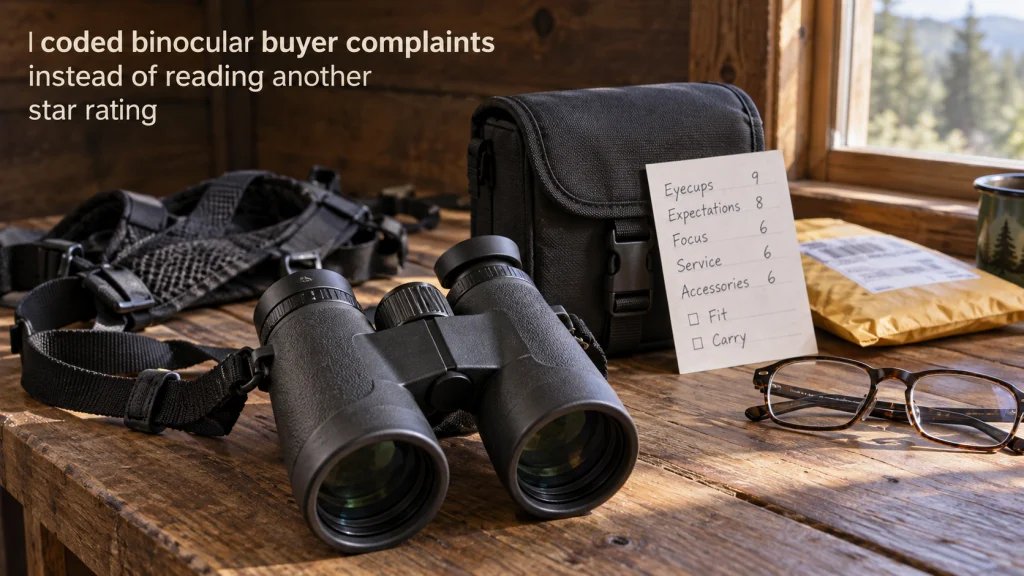
The count table shows recurrence inside the frozen sample, not a league table of binocular defects. Eyecups received the highest count at 9 units, followed by expectation mismatch at 8. Focus, warranty and service, and accessory friction each appeared in 6 units, while eye relief and fit and weight and carry each appeared in 5. Shake and alignment each appeared in 2 units, which is a reminder that a low count in a purposive sample is not evidence that a problem is rare in the wider market.
The more useful pattern is how often physical interface and ownership logistics sit beside optical complaints. A buyer can be satisfied with image quality and still dislike a collapsing eyecup, stiff focus wheel, awkward carry setup, or slow service path. That is exactly why a purchase decision should not stop at magnification, objective diameter, coatings, or a star average. The friction that makes a binocular stay in a closet is often more ordinary than the specification that sold it.
| Complaint category | Coded units | Pre-purchase implication |
|---|---|---|
| Eyecups | 9 | Check extension range, detents, stability, replaceability, and fit with or without glasses. |
| Expectation mismatch | 8 | Translate specifications into actual viewing and carrying conditions before buying. |
| Focus | 6 | Check smoothness, resistance, play, and whether focus behavior suits moving or changing-distance subjects. |
| Warranty and service | 6 | Read coverage, service route, exclusions, and realistic repair or replacement logistics. |
| Accessory friction | 6 | Verify strap, harness, replacement part, and attachment compatibility for the exact binocular. |
| Eye relief and fit | 5 | Verify usable eye position, field visibility, and eyecup range with your face and glasses. |
| Weight and carry | 5 | Judge the full carry setup, not the binocular weight in isolation. |
| Shake | 2 | Do not assume more magnification or less weight will automatically feel steadier. |
| Alignment | 2 | Persistent double image or merging trouble belongs in troubleshooting or service, not casual adjustment. |
How duplicates and multi-category complaints were handled
Duplicate URLs were removed before counting, and an identifiable cross-post would have been treated as one ownership event rather than two separate votes. No reply was counted as a new unit simply because it repeated the original complaint. Multi-code was allowed only when the opening complaint contained distinct friction that matched more than one predefined category. That rule is why 24 units produced 49 total category assignments.
The ranked complaint categories in this sample
Eyecups ranked first in this sample, but that does not mean eyecups are the most failure-prone binocular component. It means eyecup friction appeared in more of the 24 frozen units than any other predefined category. Expectation mismatch came next, which is important because many ownership disappointments were not clean defect stories at all. A technically functional binocular can still be a poor personal fit or a poor match for the buyer’s intended use.
Separate carry and weight friction from optical dissatisfaction
Weight and carry received 5 codes, and accessory friction received 6, so carrying problems should not be buried under a general complaint about the binocular itself. A neck strap, backpack, harness, case, and the time spent carrying can change whether a given weight feels acceptable. A buyer who likes the view but avoids taking the binocular outside has an ownership problem even if the optics are fine. That is a different decision problem from sharpness, field of view, or eye relief.
Separate magnification and shake expectation mismatch from defects
Shake appeared only twice in the frozen sample, but those complaints illustrate a useful boundary. A shaky view does not automatically mean the binocular is defective, and a heavier binocular does not automatically mean a less stable view. Magnification, balance, grip, face contact, hand position, fatigue, and viewing duration can all change what the user perceives. Two people can therefore react differently to the same configuration without either reaction proving a mechanical fault. That is why the correct pre-purchase question is not simply whether one magnification is “too shaky.”
The better check is whether you can hold the exact configuration steadily enough for your actual target distance and observation time. Higher magnification can make motion more visible, while very light binoculars can also be harder for some people to settle. If stability remains unacceptable after normal setup, support may be more useful than blaming the optical system. A complaint about shake belongs in the expectation and handling discussion unless there is separate evidence of a mechanical problem.
Separate fit, eye relief, and eyecup complaints from medical claims
Eye relief and fit appeared in 5 units, while eyecups appeared in 9, and several complaints touched both categories. That overlap makes sense because the eyecup is part of how the user’s eye reaches a usable position behind the eyepiece. Still, the two codes are not interchangeable. A buyer may have adequate published eye relief but dislike the eyecup range, detents, diameter, stability, or face contact.
I did not treat discomfort, visual strain, or difficult merging as a medical diagnosis. The owner-level response is to verify interpupillary distance, diopter setup, eyecup position, glasses use, and whether the image is comfortable and single under normal viewing. If persistent visual symptoms continue outside ordinary setup troubleshooting, the product discussion has reached its boundary. The article can identify fit friction, but it should not invent a health explanation for it.
Mechanical, alignment, accessory, and service complaints need different next steps
Focus, alignment, accessory friction, and service complaints can sound like one broad story about build quality, but the next step is different for each. A stiff focus wheel may need model-specific support, while a loose eyecup may be a replaceable part, a warranty issue, or simply a fit limitation. Persistent double image or suspected internal alignment trouble should not be turned into a casual owner repair project. Owner-safe checks should stop before internal adjustments when the symptom points beyond normal setup.
Service friction deserves its own code because warranty language is only part of ownership cost. Shipping, parts availability, repair routing, turnaround, and whether a company repairs or replaces can matter after the sale. Accessory friction matters for the same reason: a harness or replacement eyecup is useful only if the exact interface and dimensions work. Before buying, verify the service path and accessory attachment points that you are actually likely to use.
Why complaint frequency is not failure rate
Nine eyecup codes out of 24 units does not mean 37.5 percent of binoculars have eyecup failures. The sample was built from complaint-bearing public posts, so satisfied owners are largely absent by design. Search visibility, community culture, thread titles, and which problems motivate people to post can all affect what enters the corpus. Even the predefined query bundle can make some types of friction easier to retrieve than others.
That bias does not make the exercise useless, but it changes the claim I am willing to make. The sample shows which complaint types recurred inside a fixed, transparent collection and therefore deserve a buyer’s attention before purchase. It does not establish market prevalence, defect probability, brand reliability, or population-wide regret. If a category appears often here, the practical response is to verify it, not to assume every owner will experience it.
Limitation: Public complaint forums overrepresent people who have a question or a problem. They also underrepresent owners who solved a small issue without posting.
Interpretation: Use the counts to build a verification list, not to calculate the chance that a binocular will fail.
The pre-purchase checks I would add because of this sample
The sample changed the order of what I would verify before buying. Optical specifications still matter, but I would move eyecup behavior, face fit, focus feel, carrying setup, accessory compatibility, and service terms closer to the front of the decision. These are not glamorous features, yet they appeared repeatedly in the ownership complaints I coded. A binocular that works on paper can still become annoying if one of these interfaces is wrong for the user.
The checks below are intentionally model-specific and practical. They do not require a laboratory, and they do not assume a higher price solves fit. If you are already overwhelmed by specifications, start with the conditions in which you will actually carry and use the binocular, then eliminate options that fail the physical and service checks. That approach is more useful than trying to find one universal winner.
- Check whether the eyecups extend far enough, hold their position, and give you a stable view with your normal glasses or no-glasses setup.
- Confirm that you can see the usable field without persistent blackouts or constant head-position correction.
- Turn the focus through the distances you actually expect to use and notice stiffness, play, uneven resistance, or a speed that feels wrong for moving subjects.
- Judge total carry comfort with the strap, harness, case, and clothing you expect to use, not binocular weight alone.
- Verify that replacement caps, eyecups, harness connectors, tripod interfaces, and other accessories fit the exact model.
- Read the warranty and service route before buying, including exclusions, shipping responsibility, and whether parts are realistically available.
- Return or service a binocular with persistent double image, internal looseness, water ingress, or other signs that go beyond normal owner setup.
None of these checks guarantees a perfect ownership experience, but each converts a recurring complaint into something a buyer can verify. That is the useful role of complaint coding. It turns anecdotes into questions without pretending that the anecdotes are population statistics. The result is a shorter, more defensible list of things to check before money changes hands.
Final Thoughts: use complaints as a verification list, not a verdict
The strongest result from this sample is not that one component “fails most.” It is that ordinary interface problems such as eyecups, focus feel, carrying, fit, accessories, and service can matter as much as the headline optical specification after the purchase. Eyecups led the coded sample, but expectation mismatch was close behind, which is a useful warning against buying from a spec sheet alone. The buyer’s job is to turn those recurring complaints into checks that can be performed before committing.
I would use community complaints as a source of questions, not as a substitute for product verification. Check the exact binocular, your glasses or no-glasses setup, your carry method, and the service terms that apply to that model. Treat persistent alignment or internal mechanical trouble as a service issue rather than an invitation to start taking the binocular apart. That keeps the lesson practical without turning a small public sample into a claim it cannot support.
FAQs
The questions below are the practical ones that kept resurfacing while I reviewed ownership complaints and the surrounding discussions. They are answered at the level a buyer or owner can act on without diagnosing internal optics or medical causes. Where the answer depends on fit, configuration, or model-specific design, that condition is stated directly. The same complaint can have different causes, so the next step matters more than a quick label.
These answers also keep the sample in perspective. A repeated complaint in a forum does not prove a universal defect, and a low count does not prove a problem is rare. Use the questions to decide what to verify before purchase or what to check safely after purchase. If a problem crosses into internal damage, persistent double image, or service-only work, stop at the owner-level boundary.
🔭 What was the most frequent binocular complaint in this sample?
Eyecup friction appeared in 9 of the 24 coded units, the highest count in this sample. That does not mean eyecups have a 37.5 percent failure rate, because the corpus was built from complaint-bearing public posts rather than a random owner survey.
👓 Are blackouts always caused by too little eye relief?
No. Blackouts can involve eye position, eyecup range, usable eye relief, interpupillary setup, and the way a particular eyepiece interacts with the user’s face and glasses. Verify the exact binocular rather than treating one published eye relief number as a complete fit test.
🎯 Does a shaky view mean the binocular is defective?
Not by itself. Magnification, balance, grip, weight, viewing duration, and face contact can all affect apparent stability. Suspect a mechanical issue only when there is separate evidence such as internal looseness, abnormal movement, or another repeatable fault.
⚙️ Should I fix binocular alignment myself if I see double images?
Persistent double image should be treated as a troubleshooting and service problem, not an automatic do-it-yourself adjustment. Verify normal setup first, then use model-specific support or qualified service if the problem continues.
🎒 Is binocular weight alone enough to predict carrying comfort?
No. Carrying comfort also depends on strap or harness design, clothing, pack interaction, duration, balance, and how often you raise the binocular. Judge the complete carry system you expect to use.
🧰 What should I check about warranty service before buying?
Check coverage, exclusions, proof-of-purchase requirements, shipping responsibility, repair or replacement policy, and the service route for your location. A strong warranty headline is less useful if the practical process does not fit your situation.
References and Sources
This data post used public complaint discussions from Reddit, BirdForum, and Cloudy Nights, with the full frozen URL list retained in the coding record rather than published as a long link dump. The sources below are representative examples from the same research set and show the kinds of fit, eyecup, focus, alignment, carry, and service complaints that informed the codebook. They support the published examples and methodology rather than a claim that any one thread represents all owners. No source was used to calculate a market-wide failure rate.
Community posts are owner reports, not technical proof of root cause. I used them to identify recurring questions and friction, then kept the conclusions at the level the evidence supports. Brand names in these sources are evidence context, not product recommendations. The article’s main conclusion remains a verification checklist, not a reliability ranking.
- Reddit discussion about excessive eye relief and unstable eye placement: supports the distinction between eye fit, eyecup position, and perceived stability.
- Reddit warranty and repair discussion: supports coding warranty coverage, repair logistics, and service friction separately from optical quality.
- BirdForum binocular repair and service discussion: supports the service-process category and the separation of focus problems from warranty logistics.
- BirdForum eyecup issue discussion: supports the eyecup category and the value of checking part stability and replacement support.
- Cloudy Nights fit and refund discussion: supports coding personal fit and expectation mismatch without turning discomfort into a medical claim.
- Cloudy Nights double-image discussion: supports treating persistent image-merging problems as an alignment or service question rather than an automatic owner repair task.