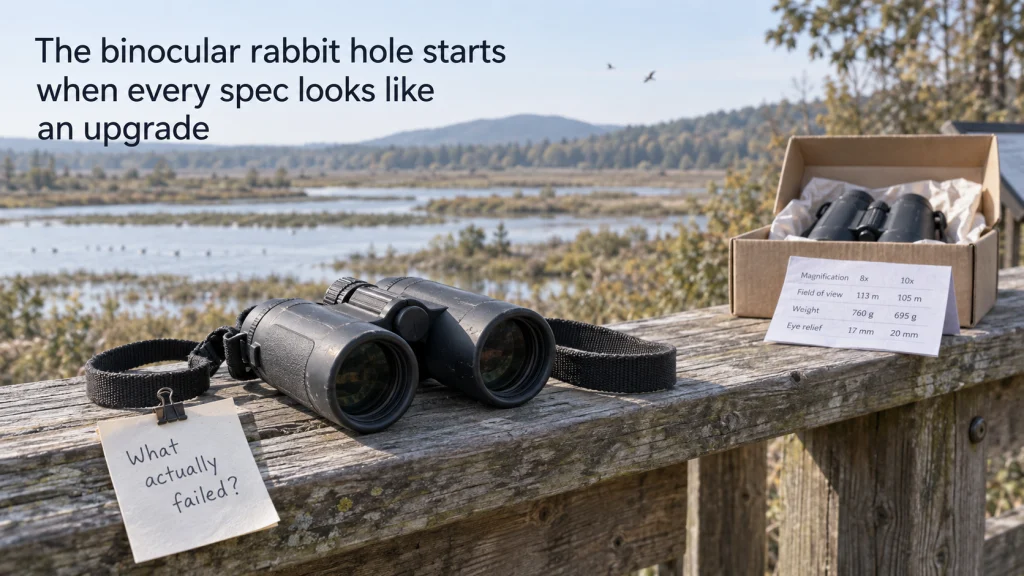
A binocular rabbit hole often starts when a pair that was doing its job gets compared against a specification that sounds better. The binocular has not changed, but the comparison can make its normal trade-offs feel like new defects. Curiosity is useful, but it becomes a poor reason to buy when there is no viewing problem to solve. The simplest stopping rule is to stop comparing until you can name what your current pair fails to do in actual use.
Comparison can change the feeling without changing the binocular
A binocular rabbit hole can begin with a pair that is already clear enough, comfortable enough, and easy enough to carry for the way you actually use it. Then you notice another model with a wider field of view, lower weight, longer eye relief, a different bridge design, or a price that suggests something more refined. Nothing about your current view has become worse. What changed is the reference point in your head, and suddenly a specification you barely noticed yesterday starts to look like a deficiency today.
That shift matters because comparison is very good at creating new questions and much worse at deciding whether those questions matter. A wider field can sound irresistible until you remember that you were not losing moving subjects at the edge of the view. A lighter body can look obviously better until you realize the current weight has never stopped you from carrying the binocular where you need it. Before treating a better number as a reason to replace anything, I would ask whether the old number has caused a real problem outside the comparison tab.
How a trade-off starts looking like a ladder
Binocular specifications are full of trade-offs, but shopping language often presents them as if every category has a clear upward direction. More magnification can sound like more reach, while a larger objective can sound like more light. A wider field can sound like easier viewing, and lower weight can sound like better portability. Each difference can be useful in the right situation, but none of them automatically means the binocular is better for the person holding it.
The trouble starts when those trade-offs are mentally rearranged into a ladder. Once that happens, a pair with one attractive advantage begins to make your current pair feel one step lower, even if it also gives up something you care about. A compact body may save weight but fit your hands differently, while higher magnification may bring a distant detail closer but make the view harder to steady. The useful question is not which specification sits higher on the ladder, because there is no single ladder; it is which compromise fits the viewing situation you actually have.
Why one better number creates another deficiency to chase
Once one specification becomes the focus, comparison tends to recruit the next one. You start by wanting a wider field of view, then notice the wider model is heavier, then find a lighter model with less eye relief, then discover another option with longer eye relief but a larger body. The original question has now produced several new questions, and the search can continue even though the first problem was never clearly defined. This is how a useful comparison turns into a moving target.
The pattern is especially persuasive because every new concern sounds reasonable on its own. Weight and eye relief matter, field of view can matter when tracking moving subjects, and focus behavior, size, grip, and close focus can matter too. But a specification deserves buying weight only when it connects to something you actually want to see, carry, fit, or do differently. If the only evidence that you need a change is that another model has a more attractive number, the comparison has started making the decision for you, and that is how binocular upgrade regret can begin.
The part of upgrade language I dislike
I dislike the way upgrade language can turn normal trade-offs into a status ladder. It encourages the idea that a higher price, larger objective, newer feature set, or more impressive specification must represent progress. Sometimes paying more gets you something you can genuinely use. Sometimes it buys a different balance of size, weight, handling, optical design, accessories, or refinement. Those are not the same claim, and treating them as the same claim is how reasonable curiosity becomes unnecessary replacement pressure.
That is why price alone is a poor shortcut for deciding what should come next. If you are trying to understand what actually changes between cheaper and more expensive binoculars, the useful differences are the ones that affect your viewing or ownership experience, not the ones that simply make a product sit higher in a lineup. I would rather keep a modest pair that solves the right problem than replace it with a more expensive pair whose advantages exist mostly on a specification sheet. An upgrade should earn that word by fixing something concrete.
The one question I would ask before opening another comparison tab
Before opening another comparison tab, I would ask one question: what exactly failed the last time I used the binoculars? Not what could be wider, lighter, brighter, newer, or more expensive. What did the pair actually stop me from seeing or doing? That wording forces the decision back into a real situation instead of letting the next specification define the problem after the fact.
A useful answer is concrete enough to test. Maybe you repeatedly lose fast-moving subjects because the view feels too narrow, or glasses prevent you from seeing the full field comfortably. Maybe the binocular stays home because its size or weight makes it annoying to carry, or you cannot hold the chosen magnification steady enough for the detail you wanted. If you cannot name a failure at that level, there is a good chance you have a comparison question rather than an upgrade problem.
- Name the viewing or carrying problem in one sentence.
- Describe when it happens, not just which specification looks weak.
- Decide what would count as a meaningful improvement before comparing alternatives.
- Stop the search if the current pair already meets that standard.
This does not mean ignoring specifications. It means giving them a job. A specification should help explain a problem you already noticed or help verify a solution you already need, rather than inventing a reason to replace a binocular that was working. Once the specification has a job, comparison becomes much easier to stop when it stops serving that job.
Curiosity is not the same thing as a buying problem
There is nothing wrong with reading about different binocular designs because the subject is interesting. You can compare fields of view, weights, prism layouts, coatings, focus systems, or brand strategies without turning every discovery into a purchase decision. Curiosity becomes expensive only when learning about a difference is treated as proof that you need that difference. The distinction is simple, but it takes some discipline because shopping pages are built to keep showing you what comes next.
One way to keep those two motives separate is to decide which mode you are in before you start reading. In curiosity mode, you are allowed to learn without choosing anything. In buying mode, you should be able to state the problem, the constraints, and the improvement you are looking for. Looking at how binocular brands structure their current lineups can be interesting without turning every higher-tier or adjacent configuration into a personal requirement. Knowledge does not create an obligation to upgrade.
The permission to keep the pair you already like
If your binocular gives you a comfortable view, fits your face and hands, is easy enough to carry, and works for the distances and conditions that matter to you, keeping it is a legitimate decision. You do not need to prove that it is the best possible pair at its price or that no newer model has a stronger specification. The relevant standard is whether it keeps doing the job you bought it to do. A product can be imperfect on paper and still be completely adequate in use.
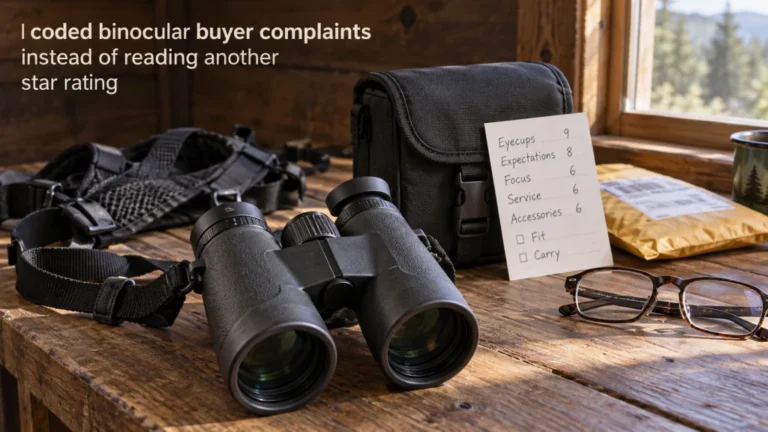
This is also where other people’s complaints need context. Recurring issues can be useful because they show what owners notice, but they do not automatically predict what will matter to you. Our look at recurring binocular buyer complaints and ownership checks is useful when you are checking a real concern, not when you are searching for a new reason to become dissatisfied. If a complaint category has never affected your viewing, fit, or ownership experience, you do not need to adopt it as your own.
What I refuse to call an upgrade without a concrete problem
I would not call a change an upgrade just because it costs more, uses a larger objective, adds magnification, reduces weight, or belongs to a more premium range. Those differences can matter, but only when they solve the right problem without creating a worse compromise somewhere else. A lighter binocular that is less comfortable in your hands is not automatically an upgrade. A higher magnification that you struggle to hold steady is not automatically an upgrade either.
The same rule applies when the advantage is real but irrelevant. A wider field can be valuable, yet it may not change anything if you mostly observe slow or stationary subjects and already find targets easily. Longer eye relief can be essential for some eyeglass wearers, but it is not a universal reason to replace a pair that already fits your viewing position. Better specifications deserve attention when they answer an actual constraint. Without that connection, I would call the change different, newer, or more expensive, but I would not automatically call it better for you.
When to leave this post and use the real upgrade framework
This post is intentionally not a complete upgrade decision system. Its job is to help you notice when comparison itself has become the reason you are shopping. Once you can name a repeatable viewing, fit, carrying, or ownership problem, you have moved beyond the emotional part of the decision. At that point, specifications become useful again because they can be evaluated against something specific.
That is when to move to the practical framework for deciding whether your binoculars need an upgrade. There, the question can be worked through in terms of what you observe, the conditions you use the binoculars in, and the trade-offs a replacement would introduce. Until you can name that problem, more comparison is unlikely to create clarity. It is more likely to produce another attractive number and another reason to keep looking.
Final Thoughts: stop comparing until the problem has a name
A binocular rabbit hole does not require a bad binocular. It only requires enough adjacent choices to make every compromise feel temporary. The cleanest way out is not to prove that your current pair is perfect, because it is not. It is to decide that a replacement needs a job before it gets your attention.
If you can name a repeated failure, compare with purpose. If you cannot, keep using the pair you already have and let real use reveal whether anything actually needs to change. That does not end curiosity. It simply stops curiosity from pretending it is a buying requirement.
FAQs
🔭 How do I know if I actually need to upgrade my binoculars?
Name a repeatable problem that affects what you can see, how comfortably you can use the binoculars, or whether you carry them at all. If you cannot name that problem without referring to another model’s specifications, keep using your current pair until a real limitation becomes clear.
📊 Is a better specification enough reason to replace a pair I like?
No. A better number matters only if it improves something you actually need, such as steadiness, field coverage, eye position, carrying comfort, or performance in the conditions you use most.
👓 What if I find a model with longer eye relief?
Longer eye relief can be important if glasses prevent you from seeing the full field with your current pair. If your current eye position is already comfortable and you see the field you need, the larger number alone does not create a problem that needs solving.
🎒 Should I switch just because another binocular is lighter?
Only if weight is causing a real carrying or handling problem. A lighter model can also change grip, balance, size, and other trade-offs, so compare the whole use experience rather than treating lower weight as an automatic win.
🧭 Is it okay to keep comparing binoculars just because I enjoy it?
Yes. Treat it as curiosity rather than a purchase process. You can learn about different designs without turning every interesting feature into a requirement for your next pair.
🛑 What is the simplest way to stop overthinking binoculars?
Stop comparing until you can describe one concrete problem in actual use. When that problem exists, compare only the features that could realistically solve it and ignore improvements that do not affect the way you observe.