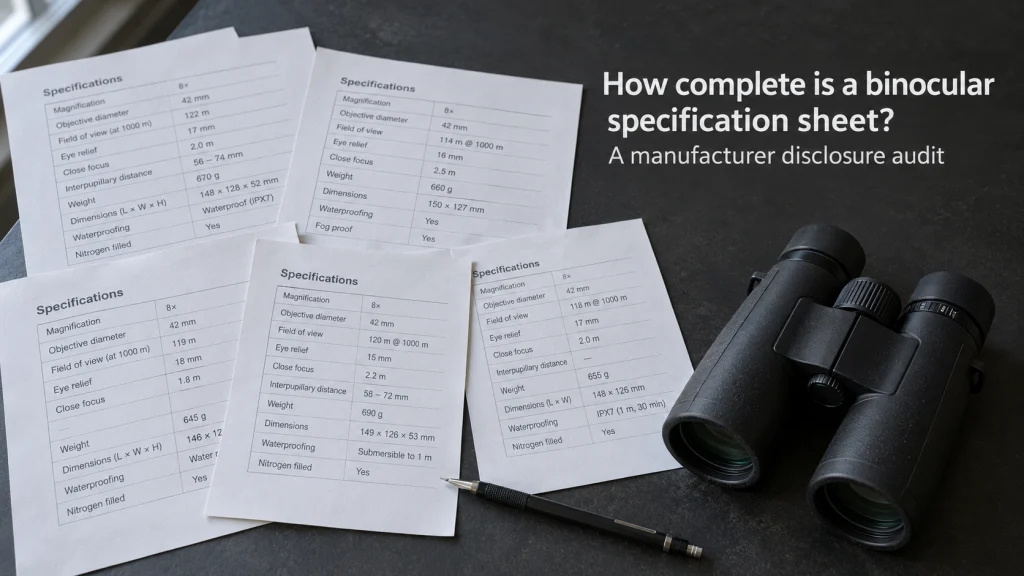
A binocular specification sheet can look detailed while still leaving important comparison work to the buyer. In this five-page audit of current official manufacturer product pages, eight of nine predefined fields appeared on every page, while interpupillary distance appeared on only three. The bigger problem was not simple absence: dimensions and waterproofing were often disclosed in forms that were harder to compare directly across brands. The practical takeaway is to treat a spec page as a documented starting point, then verify missing fields, terminology, and physical fit before making a decision.
Two official pages can show very different levels of detail
The Nikon MONARCH M7 8×42 page and the Maven B1.2 page both provide a recognizable binocular specification sheet, but they do not disclose the same set of buyer-relevant details. Nikon publishes magnification, objective diameter, multiple field-of-view figures, close focus, eye relief, size, weight, and waterproofing information on the product page. Maven publishes those categories too, while also giving an eye-width adjustment range, three-axis dimensions, and a more explicit pressure-test statement for water resistance. That contrast is useful because neither page needs to be labeled good or bad before the rules of the audit are defined.
I treated the pages as documents to be coded, not as products to be ranked. That matters because a long spec block can contain many secondary optical details while a shorter block can still cover the fields that matter for a particular comparison. Readers who need the meaning of individual numbers can use the broader explanation of how binocular specifications affect real viewing decisions, while shoppers can use what to verify before buying binoculars online as a separate purchase check. This audit stays narrower: it asks what manufacturers actually put on the page, how consistently they label it, and where the page stops being enough.
The manufacturer sample and fields were frozen before coding
The audit unit was the official U.S.-market product page, not each magnification option shown on that page. The frozen sample contained five pages: Nikon MONARCH M7 8×42, Nikon MONARCH M7 10×42, Vortex Diamondback HD 8×42, Vortex Diamondback HD 10×42, and Maven B1.2 8×42/10×42. The Maven page counts once because both configurations are presented inside one product page and one specification table. This keeps the denominator tied to disclosure behavior at the page level rather than giving a multi-configuration page extra weight.
Nine fields were defined before coding: magnification, objective diameter, field of view, eye relief, close focus, interpupillary distance, weight, dimensions, and waterproofing wording. A field counted as present when the product page itself supplied a value or explicit statement that matched the predefined category. A field could still receive a comparability note when the label, unit structure, number of dimensions, or level of waterproofing detail differed. I did not fill a missing product-page field from a manual, press release, retailer listing, or comparison tool because that would change the question from page disclosure to brand-level information availability.
Audit rule: Present means the field appears on the coded product page. Missing means a relevant field has no corresponding value or statement there. Not applicable means the field genuinely does not apply. Ambiguous means the wording cannot be mapped cleanly without an assumption.
The sample is intentionally small, so its frequencies describe these five pages only. They should not be generalized to every binocular maker or every product line. The value of the audit is the coding discipline: the denominator is visible, the fields are fixed, and the same rule is applied to each page. That makes a modest sample more useful than a broad claim built from an undefined set of pages.
Basic optical fields appeared across the frozen sample
Magnification and objective diameter were present on all five pages, which is unsurprising because those two values are part of each model’s basic configuration. Field of view, eye relief, and close focus also appeared on all five pages. Weight appeared on all five, and each page included at least some external size information. On a simple present-or-missing count, those seven categories therefore reached 5/5 disclosure in this sample.
That result should not be mistaken for perfect standardization. A buyer can find a field on every page and still face extra work if the brands name it differently or provide a different level of dimensional detail. For example, the pages all supply field of view in a form that can support comparison, but they do not all present the same set of angular and apparent figures. The matrix below therefore separates presence from the notes that affect direct comparison.
| Official product page | Mag. | Objective | FOV | Eye relief | Close focus | IPD | Weight | Dimensions | Waterproofing |
|---|---|---|---|---|---|---|---|---|---|
| Nikon MONARCH M7 8×42 | Present | Present | Present | Present | Present | Missing | Present | Present | Present |
| Nikon MONARCH M7 10×42 | Present | Present | Present | Present | Present | Missing | Present | Present | Present |
| Vortex Diamondback HD 8×42 | Present | Present | Present | Present | Present | Present | Present | Present | Present |
| Vortex Diamondback HD 10×42 | Present | Present | Present | Present | Present | Present | Present | Present | Present |
| Maven B1.2 8×42/10×42 page | Present | Present | Present | Present | Present | Present | Present | Present | Present |
The matrix is deliberately conservative. It does not reward a page for publishing extra fields outside the predefined set, and it does not penalize a page merely because another manufacturer lists more technical detail. That keeps the audit focused on disclosure consistency rather than spec-sheet length. For a buyer, the next question is whether the fields that are present can actually be compared without translating labels or filling gaps.
Consistent disclosure did not always mean consistent presentation
Eight of the nine predefined fields were present on all five pages: magnification, objective diameter, field of view, eye relief, close focus, weight, dimensions, and waterproofing wording. Interpupillary distance was the only field that failed to reach 5/5, appearing on both Vortex pages and on the Maven page but not on either Nikon product page. That makes IPD the clearest disclosure gap in this frozen sample. It does not prove that Nikon lacks an IPD specification elsewhere, only that the value was not disclosed on the two coded product pages.
The dimensions result needs a second layer of interpretation. Nikon labels size as length by width, Vortex lists height and width, and Maven supplies width by height by depth. All five pages therefore pass the simple presence rule, yet the physical envelopes are not documented with the same number of axes. A buyer comparing storage fit or case clearance should notice that distinction rather than treating every dimensions row as equally complete.
Where field-of-view formats made comparison harder
Field of view was one of the better documented categories in the sample. Nikon publishes real angular, apparent angular, and linear FOV; Vortex publishes angular and linear FOV; Maven publishes all three forms. All five pages therefore share a linear basis for comparison. The separate 8x versus 10x binocular field-of-view comparison explains why magnification still matters when those numbers are compared.
How often eye relief and IPD were disclosed
Eye relief appeared on all five pages, while IPD appeared on three. Maven uses “Eye width adjustment” for the range that Vortex calls “Interpupillary Distance.” A search for the exact term “IPD” could therefore miss a value that is actually present. The wording changes, but the fit question does not. For shoppers comparing fit, label translation matters almost as much as field presence.
How often close focus, weight, and dimensions appeared
Close focus and weight were both present on all five pages. Close focus was labeled “Close Focus Distance” by Nikon, “Close Focus” by Vortex, and “Near focus” by Maven, which is easy to reconcile once the terms are recognized as the same category. Weight was more straightforward and could be compared directly after checking units. For a deeper look at how published mass changes even within a nominal configuration, the separate binocular size and weight comparison examines that issue without turning this disclosure audit into a model ranking.
A terminology crosswalk reduces false missing-field calls
One risk in a document audit is treating a vocabulary difference as if the manufacturer omitted the field. The Maven page is the clearest example because “Near focus” maps to the same practical category as “Close Focus,” while “Eye width adjustment” maps to interpupillary distance. Dimensions create another naming problem because one brand calls the field “Size,” another splits height and width into separate rows, and another labels a three-axis dimension string. A useful comparison process normalizes these terms without pretending that every presentation contains the same amount of information.
The crosswalk below shows how I mapped the manufacturer language into the frozen audit fields. It is not a claim that one wording is technically superior. The purpose is to prevent a mechanical keyword search from creating false absences and to make the coding rules reproducible. Once the labels are normalized, the remaining differences are genuine differences in disclosure depth or omission.
| Audit field | Nikon wording | Vortex wording | Maven wording |
|---|---|---|---|
| Objective diameter | Objective Diameter | Objective Lens Diameter | Obj. lens diameter |
| Field of view | Angular Field of View and FOV at 1000 yds | Angular Field of View and Linear Field of View | Field of View and field of view ft/1000 yds |
| Close focus | Close Focus Distance | Close Focus | Near focus |
| Interpupillary distance | Not disclosed on coded page | Interpupillary Distance | Eye width adjustment |
| Dimensions | Size Length x Width | Height and Width | Dimension WxHxD |
| Waterproofing | Waterproof / Fogproof plus depth wording | Waterproof plus gas purge and O-ring wording | Pressure test wording with IPX7 |
Waterproofing language differed even when every page disclosed it
Waterproofing was present on all five pages, but the evidence was not equally specific. Nikon gives a waterproof/fogproof status and a depth statement on the coded pages. Vortex describes waterproofing qualitatively and pairs it with argon gas purging and O-ring sealing language. Maven goes further on the product page by publishing a pressure-test row that states one meter for 30 minutes and identifies IPX7.
“Waterproofing present” is easier to score than “waterproofing directly comparable.” A yes/no status, a depth without duration, a construction description, and a timed immersion rating do not carry identical information. Those claims should not be treated as interchangeable. Compare the exact conditions actually stated instead of assuming the strongest-sounding phrase wins. A page supports the sealing claim it makes, not a harsher condition it never specifies.
Missing, not applicable, and ambiguous are not the same
A missing field means the field belongs in the audit and could reasonably describe the product, but the coded page does not disclose it. That is how the two Nikon pages were treated for interpupillary distance. Not applicable would require a real reason the field does not pertain to a given product, rather than a page simply failing to list it. None of the nine predefined fields needed a not-applicable code in this five-page sample.
Ambiguous should also remain separate from missing. If a page provides a value under an unfamiliar but clearly equivalent label, the field can be mapped and marked present; if the wording cannot be mapped without a guess, it should be marked ambiguous rather than silently forced into a category. This is especially important for dimensions and sealing language, where manufacturers may describe different axes or different test conditions. Keeping those statuses separate prevents the audit from manufacturing a cleaner result than the documents support.
Coding rule: Do not repair a product page during the audit. Record an absent field as absent on that page. Map an equivalent label transparently. If equivalence is uncertain, keep the uncertainty visible.
Normalized comparison tables can make every row look equally complete. They may combine data from sources that the original product page does not contain. That can help shoppers, but it changes the document being measured. For this audit, the official product page remains the unit of evidence.
What no online specification sheet can establish without measurement
Even a densely populated specification table cannot prove how a binocular will fit a particular person’s hands or face. Published eye relief does not show whether a specific eyeglass frame lets the user reach the full field, and an IPD range does not show whether the hinge shape feels comfortable at that setting. Weight does not reveal balance, while external dimensions do not fully describe grip geometry. Those are physical-use questions that documentation can narrow but cannot settle by itself.
The same boundary applies to controls and subjective optical behavior. A page may name the focus system and eyecup design, but it does not measure focus-wheel resistance, eyecup detent feel, sample variation, glare behavior, or the viewer’s perception of edge softness. Manufacturer claims about clarity or comfort should therefore remain manufacturer claims unless independent measurement or controlled testing supports something more specific. This is also why buyer complaints can identify questions worth checking without becoming proof of a technical defect; the separate binocular buyer complaints analysis is better suited to that evidence type.
Limit: Documentation can establish what a manufacturer publishes. It cannot establish personal fit. It cannot establish handling feel. It also cannot establish unmeasured optical performance from text alone.
A complete-looking page should reduce uncertainty, not erase it. Specs are strongest when they describe measurable boundaries. They are weaker evidence for comfort, control feel, or visual preference. Reading that boundary correctly is part of using a spec sheet well.
The disclosure checklist I would use before comparing products
Before comparing two binoculars online, I would first check whether both pages publish the same decision-relevant fields. If one page omits a value, I would mark the gap rather than substitute a number from memory or a retailer without noting the source change. If both pages publish the field, I would then check whether the units, label, and measurement basis match. That sequence is slower than copying numbers into a spreadsheet, but it prevents false precision.
The checklist also keeps the comparison tied to the reader’s actual decision. Someone wearing glasses may care more about eye relief and eyecup behavior, while someone packing binoculars into a small case may need a genuinely comparable set of external dimensions. A user who frequently shifts between near and distant subjects may prioritize close focus, while long carrying time makes weight more relevant. The page does not need every possible technical field, but it does need the fields required by the comparison being made.
- Confirm magnification and objective diameter for the exact configuration.
- Compare field of view using the same format, preferably a shared linear or angular basis.
- Check eye relief and IPD separately because one does not substitute for the other.
- Verify close focus when nearby subjects matter to the intended use.
- Compare weight in the same unit and dimensions using the same physical axes.
- Read the exact waterproofing wording instead of reducing every claim to a generic yes.
- Keep missing values visibly missing until another source is introduced and identified.
- Do not infer hand fit, eyeglass fit, balance, focus feel, or optical preference from published numbers alone.
That process turns a specification page into a decision tool instead of a completeness contest. A longer table is useful only when its extra rows answer questions the buyer actually has. A shorter table can still be sufficient for a narrow comparison, but missing fit-relevant fields should prompt another verification step. The goal is not to reward the page with the most numbers; it is to know exactly what the available numbers can support.
Final Thoughts: treat the spec page as evidence, not the whole answer
In this frozen five-page sample, eight of nine predefined fields appeared everywhere, while IPD appeared on three pages. That sounds highly consistent until the presentation details are examined more closely. Dimensions were present across the sample but used different axis structures, and waterproofing ranged from general status language to a defined immersion statement. The audit therefore found more variation in comparability and disclosure depth than in simple field presence.
The practical move is to separate three questions: is the field present, is it presented on a comparable basis, and can that field actually answer the fit or use question you care about. A binocular specification sheet is valuable when those boundaries stay visible. When a field is missing, verify it from an appropriate source and note that the source changed; when a physical-use question remains, numbers alone should not be pushed beyond what they establish. That approach produces a cleaner comparison and a more defensible buying decision without pretending the longest spec table is automatically the most useful.
FAQs
Binocular spec questions usually involve either a missing field or a field that is labeled differently across brands. Those problems need different responses. An omitted IPD value is not the same as a renamed close-focus field. The answers below keep that distinction visible.
These answers stay limited to documentation and comparison. Published numbers do not prove personal fit. Manufacturer wording does not become an independent performance finding. Physical fit, control feel, and eyeglass interaction still require separate verification.
🔭 What should a useful binocular specification sheet include?
For comparison, start with magnification, objective diameter, field of view, eye relief, close focus, IPD, weight, dimensions, and clear waterproofing information. Other fields can be valuable, but these cover several of the most common optical, fit, carrying, and environmental checks.
📐 Is field of view always listed the same way?
No. It may appear as degrees, feet at 1,000 yards, apparent field of view, or a combination of formats. Compare the same measurement type across products rather than mixing angular, linear, and apparent figures.
👀 Why might IPD be missing even when a page lists many other specs?
Disclosure priorities vary by manufacturer and page design. In this sample, IPD was the only predefined field missing from two pages, so a long specification block did not guarantee that every fit-related value was present.
📦 Can published dimensions tell me whether binoculars will fit my hands or case?
They can help with case clearance only when the relevant axes are provided and measured on a comparable basis. They cannot establish hand fit because grip shape, hinge geometry, balance, and control placement are not captured by a simple size line.
💧 Does waterproof mean the same thing on every manufacturer page?
No. One page may give a general waterproof claim, another may describe sealing construction, and another may publish a defined immersion test. Read the stated condition rather than assuming the label represents the same test across brands.
References and Sources
The disclosure counts require a fixed source set. These five official pages are the coded documents. Each supports one matrix row, with Maven counted once despite showing two magnifications. Retailer data was not used to fill missing fields.
The source list stays narrow by design. Third-party comparison tools may normalize fields that a product page omits. That can be useful elsewhere, but it would change this audit. If a source page changes, its row should be coded again.
- Nikon MONARCH M7 8×42: Supports the coded Nikon 8×42 fields, including FOV, close focus, eye relief, size, weight, and waterproofing wording.
- Nikon MONARCH M7 10×42: Supports the coded Nikon 10×42 fields and the absence of an IPD value on the product-page specification block.
- Vortex Diamondback HD 8×42: Supports the Vortex 8×42 row, including IPD, dimensions, weight, FOV, close focus, and sealing language.
- Vortex Diamondback HD 10×42: Supports the Vortex 10×42 row and the same predefined disclosure categories used in the matrix.
- Maven B1.2 8×42/10×42: Supports the combined Maven page row, including eye width adjustment, three-axis dimensions, FOV formats, weight, and IPX7 pressure-test wording.